
Why Day 1 Makes or Breaks Your Cold Email Cadence (Everything Else Is Just Follow-Through)
A 15-touch outbound sequence built on a weak Day 1 is not a cadence. It’s automated noise. Here’s why the first email is the only one that actually does persuasion work — and exactly what it needs to contain.
 Konnektys TeamJune 6, 2026 · 10 min read · Cold Email Strategy
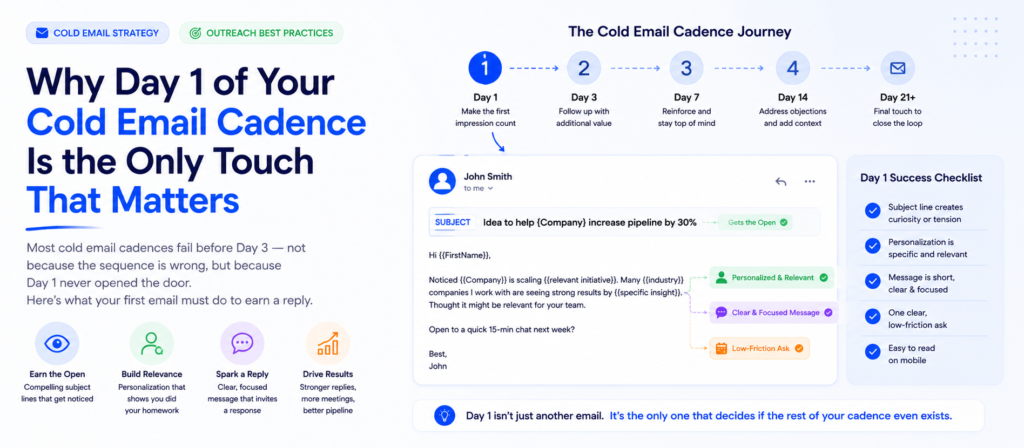
You spent hours building a 15-day cold email cadence. Seven touchpoints. Three channels. Timed follow-ups, LinkedIn views baked in, a breakup email at the end.
And it’s generating nothing.
The response is usually to rework the sequence — adjust the timing, add a touch, try a different channel mix. But the problem is almost never the sequence structure. It’s Day 1.
The Hard Truth About Cold Email Cadences
A cadence is not a sales strategy. It’s infrastructure. It only works when there’s something worth delivering inside it.
That something is your first email.
If the first touchpoint doesn’t land — doesn’t get opened, doesn’t earn a read, doesn’t create at least a flicker of curiosity — the prospect doesn’t open Day 4. They don’t see your Day 7 LinkedIn message. They don’t read your Day 10 follow-up. You are generating noise in an inbox that already contains 80 to 120 cold emails per week from people who also think their sequence is the problem.
The rest of the cadence assumes interest that Day 1 has to create.
This is where most sales teams get it wrong. They optimize the structure — timing gaps, touchpoint count, channel mix — while leaving Day 1 as an afterthought. A template. A “quick personalization” field dropped into a boilerplate opener. They treat the sequence as the product and the first email as just one piece of it.
It isn’t. It’s the whole game. As we describe in our analysis of why outbound campaigns fail, copy optimization is the last step in a seven-step hierarchy — but within copy, Day 1 is the single element that determines whether the rest of the sequence has any audience at all.
What “Strong Day 1” Actually Means — Three Elements
Three components. Not ten. Three. Nail all three and you have a door worth knocking on.
1. A Subject Line With Tension or Curiosity
Not a subject line that describes the email. Not “Quick intro” or “Partnership opportunity” or the increasingly useless “Quick question.” Those are subject lines that tell the prospect exactly what to skip.
A subject line that works creates a gap — a small piece of incomplete information that the brain is uncomfortable leaving unresolved.
Tension
“Your SDR team is burning pipeline” creates discomfort. “Introduction from Konnektys” does not. Tension subjects work because they imply a problem the prospect hasn’t solved yet.
Curiosity
“How [Direct Competitor] cut CAC by 34% last quarter” is specific enough to feel credible. “A tool your sales team might find useful” is not specific enough to feel like anything.
The subject line has one job: earn the open. It doesn’t need to explain your offer, introduce your company, or pre-justify the email. It just needs a click from someone who is busy, skeptical, and has seen every subject line pattern before. This is also why misleading subject lines — “RE:,” “URGENT,” “FWD:” — backfire: they earn a resentful open, which kills the reply. For more on that dynamic, see our breakdown of the six cold email mistakes that quietly kill reply rates.
2. A First Line That’s About Them, Not You
“Hi [First Name], I’m [Name] from [Company] and we help B2B sales teams with [value prop]” is not a first line. It’s a reason to stop reading.
Nobody cares who you are yet. The prospect cares about themselves — their pipeline, their targets, their current problems, the thing that’s keeping them up at 2am. You haven’t earned the right to talk about yourself in sentence one.
A first line that works is one the prospect didn’t expect to read. Something specific enough to prove you actually looked at their business — not “I came across your profile” (everyone does that), but something like:
- •A recent hire pattern on their LinkedIn that suggests they’re scaling outbound
- •A job posting that reveals internal friction you can solve
- •A product launch in the past 90 days that signals a specific need
- •A comment they made publicly that’s directly relevant to your opening
One sentence. About them. No preamble, no throat-clearing, no “Hope this finds you well.”
This kind of personalization requires real research — not a merged field, but actual signal about the account. AI-powered lead research surfaces buying signals, trigger events, and contact-level context that make first lines feel written, not generated. For a deep breakdown of the psychology behind why signal-based first lines earn replies while observation-level personalization doesn’t, see our analysis of why cold email gets replies.
3. One Clear Ask — Not Three
Most cold emails ask for too much. “Would love to connect, learn more about your goals, share some resources, and see if there might be a fit” is four asks dressed as one.
Pick one. Usually it’s a short call. Sometimes it’s a yes/no question designed to confirm a pain point. Whatever it is, it needs to be low-friction and singular.
The more options you give, the less likely they are to choose any. Decision fatigue is real. Optionality feels like consideration but reads as confusion.
Make it effortless to say yes to one specific thing. A direct, simple question — “Is this a priority this quarter?” or “Open to a brief conversation?” — consistently outperforms the reverse-psychology gimmicks (“Would you be opposed to…?”) that experienced buyers now recognize instantly. As we covered in our 239-reply personalization analysis, when the offer is strong enough, the CTA doesn’t need to be clever — it just needs to be clear.
The Research Problem Nobody Talks About
Strong Day 1 emails require knowing something real about the prospect. That’s the constraint most teams hit and then work around badly.
They work around it with fake personalization: merge tags that insert a job title or company name and call it “highly relevant outreach.” It isn’t. Prospects recognize mail merge in two seconds — the specificity isn’t there and neither is the credibility.
Real first-line personalization means:
Account-level signals
Recent funding, hiring surges, product launches, expansions. These are publicly available but operationally invisible to teams that don’t systematically monitor them. Events and buyer intent data tracks these across your ICP universe in real time.
Contact-level signals
Content they’ve published, positions they’ve taken, problems they’ve discussed publicly. These are the highest-quality personalization inputs because they reference something the prospect chose to say — not something a database said about them.
Technographic context
What tools they’re running that your offer fits, replaces, or integrates with. Knowing a prospect runs HubSpot but hasn’t adopted a sequencing tool tells you exactly what problem to open with. Technographic data append maps these configurations at the account level.
CRM history
Whether they’ve engaged before, what conversations have already happened, where they sit in a prior cycle. Stale CRM records without enrichment make this impossible. CRM data enrichment keeps the records accurate and current.
This is one reason building a targeted contact list properly — before you write a single email — matters so much. When you know exactly who you’re reaching, you can write for that person instead of the average of everyone.
Good email finding and verification is the other half of this. A perfect first line sent to a dead inbox is invisible. Deliverability and personalization are both required, and neither compensates for the other.
For a full framework on how to discover the right personalization angles before scaling them with automation, see our guide on why manual prospect research still wins.
Why the Rest of the Cadence Is “Just” Follow-Through
That word “just” is not dismissive. Follow-through matters enormously. A prospect who opened Day 1 and didn’t reply might reply on Day 5. They got pulled into a board prep. Their quarter closed badly. Timing matters.
But follow-through only works when Day 1 has already established relevance.
Day 3 follow-ups don’t create interest from nothing. They remind someone who was already curious. Day 7 LinkedIn touches don’t introduce you — they reinforce a name the prospect already encountered and found interesting. Even a well-executed LinkedIn outreach sequence running in parallel with email only works when the email thread gave the prospect a reason to recognize your name in their connection requests.
The cadence is a reinforcement mechanism,
not a persuasion mechanism.
That distinction is the entire point.
If Day 1 was generic, forgettable, or about you instead of them, your follow-up sequence is just reminding the prospect that they didn’t care about your last email. You’re spending touchpoints to reinforce irrelevance.
What Day 1 Determines About Your Infrastructure
Day 1 is not just a conversion problem. It’s an infrastructure problem — and this is the connection most teams miss entirely.
When Day 1 reply rates are low, teams increase volume to compensate — more sends, more sequences running simultaneously, more domains pushed harder. The instinct is “if fewer people are responding, reach more people.” But that approach accelerates the infrastructure degradation that makes everything worse.
Low engagement signals from weak Day 1 emails feed directly into the seven signals that inbox providers use to classify sending domains. Low opens, low replies, high ignore rates — all of these accumulate at the domain level and tell Gmail and Outlook that mail from this domain is unwanted. The domain degrades faster than it should, inbox placement falls, and the pipeline problem that started as a messaging issue becomes a deliverability issue.
Positive Loop
Better first emails → higher engagement → stronger domain reputation → better inbox placement → more emails actually seen → more replies.
Negative Spiral
Worse emails → lower engagement → faster domain degradation → worse inbox placement → fewer emails seen → even fewer replies.
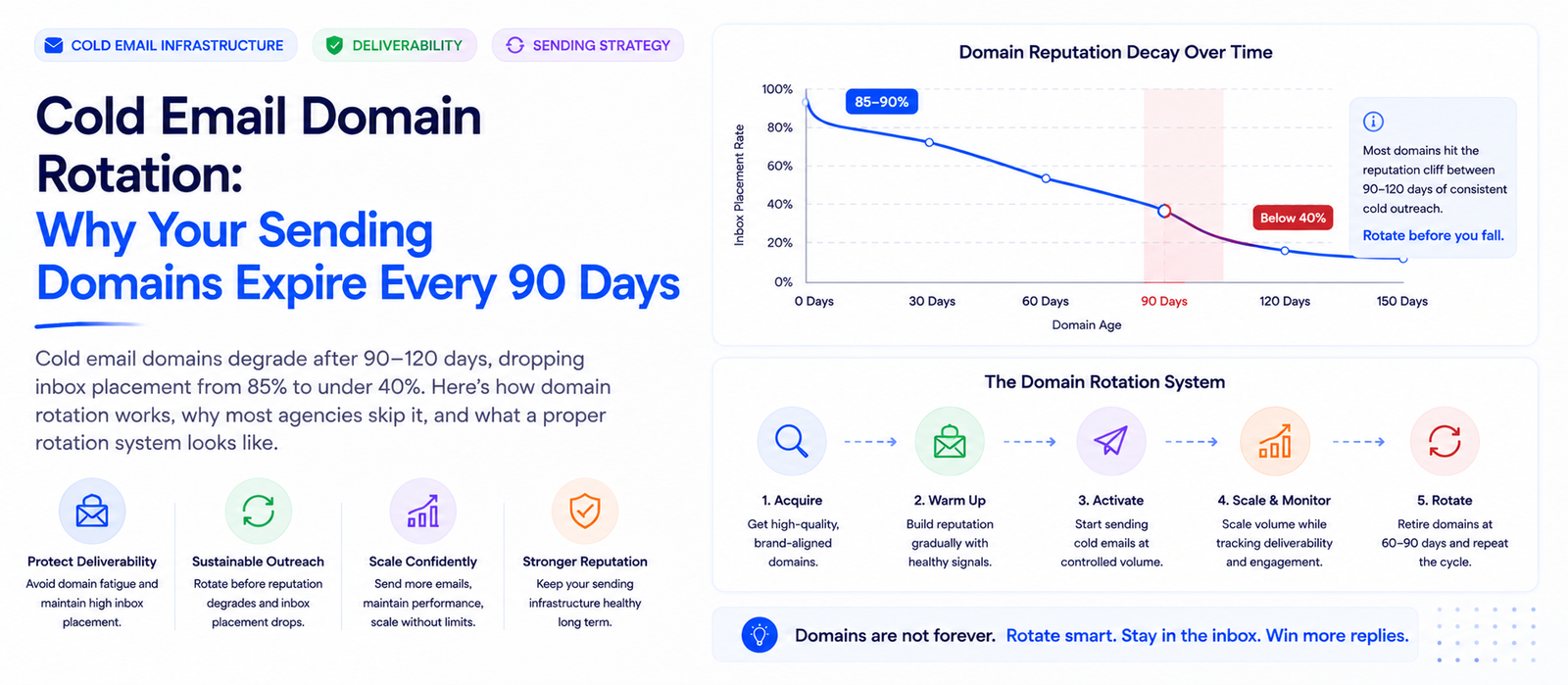
Email infrastructure setup manages the infrastructure side — domains, warmup, rotation — but infrastructure can’t outperform the engagement signals that the email itself generates. The message quality and the infrastructure quality are two halves of the same system. For the full breakdown of how domain degradation works and why a 90-day rotation schedule is non-negotiable, see our domain rotation guide.
The Seven Most Common Day 1 Mistakes
Opening with your company. Nobody cares yet. You have not earned the right to talk about yourself in sentence one. Open on them, then introduce context.
A subject line that describes the email. “Intro + partnership opportunity” tells them exactly what to ignore. Same goes for “Following up on my previous email” as a Day 1 subject — that’s not a thing.
Social proof in the first line. “We work with companies like Salesforce, HubSpot, and Zendesk” reads as desperation when it’s the first thing out of your mouth. Save proof for after you’ve given them a reason to care.
A long first email. If it takes more than 90 seconds to read, it won’t get read. 100–150 words is the sweet spot for Day 1. Save the case studies for follow-up.
Multiple CTAs. “Let me know if you’d like to connect, or I can send over a case study, or if you just want to answer a quick question that works too.” Pick one. One.
Generic personalization. “I noticed you’re in the SaaS space” is not personalization. It’s a filter applied to 40,000 companies. “I noticed you posted about hiring three enterprise AEs in Q1 while your SDR headcount stayed flat” — that’s personalization. Hiring intent data surfaces exactly these patterns without manual job board monitoring.
Unverified contacts. Sending Day 1 to a list full of bounced, outdated, or wrong-role contacts tanks your sender reputation before the cadence has a chance to perform. Reverse email and phone appending and email verification should happen before any sequence goes live.
How to Audit Your Day 1 Before You Deploy
Before you launch a new cadence, run this five-point check on the Day 1 email:
The stranger test.
Show the email to someone who doesn’t know your product. Ask: “What problem does this company solve, and why should the person reading this care?” If the answer takes more than two sentences, the email is doing too much explaining and not enough resonating.
The subject line test.
Read the subject line out loud. Would you open it from a sender you don’t know? Be honest. If the answer is “maybe” rather than “yes,” it’s not strong enough.
The first-line test.
Cover everything after the first line and ask: “Is this about me or about them?” If it’s about you or your company, rewrite it.
The CTA test.
Count the asks. If there’s more than one, cut until there’s one.
The length test.
Paste the email into a word counter. If it’s over 175 words, find what to cut. If it’s under 50, check whether you’ve stripped out so much that it no longer communicates enough value to justify a reply — a mistake we cover in detail in our cold email mistakes guide.
What This Means for Your Outbound Right Now
If reply rates are low and you’re blaming the sequence, check Day 1 first.
Pull your last 20 sent emails. Read the subject lines. Read the first lines. Ask honestly: would you open this from a stranger? Would you keep reading?
Most of the time the answer is no — and that’s where the problem lives, not in the follow-up timing.
Fix Day 1. The door opens.
Everything else follows.
If you’re not sure whether your outbound problem is Day 1, deliverability, or something else entirely, our full diagnostic framework in why outbound campaigns fail walks through the seven root causes in priority order. And if the question is whether cold email is even the right channel for your business before optimizing any layer, the cold email qualification framework addresses that upstream question first.
FAQ: Cold Email Cadence Questions Answered
What is a cold email cadence?
+
Why does Day 1 matter most in a cold email cadence?
+
What should a cold email subject line include?
+
How long should a cold email Day 1 email be?
+
What is the best CTA for a cold outreach email?
+
How many touches should a B2B cold email cadence have?
+
What’s the difference between personalization and merge tags?
+
What causes cold email cadences to fail?
+
How does Day 1 quality affect email infrastructure?
+
Should I test different Day 1 emails or different follow-up sequences first?
+
Ready to Fix Day 1?
Day 1 isn’t a copywriting problem. It’s a system problem — the right signal, about the right account, delivered to a verified contact, through healthy infrastructure, in a message short enough to be read and specific enough to earn a reply.
Konnektys Builds the System Behind Day 1
AI-powered signal research to surface the trigger that belongs in your first line, verified contact lists so the message reaches a real inbox, email infrastructure with domain rotation so it lands in the primary tab, and fully managed cold email and LinkedIn outreach that executes the full cadence — Day 1 through breakup — consistently, at scale.
- The Hard Truth About Cold Email Cadences
- What “Strong Day 1” Actually Means — Three Elements
- The Research Problem Nobody Talks About
- Why the Rest of the Cadence Is “Just” Follow-Through
- What Day 1 Determines About Your Infrastructure
- The Seven Most Common Day 1 Mistakes
- How to Audit Your Day 1 Before You Deploy
- What This Means for Your Outbound Right Now
- FAQ: Cold Email Cadence Questions Answered
- Ready to Fix Day 1?
Want your Day 1 emails built on real signal instead of merge tags? We’ll handle the research, the list, the infrastructure, and the send.
Talk to Konnektys →Share this article:
Related articles
Why Most B2B Companies Miss 60% of Their Market — And How to Fix It
Konnektys Team · 19 May, 2026
Your Cold Email Domain Has a 90-Day Shelf Life — Here’s What That Means for Your Pipeline
Konnektys Team · 23 May, 2026
How to Find High-Intent B2B Leads on LinkedIn in 2 Minutes
Konnektys Team · 22 May, 2026