
239 Positive Replies With Zero Personalization: The Cold Email Lesson Most Sales Teams Still Miss
A cold email script with virtually no personalization generated 239 positive replies. It didn’t reference LinkedIn posts, podcasts, mutual connections, or funding rounds. It made an offer the prospect immediately understood. That result reveals something specific about what “personalization” actually does in cold outreach — and what most teams are still getting wrong about it.
 Konnektys TeamJune 8, 2026 · 11 min read · Cold Email Strategy
Everyone says cold email personalization is dead.
That’s not exactly true.
What’s dead is lazy personalization — the kind that proves you spent fifteen seconds on someone’s LinkedIn profile, but doesn’t prove you understand why your outreach should matter to them specifically.
It’s the line that looks like this: “Saw your recent LinkedIn post.” “Love what you’re building.” “Congrats on the recent funding.” “Noticed we have mutual connections.”
These lines aren’t personalization. They’re observations — and prospects know the difference, because they receive twenty emails a week that open with the exact same observations from twenty different senders using the same scraping tools.
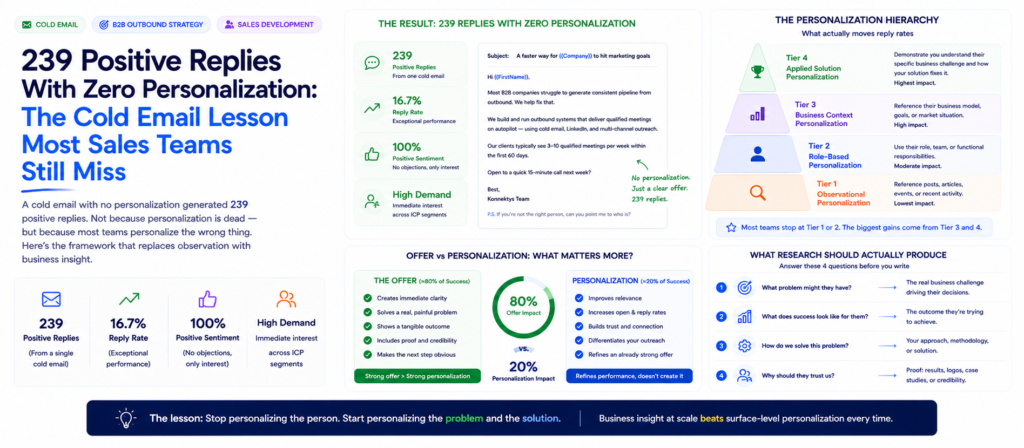
A cold email script with virtually no personalization recently generated 239 positive replies. It didn’t reference LinkedIn posts, podcasts, mutual connections, or company news. Instead, it did something most outbound campaigns fail to do: it made an offer the prospect could immediately understand, visualize, and evaluate — without needing any context about who the sender was or how much research they’d done.
That result doesn’t mean personalization is irrelevant. It means most teams are personalizing the wrong layer of the email.
What Died and What Didn’t
What died: observation-level personalization — first lines that reference something the prospect said or did publicly, without connecting it to a commercial reason the email matters. These lines were never personalization in the first place. They were research signals dressed up as relevance, and buyers learned to recognise them as markers of automated outreach rather than genuine understanding.
What didn’t die: business-level personalization — messages that demonstrate understanding of the prospect’s specific situation, the problem they’re likely facing, and how the sender’s offer applies to their commercial reality. This kind of personalization is harder to produce, harder to automate, and harder for competitors to replicate — which is exactly why it still works.
The distinction between these two is the single most important concept in cold email strategy right now. Every decision about research depth, AI tooling, signal sourcing, and message construction flows from understanding what kind of personalization actually moves prospects to reply.
The Real Job of Personalization
Most sales reps think personalization is about proving: “I know who you are.”
Buyers care about something different: “Do you understand why this matters to me?”
The distinction is the entire game.
The prospect doesn’t reward you because you found their latest LinkedIn post. They respond because you connected your solution to a problem they actually care about — and they can see, in the first few sentences, that the connection is real rather than manufactured.
Good personalization isn’t “I noticed your company.” It’s “I understand the operational challenge that companies in your specific situation face right now, and here’s how what I do applies to it.”
The first is about the sender’s research effort. The second is about the prospect’s commercial reality. Only one of those motivates a reply.
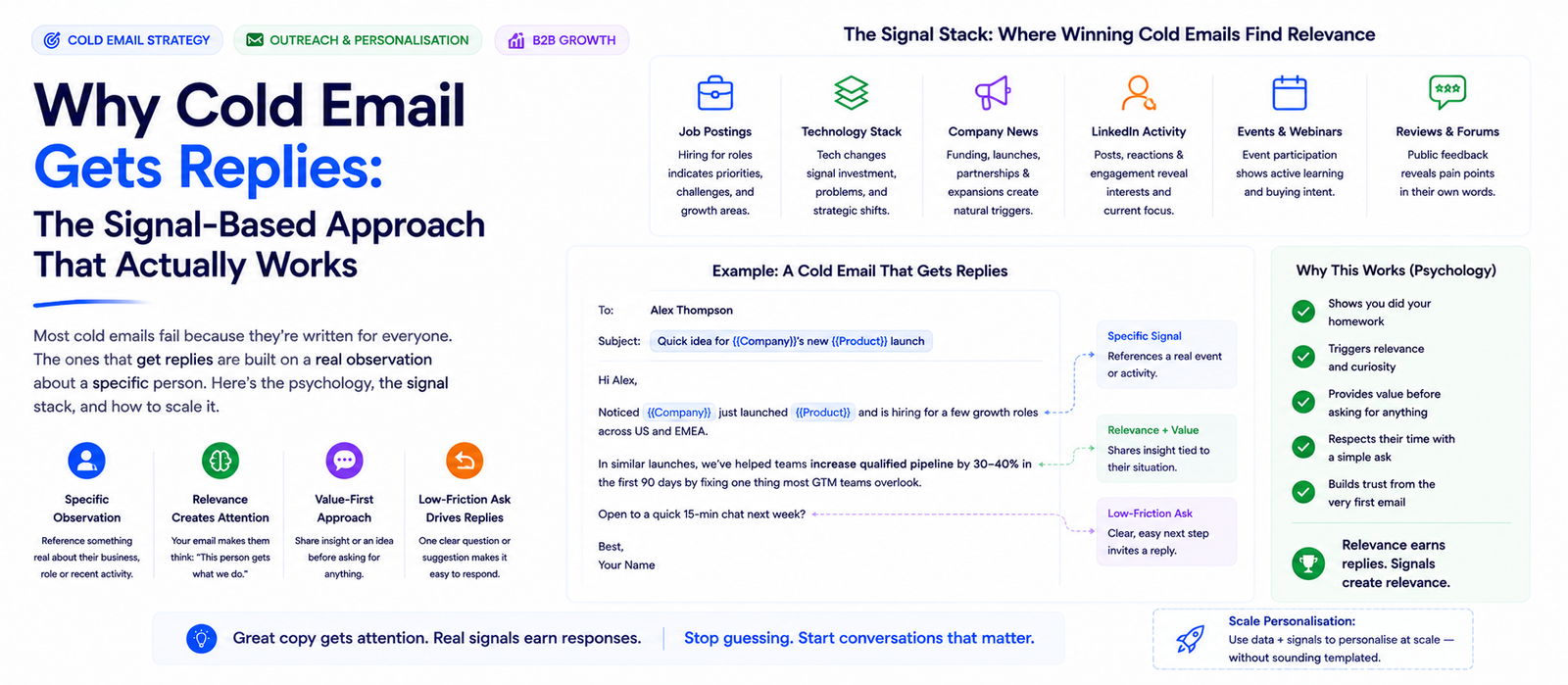
This is the same principle behind the signal-based cold email approach — where the email that generated the most attention in B2B sales circles was six sentences long, contained no traditional personalization, and opened with a specific observation about the prospect’s technical environment that demonstrated genuine understanding. Not “I noticed.” “I understand.”
Why Generic Personalization Fails — The Mechanism
Generic personalization doesn’t just underperform. It actively works against you — and the mechanism is worth understanding, because it explains why doubling down on better observation-level personalization makes the problem worse, not better.
1. Association with mass outreach
Observation-level personalization has become so closely associated with automated cold outreach that it now functions as a negative signal. The prospect reads “Saw your recent LinkedIn post about pipeline velocity” and pattern recognition fires: this is automated. The line meant to build trust instead confirms suspicion.
2. It proves research, not relevance
Mentioning something specific about a prospect proves you spent time on their profile. It doesn’t prove you understand their business, their challenges, or how your offer applies to their situation. Buyers don’t respond to evidence of effort — they respond to evidence of understanding.
3. It’s trivially easy to produce at scale
Every AI enrichment tool can scrape LinkedIn posts, pull funding announcements, and generate complimentary first lines. When every SDR team has the same capability, the output stops differentiating — your email looks identical to the fifteen others using the same tools.
4. It shifts attention to the sender
An email opening with “I noticed your company just launched a new product line” is, structurally, about the sender’s research process — not the prospect’s situation. The prospect’s internal response is “so what?” That’s the last reaction a cold email opener should produce.
The failure isn’t that observation is bad. It’s that observation without application is meaningless — and “meaningless with effort” is worse than “no effort at all,” because it generates the active friction of recognised automation.
The Visualization Principle: Why 239 Replies Happened
The 239-reply email worked because the prospect could immediately visualize the deliverable.
Most cold outreach focuses on the seller — what the company does, what capabilities it offers, what outcomes it promises in abstract terms. The prospect reads “We help brands create engaging content” and has no concrete image of what that means for them specifically. The value is abstract. The next step is unclear. The email gets deleted.
The email that generated 239 replies did the opposite. Instead of describing a capability, it described a specific deliverable the prospect could picture:
Weak — Capability
“We help brands create engaging content.”
Strong — Deliverable
“We could create a series of street-interview videos where consumers blind-test your protein bar against leading competitors and share reactions live.”
The second version works because the prospect can immediately see the output — the content format, the campaign structure, the audience reaction, the business impact. The mental work required to evaluate the opportunity drops from “what does this company even do?” to “would this work for us?” And that second question is far more likely to generate a reply.
This is the visualization principle: prospects respond when the email reduces the mental work required to understand the opportunity. The less cognitive effort the prospect needs to invest, the more likely they are to engage.
The 239 replies didn’t come from research. They came from clarity.
The Offer Matters More Than the Opener
Multiple experienced outbound operators observing the 239-reply result reached the same assessment: the offer determines approximately 80% of campaign success. Not the personalization. Not the copywriting. Not the AI. The offer.
A compelling offer has four properties:
Immediate comprehension
The prospect understands what’s being offered in one read — no jargon, no abstraction, nothing that requires a follow-up call to decode.
Low perceived risk
The next step feels safe — a short conversation, a quick review, a pilot — rather than a commitment that triggers procurement anxiety.
Meaningful upside
The outcome, if it works, is clearly worth the prospect’s time — a specific result produced in a similar situation, not “we might be able to help.”
Obvious next step
The CTA is singular and low-friction — not three options, not an essay about next steps. One clear ask.
When all four properties are present, the email works regardless of whether the first line references a LinkedIn post. The offer does the work that personalization was supposed to do: it creates relevance.
The practical implication: if your reply rates are low and you’re investing in better personalization, check the offer first. A strong offer with a generic opener consistently outperforms a weak offer with a brilliantly personalized first line. Fix the offer before touching the personalisation layer.
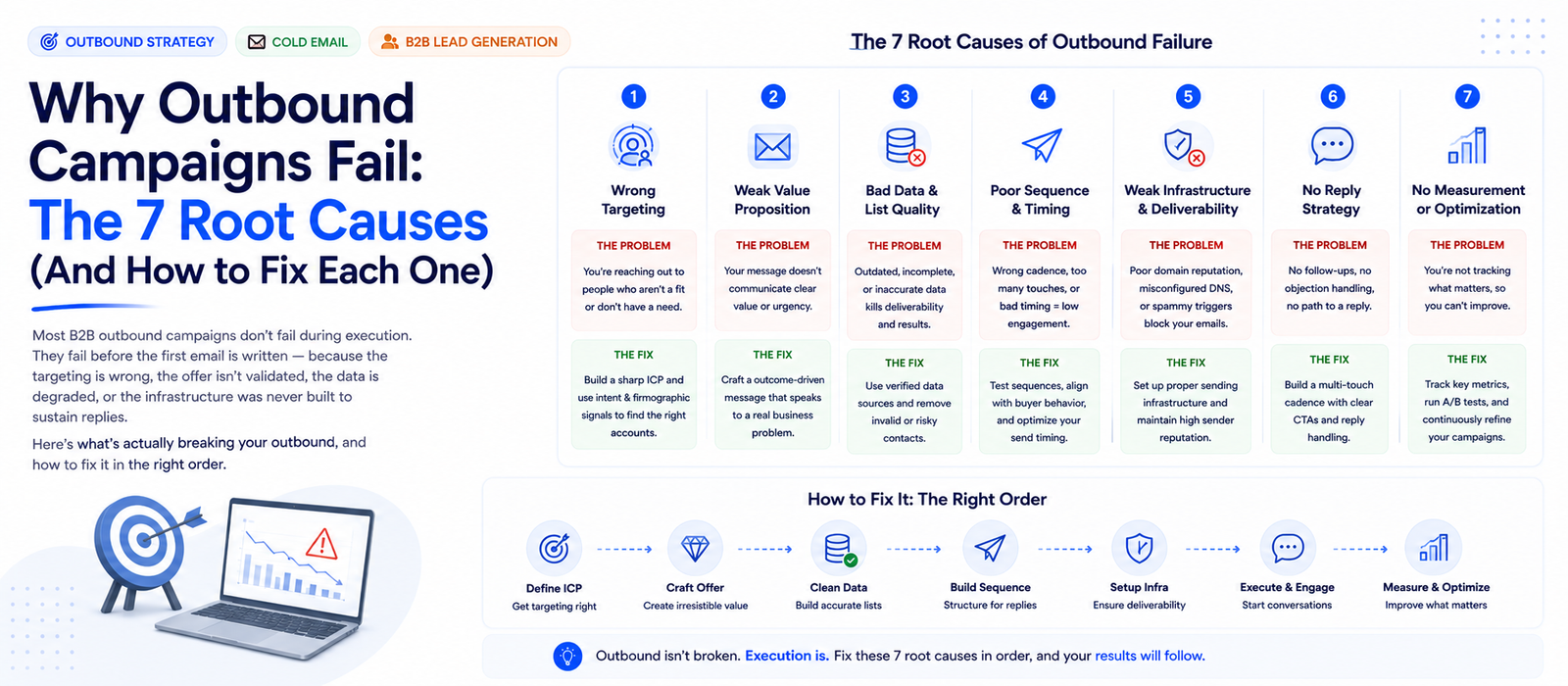
This is the same priority order we describe in our analysis of why outbound campaigns fail — offer validation comes before copy optimisation in the hierarchy, because copy cannot compensate for an offer that doesn’t resonate.
Research Should Create Insight, Not Openers
Many SDRs spend significant time researching prospects — reading LinkedIn profiles, scanning company news, reviewing recent posts — and then use that research to write a first line: “Congrats on the award.”
This is a poor return on research effort. The research produced a decorative opener when it should have produced a commercial insight.
Research should answer four questions:
What problem might they have?
Not a generic category problem (“companies like yours struggle with pipeline”) — a specific, observable problem this company is likely experiencing given its current situation.
Why might they have it now?
The timing trigger that makes this problem live today rather than theoretical — a new hire, a product launch, a competitive shift, a tech stack change.
How does your solution fit?
The specific application of your offer to their situation — not what you do in general, but what you would do for them specifically.
What outcome would matter most?
The result they’d care about — revenue, cost reduction, time savings, competitive advantage — stated in terms that connect to their role, not yours.
If your research only produces a personalized first sentence, you’re researching the wrong things. Research should improve relevance throughout the email — from the problem you reference, to the timing you cite, to the solution you offer, to the outcome you promise.
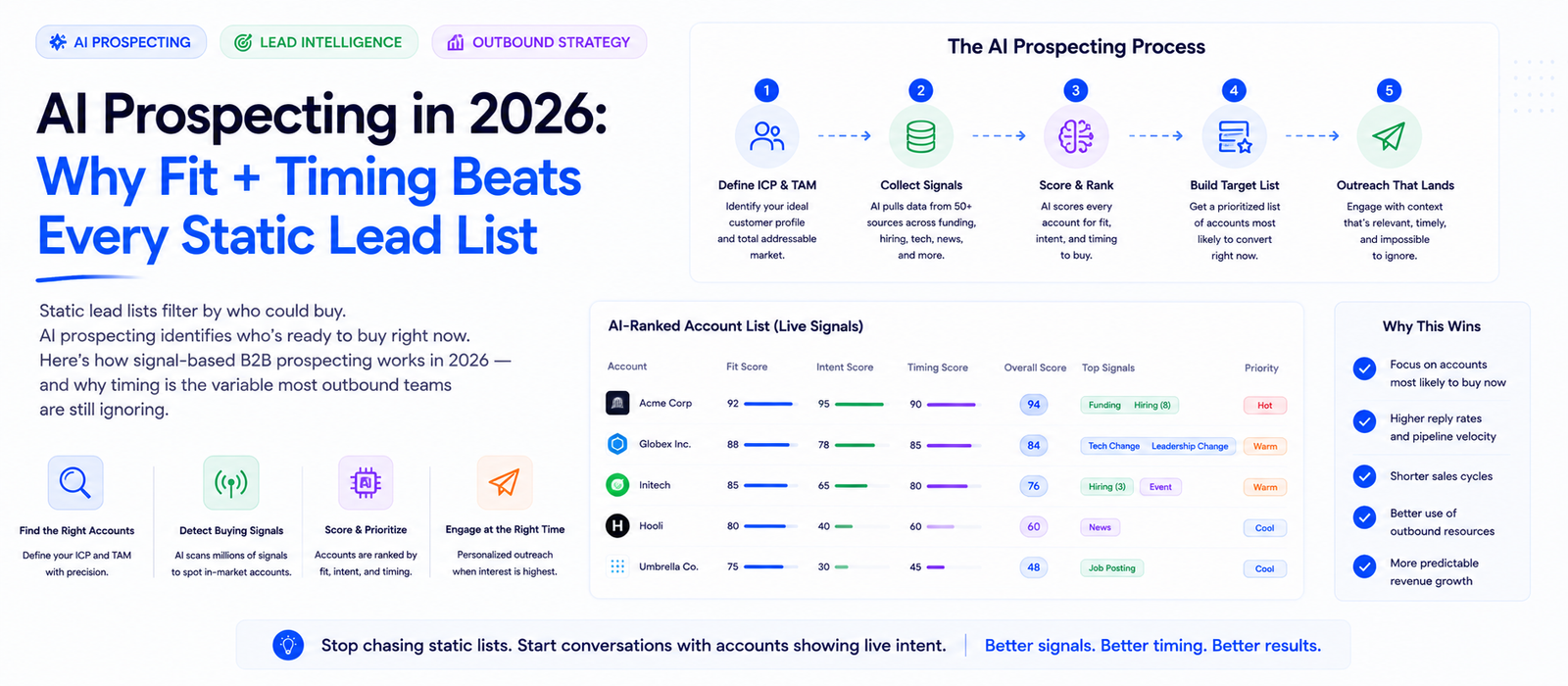
This is exactly where AI-powered lead research creates its highest leverage — not by generating first-line compliments, but by surfacing the business signals (hiring patterns, tech stack changes, funding events, leadership transitions) that answer the four questions above for every account in your ICP universe.
Signal + Offer + Proof: The Modern Outbound Formula
The strongest cold email campaigns in 2026 combine three ingredients. When all three are present, observation-level personalization becomes unnecessary because relevance is already doing the heavy lifting.
1. Signal — Why Now?
Hiring activity, new product launches, tech stack changes, funding rounds, leadership changes, market shifts, geographic expansion, competitor moves.
2. Offer — Why Care?
A specific, immediately comprehensible outcome: reduced costs by a quantifiable amount, a specific pipeline result, a conversion lift, a capability gap filled.
3. Proof — Why Believe You?
A specific number (“we’ve done this 37 times”), a specific result, a named case study — not “trusted by leading companies.”
Hiring intent data surfaces the hiring signals. Events and buyer intent data surfaces the trigger moments. Technographic data maps the tech stack context. Together, they answer “why now” for every account in your target universe — without requiring the SDR to manually research each one.
The 239-reply email had a strong offer — the prospect could visualize the deliverable immediately. That visualization is what made personalization unnecessary.
As the Kevin email breakdown demonstrated — “I’ve done 37 migrations like this” is more credible than “we’ve helped hundreds of companies,” because the specificity implies direct, personal experience rather than corporate marketing.
When Signal + Offer + Proof are all present, the first line matters far less than most teams believe. The relevance is built into the structure, not bolted on through a researched opener.
The Personalization Hierarchy: Four Tiers
Not all personalization is equal. This framework ranks four tiers from lowest to highest impact — and explains why most outbound teams are stuck at Tier 1, while the strongest performers operate at Tiers 3 and 4.
Tier 1 — Observation (Lowest Impact)
“Saw your LinkedIn post.” “Congrats on funding.” “Heard your podcast.” This tier proves you spent fifteen seconds on the prospect’s public profile. It’s trivially easy to automate, universally recognised as a cold outreach marker, and indistinguishable from every other email the prospect received this week. Impact on reply rate: negligible to negative.
Tier 2 — Business Context (Low-Medium Impact)
“Noticed you’re expanding into enterprise accounts.” “Looks like you’re hiring SDRs across multiple regions.” Better — this shows awareness of the company’s operational direction. But it still doesn’t answer the prospect’s core question: “So what? What does this mean for me?”
Tier 3 — Commercial Insight (High Impact)
“Companies expanding into enterprise often see reply rates drop because messaging remains SMB-focused. The positioning that worked at $15K ACV doesn’t land at $80K.” This tier shows the sender understands the downstream consequence of what the company is doing — and can name a problem the prospect may not have fully articulated yet.
Tier 4 — Applied Solution (Highest Impact)
“We’ve helped three companies in your stage reposition from SMB to enterprise messaging and saw reply rates increase by 37% within 60 days. Here’s how we’d approach it for you.” The sender has moved from “I know about you” through “I understand your challenge” to “I have a specific, credible, proven approach to your situation.” The prospect can visualize the outcome. The proof is embedded. The relevance is undeniable.
The critical insight: most outbound teams invest their personalization effort at Tier 1 because it’s the easiest to produce and the most natural output of standard research workflows. The reply rate differential between Tier 1 and Tier 4 isn’t incremental — it’s a multiple. Moving from Tier 1 to Tier 3 or 4 is the single highest-leverage change most outbound teams can make.
The signals that enable Tier 3 and 4 personalization — hiring patterns, tech stack configurations, competitive positioning, growth-stage challenges — are exactly the outputs of AI-powered lead research and web and LinkedIn data scraping. The research produces commercial insight rather than biographical facts — which is what makes the jump from Tier 1 to Tier 3+ possible at scale.
What AI Gets Wrong About Personalization
AI-powered outbound tools are excellent at finding facts. They’re significantly worse at finding relevance.
AI can tell you what someone posted on LinkedIn, which podcast they appeared on, which conference they attended, what their company announced last month, and what their job title implies about their responsibilities.
But buyers don’t respond because you found information. They respond because you created meaning from it — because you connected a fact about their situation to a consequence they care about and a solution that addresses it.
The gap between “fact-finding” and “meaning-making” is where most AI personalization breaks down. AI generates the observation: “I noticed your company recently expanded into the UK market.” The human insight that makes it relevant is: “Companies expanding internationally at your stage typically see outbound reply rates drop 40% because messaging localisation is treated as a translation exercise rather than a positioning exercise. We’ve solved this for six companies in your segment.”
The observation is the starting point. The insight is what earns the reply. AI produces the first. The second requires understanding of the prospect’s business context — which comes from deep human expertise in the vertical, or from structured signal research that maps business conditions to commercial consequences.
The future of outbound personalization isn’t AI-generated icebreakers. It’s AI-assisted business understanding — using AI to surface the signals and facts, then applying commercial judgment to translate those facts into insights that create meaning for the prospect.
How to Build Business Understanding at Scale
The practical question most teams face: Tier 3 and 4 personalization sounds great in theory. How do you actually produce it at volume without spending 30 minutes researching each prospect individually?
The answer is segment-level commercial insight combined with account-level signal data.
Step 1: Define ICP segments with shared commercial challenges.
Not “mid-market SaaS companies” — segments specific enough that the commercial insight applies to every account in the cohort. Example: “B2B SaaS companies with 50–200 employees that have raised Series A in the last 18 months and are expanding their outbound function for the first time.”
Every company in that segment shares a specific set of challenges: first-time ICP definition, unvalidated messaging, no sending infrastructure, SDR ramp risk. One Tier 3 insight applies to the entire cohort — because it’s a genuinely shared commercial reality.
Market research and TAM analysis defines these segments properly — identifying the cohorts within your ICP that share commercial challenges, not just firmographic attributes. The segment definition is what makes scalable Tier 3 personalization possible.
Step 2: Layer account-level signals onto segment-level insight.
Within the segment, individual accounts show different buying signals at different times. One company just hired three SDRs (scaling outbound). Another just posted for a VP of Sales (rebuilding the function). A third just adopted Salesforce (infrastructure investment).
Hiring intent data, technographic data, and events and buyer intent data provide this account-level signal layer — determining which accounts are in motion right now and giving you the “why now” that elevates the email from commercial insight to applied solution.
Step 3: Write one email framework per segment, triggered by account-level signals.
The framework carries the Tier 3 commercial insight. The account-level signal provides the timing hook and the specific “why you, why now.” One framework, many valid targets — each email reads like individual research because it’s built on a genuinely shared commercial reality combined with a genuinely specific timing signal.
Step 4: Verify contacts and execute through proper infrastructure.
Email finding and verification ensures deliverable contact data matched to current roles. Contact list building constructs the list against the precise segment definition. Email infrastructure setup — secondary domains, warmup, rotation — ensures the message actually reaches the primary inbox. As our domain rotation guide explains, even the best Tier 4 personalization is invisible if it lands in spam.
Cold email and LinkedIn outreach executes the coordinated multi-channel sequence, with the segment framework and signal data directly informing every touchpoint.
Where This Connects to Your Outbound System
The 239-reply result isn’t an argument against personalization. It’s an argument against personalizing the wrong layer of the email.
The hierarchy is clear: offer first, signal second, proof third, personalization fourth. When the first three are strong, the fourth becomes a refinement — not the foundation.
This maps directly onto the seven-step outbound priority order: ICP definition → offer validation → infrastructure setup → list building → sequence structure → campaign launch → copy optimisation. Personalization is a subset of the last step — the final refinement applied after everything upstream is working.
If your outbound isn’t generating replies and your team is focused on writing better first lines, the problem is almost certainly not the first line. It’s the offer, the targeting, the infrastructure, or the list quality — one of the structural layers personalization cannot compensate for.
For teams asking whether cold email is even the right channel for their business before optimizing any layer, the cold email qualification framework addresses that upstream question.
And for the specific mechanics of what makes a Day 1 email open doors — subject line tension, prospect-centred first lines, single clear CTAs — our Day 1 cadence breakdown covers the tactical layer once the strategic foundation (offer, signal, proof) is in place.
FAQ: Cold Email Personalization Questions Answered
Does personalization still matter in cold email?
+
What is the best type of cold email personalization?
+
Why did a cold email with no personalization generate 239 replies?
+
What matters more — the offer or the personalization?
+
How do I personalise cold emails at scale without spending 30 minutes per prospect?
+
What should cold email research actually produce?
+
What is the Signal + Offer + Proof framework?
+
What does AI get wrong about cold email personalization?
+
How do I know if my personalization is working or just decorative?
+
Where does personalization fit in the outbound priority order?
+
The Bottom Line
The 239-reply email didn’t succeed because personalization is dead. It succeeded because it prioritised the right layer.
The offer was clear. The deliverable was visualisable. The next step was obvious. The prospect didn’t need a researched first line about their LinkedIn activity to decide whether the email was worth a reply — the email made the case on its own terms.
That’s the lesson most teams are still missing. Not “stop personalizing.” But “stop personalizing the wrong thing.”
Personalize the insight. Personalize the application. Personalize the consequence. Those are the layers that move prospects from “delete” to “reply.” The first line about their LinkedIn post was never doing that work.
Konnektys Builds Outbound Systems Where Research Produces Insight — Not Decoration
From AI-powered lead research and signal-based targeting to verified contact lists, email infrastructure, and fully managed cold email and LinkedIn outreach.
- What Died and What Didn’t
- The Real Job of Personalization
- Why Generic Personalization Fails — The Mechanism
- The Visualization Principle: Why 239 Replies Happened
- The Offer Matters More Than the Opener
- Research Should Create Insight, Not Openers
- Signal + Offer + Proof: The Modern Outbound Formula
- The Personalization Hierarchy: Four Tiers
- What AI Gets Wrong About Personalization
- How to Build Business Understanding at Scale
- Where This Connects to Your Outbound System
- FAQ: Cold Email Personalization Questions Answered
- The Bottom Line
Want replies like this from your own outbound? We’ll build the signal, offer, and proof into your campaigns.
Talk to Konnektys →Share this article:
Related articles
Why Outbound Campaigns Fail: The 7 Root Causes (And How to Fix Each One)
Konnektys Team · 7 Jun, 2026
AI Prospecting in 2026: How Signal-Based Targeting Is Replacing List Buying
Konnektys Team · 30 May, 2026