Most cold email advice focuses on the wrong variable.
The conversation is always about subject lines, email length, send times, personalisation tokens, and follow-up frequency. These are the knobs that feel tunable. They’re also mostly irrelevant if the underlying email isn’t relevant to the person reading it.
Relevance is not a formatting choice. It’s not a subject line formula. It’s not a personalisation field that inserts someone’s first name and company into a template that was written for ten thousand people simultaneously.
Relevance is the result of actually looking at someone’s specific situation and noticing something that’s true about it. That’s the thing most cold outreach doesn’t do — and it’s why most cold outreach doesn’t get replies.
The Email That Everyone Is Talking About
There is an email circulating in B2B sales communities that demonstrates what relevant outreach looks like in practice. It has six sentences. It has no subject line tricks. It makes no big claims about scale or impact. And people who work in sales talk about it the way you’d talk about a piece of writing that got something exactly right.
The Email Everyone Is Talking About
Hey Jim, looks like you’re on an unsupported Spotify API version. That often shows up later as timeouts and manual clean-ups.
Folks bring me in temporarily to move off batch processing and into webhook-based integrations so this doesn’t keep resurfacing. I’ve done 37 migrations like this.
Guessing you’re handling this internally?
Kevin
No “hope this finds you well.” No “I came across your profile and was impressed.” No three-paragraph explanation of Kevin’s company, its services, its client roster, or its pricing.
The reason it outperforms carefully crafted campaigns isn’t hard to explain once you see it: Kevin’s email was written for Jim. That’s the entire game.
✕ Written for everyone
“We help companies streamline innovation with AI-powered solutions that drive measurable growth and accelerate your go-to-market strategy.”
✓ Written for Jim
“Looks like you’re on an unsupported Spotify API version. That often shows up later as timeouts and manual clean-ups.”
One of those is about the sender. The other is about Jim. Only one of them gets a reply. The moment you write for everyone, you’ve written for no one.
Line-by-Line: The Psychology Behind Every Sentence
L1
“Looks like you’re on an unsupported Spotify API version.”
Proves Kevin looked. Not research in the abstract — specifically at Jim’s technical environment. Most cold emails open with something that could have been written without looking at the prospect at all: a compliment about their growth, a reference to their industry, a vague statement about a common challenge. These are immediately recognised as template-filling. Scepticism drops only when someone has clearly done actual work.
“Specificity creates credibility faster than any track record claim, any testimonial, or any logo wall. In the first line. Before the prospect has any reason to keep reading.”
L2
“That often shows up later as timeouts and manual clean-ups.”
Most emails pivot from observation to solution. Kevin pivots from observation to consequence. The prospect isn’t motivated by Kevin’s solution — they don’t know Kevin. What they are motivated by is the cost of their current situation.
“People move faster away from pain than toward gain. The email names the pain in concrete terms before making any case for the solution.”
L3
“Folks bring me in temporarily to move off batch processing and into webhook-based integrations so this doesn’t keep resurfacing.”
Notice the absence of an enterprise pitch. No “we’re a leading platform for.” Just: here is the category of thing I help with. Here is the specific technical shift. Here is the outcome.
“Kevin gives Jim exactly enough context to decide whether the relevance is there. Not enough to make a buying decision. Over-explaining signals the sender isn’t sure the relevance is there — and if the sender isn’t sure, the prospect definitely isn’t.”
L4
“I’ve done 37 migrations like this.”
Not hundreds. Not “50+ enterprise clients.” Not a logo wall. Thirty-seven. A round number — “we’ve helped hundreds of companies” — carries almost no weight. Thirty-seven is odd enough to be credible, specific enough to imply direct experience with this exact type of problem.
“The implicit message: I have seen this problem 37 times. I know how it ends. I probably know something about your situation that you don’t yet. That’s the authority of repetition and pattern recognition.”
L5
“Guessing you’re handling this internally?”
Does not ask for a call. Does not push a calendar link. Invites correction. Gives Jim an out — and giving someone an out is what makes them more likely to engage.
“A closing question that opens a door removes friction even when the stakes are real. “Guessing you’re handling this internally?” is a question Jim can answer in one word. That low barrier to response is a feature, not a casualty of the email’s brevity.”
The One Thing Most Reps Get Wrong
Reading this breakdown, most people will try to copy the format. They’ll write emails that mention a technical detail, drop a specific number, end with a soft question — and wait for the replies that don’t come.
The format isn’t the thing. The signal is the thing.
You can engineer a technically well-structured email that hits every element in Kevin’s playbook and still get nothing. Because if the underlying observation isn’t real, the prospect knows immediately.
There is a specific quality to an email that was guessed versus an email that was looked. The email that was guessed will mention an API version that the reader doesn’t use. It will reference a problem that doesn’t apply to their stack. The reader can tell. And when they can, they don’t reply — they delete.
“The friction I see is that many reps can write specific notes, but they don’t know which accounts actually have the problem — so they send plausible-sounding guesses and waste outreach on accounts that aren’t relevant.”
This is an operational gap, not a copywriting gap. As we’ve covered in our breakdown of
why outbound campaigns fail — the problem is almost never the copy. It’s what happens before the copy.
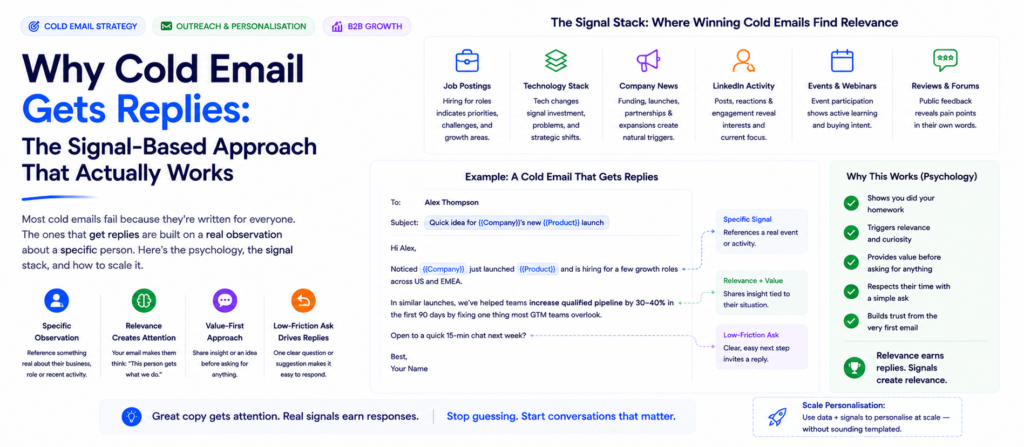
Where Real Signals Actually Come From
Kevin knew Jim was on an unsupported API version. That’s not a guess. That’s a signal — a specific, verifiable piece of information about Jim’s technical environment that Kevin obtained through deliberate research.
For most B2B teams, the question is: where do signals like this actually live, and how do you surface them systematically rather than by accident?
Job postings
One of the richest, most underused signal sources in B2B prospecting. When a company posts for a DevOps engineer who needs experience with a specific legacy tool, they’re announcing the problem they’re trying to solve.
Hiring intent data surfaces precisely these signals — not just that a company is hiring, but what that hiring pattern reveals about their operational state and near-term priorities.
Technology stack data
What tools is a company currently running? What did they recently add or drop?
Technographic data append maps the technology environment at the account level — which is how Kevin could identify that Jim’s company was on a specific API version. Tech stack signals reveal what problems the current configuration creates.
LinkedIn activity & company announcements
Leadership posts, product launches, expansion announcements, hiring freezes, acquisition news.
Web and LinkedIn data scraping automates collection of this signal data across your target account universe — turning what was previously manual, serendipitous research into a structured input.
Events & trigger moments
Conference sponsorships, speaking engagements, product release notes, press releases. Companies are most visible — and often most open to new relationships — around events that mark transitions or growth.
Events and buyer intent data tracks these moments across your ICP.
Review sites & public forums
G2 reviews, Reddit complaints, GitHub issue threads, StackOverflow questions from company domains. When Jim’s engineers are publicly asking questions about webhook migration on Stack Overflow, that’s a signal. Not an inference — a signal. The prospect has publicly documented the problem.
Intent data
Third-party behavioural data showing which companies are actively researching specific topics — solution categories, competitor names, problem statements. This is the broadest and noisiest signal source, but when stacked with technographic or hiring data, it becomes a strong buying indicator.
How to Build a Signal Stack for Your ICP
Kevin’s email works because he had one real, verified signal about Jim’s situation. At scale, the goal is a system that surfaces that kind of signal for every account in your target universe — not manually, one at a time, but systematically.
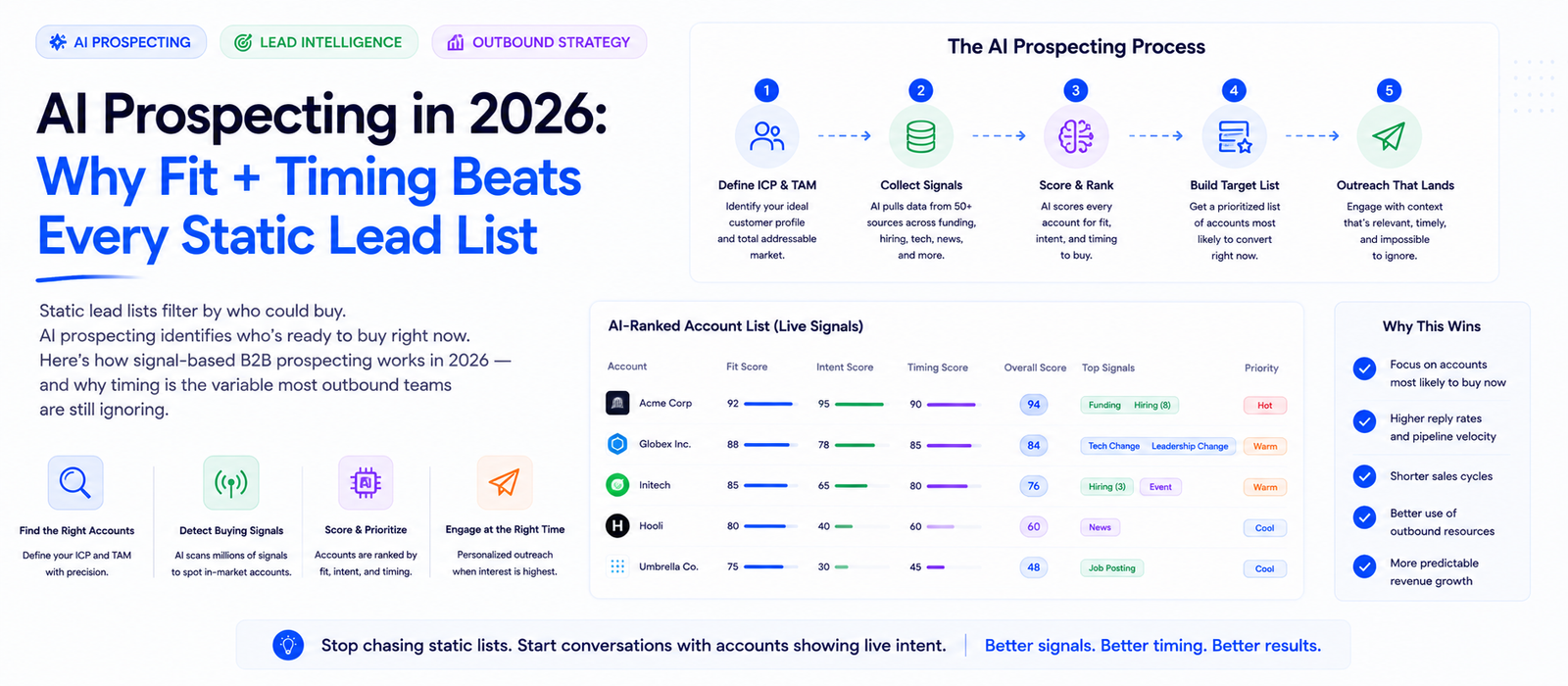
A signal stack is the combination of signal sources you monitor continuously for accounts that match your ICP:
Account universe
The full list of companies that meet your ICP criteria — industry, headcount, geography, tech stack requirements, revenue stage.
Contact list building against a precise ICP creates the universe that signal monitoring runs within. Without a defined universe, you’re monitoring signals from everyone and prioritising nothing.
Signal enrichment
Each account is enriched with signal data — tech stack, hiring patterns, leadership changes, event participation, intent indicators.
AI-powered lead research runs this enrichment continuously, surfacing accounts where something is actively changing. Change is the leading indicator of buying opportunity.
Account scoring
Accounts are ranked by signal strength — the combination of ICP fit and the quality and recency of buying signals. The output is a prioritised queue: hot accounts at the top (strong fit, multiple recent signals), warm accounts in a nurture track, watch-list accounts monitored for changes.
Contact identification
For high-priority accounts, identify the specific decision-makers who matter.
Email finding and verification produces verified, deliverable contact data for each target — not six months out of date.
Signal-to-email translation
This is the part Kevin did manually. The signal (unsupported API version) becomes the opening observation. The consequence (timeouts, manual clean-ups) becomes line two. The relevant experience (37 migrations) becomes line four. Each element of the email maps to a specific piece of research.
When this system runs well, you’re not writing one email for Jim at a time. You’re writing one email framework for every company with the same observable signal, and sending it to the right person at each of those companies.
The Kevin Approach for Non-Technical Offers
The first objection most people raise: Kevin sells a technical service. The signal (API version) is technical. This doesn’t apply to what we sell.
It does. The email structure — specific observation, concrete consequence, proof of pattern recognition, low-pressure question — applies to any offer where a real signal exists. The signal just looks different.
B2B SaaS → Sales Ops
Signal: hiring imbalance via job posting data
“Hey Sarah — noticed you’re hiring three enterprise AEs but your SDR headcount hasn’t changed in 18 months. That usually means AEs are doing their own prospecting, which tends to compress closing time significantly. Folks bring us in to fix the ratio without adding headcount. We’ve helped six companies in your stage do exactly this. Guessing you’ve noticed the same pattern?”
Data Agency → RevOps
Signal: Salesforce migration intent via job postings
“Hey Marcus — saw you’re migrating from HubSpot to Salesforce later this quarter based on your recent job postings. Contact data usually doesn’t survive that transition cleanly — duplicates, stale records, missing fields. We’ve cleaned and migrated 23 datasets through exactly this process. Handling the data layer in-house?”
Finance Consultancy → CFO
Signal: FP&A hire timing at growth stage implies capacity gap
“Hey David — your team posted for a FP&A analyst with Series B financial modelling experience three weeks ago. That timing usually means the board is pushing harder on scenario planning than your current team capacity supports. We’ve supported six CFOs through exactly this gap on a fractional basis. Handling this with the existing team for now?”
The signal type changes. The discipline doesn’t. Find something real, name the consequence, prove pattern recognition, open a door.
How to Scale This Without Losing What Makes It Work
The most common failure when teams try to scale the Kevin approach: they replace the real signal with a simulated one. The “API version” becomes “your current tech stack.” The “37 migrations” becomes “companies like yours.” The signal is gone. The format is there. And it doesn’t work.
Scaling signal-based outreach requires accepting that there are two different levels at which personalisation can operate:
Segment-level
One framework, many valid targets
Written for a specific segment sharing the same observable signal — same tech stack gap, same hiring pattern, same growth stage challenge. Reads like individual research because it’s built on a real observation that genuinely applies to every account in the cohort.
Best for: the broader ICP — accounts with moderate signal strength
Account-level
One signal, one company, one person
For the highest-priority accounts — multiple strong signals, high ICP fit. Individual research produces individual emails that nobody else could have sent.
Best for: top 10–20% of prioritised accounts
Most programmes should run both layers simultaneously: segment-level frameworks for the broader ICP, account-level research for the top 10–20% of prioritised accounts. Guesses get deleted. Real signals get replies.
The Five Principles — Expanded
The Kevin email demonstrates five principles that hold across every domain where signal-based cold outreach works:
1
Observation beats positioning
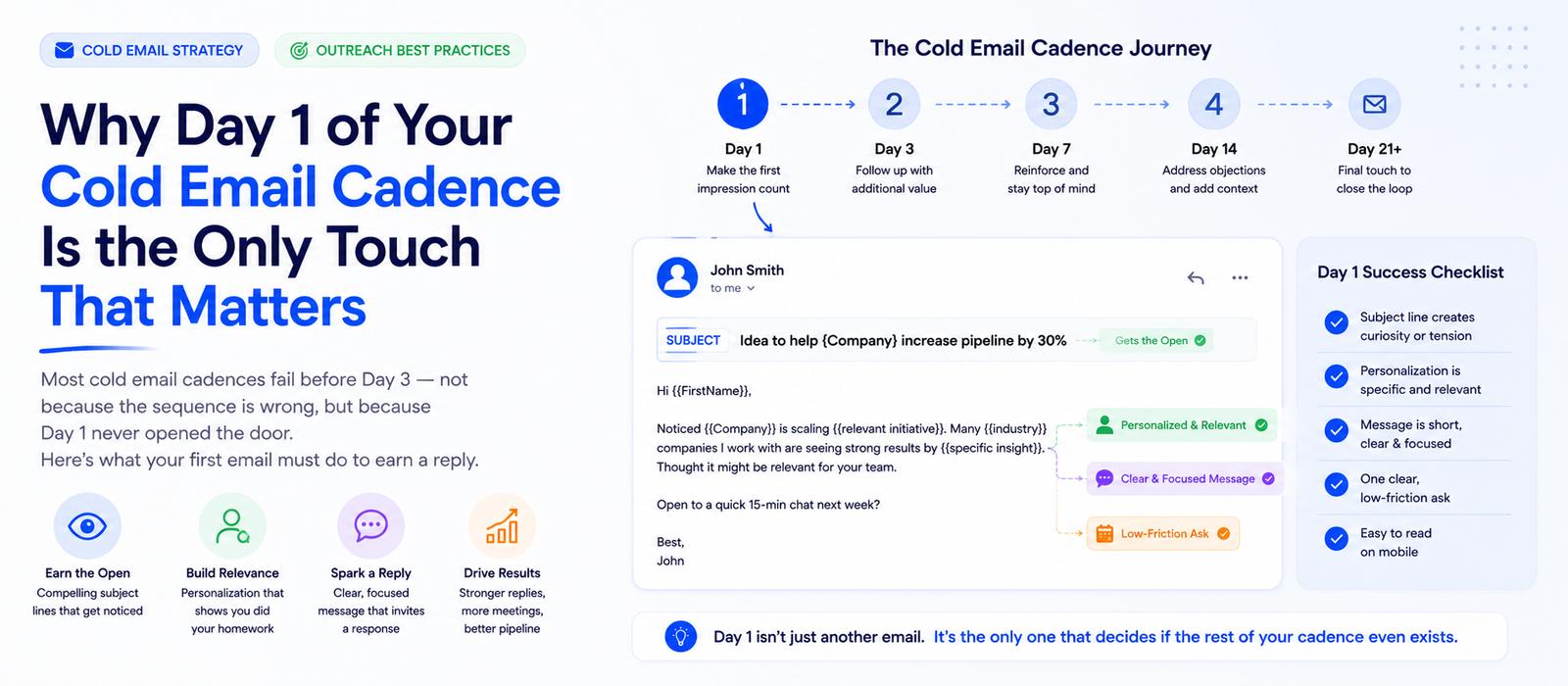
A specific thing you noticed about the prospect’s situation does more persuasion work than three paragraphs about your company’s positioning. Positioning is about you. Observation is about them. Research comes before writing. Always. For a detailed breakdown of what makes Day 1 outreach work or fail, see our
cold email cadence guide.
2
Name the cost, not the fix
The prospect isn’t motivated by your solution — they’re motivated by the cost of their current situation. Lead with what happens if the problem doesn’t get solved. Make the cost feel concrete and slightly uncomfortable. People move faster away from pain than toward gain.
3
Restraint signals confidence
Over-explaining is a tell. It signals that the sender isn’t sure the relevance is there — so they compensate with volume. When the relevance is real, you don’t need to explain it at length. Six sentences work precisely because they communicate confidence that the observation is enough.
4
Specific numbers beat round claims
“37 migrations” is more credible than “hundreds of clients.” Not because 37 sounds more impressive — but because it implies direct personal experience with the exact problem. Round numbers suggest scale. Specific numbers suggest depth. Depth is what Jim needs to decide whether to reply.
5
The close should open a door, not force a decision
“Guessing you’re handling this internally?” invites correction. Low-barrier closes get more replies than calendar links pushed in the first message — because they don’t ask for anything the prospect isn’t ready to give. First replies earn follow-up. Follow-up earns meetings.
The Infrastructure Layer: Signals Only Matter If They Land
There is one more element of the Kevin email that the breakdown doesn’t address: the assumption that it arrived in Jim’s inbox.
Signal-based outreach depends entirely on the email actually landing in the primary inbox. An email with a real signal, a real observation, and a real proof point that lands in spam is invisible. It doesn’t get replied to. It doesn’t get opened. It generates a phantom metric and nothing else.
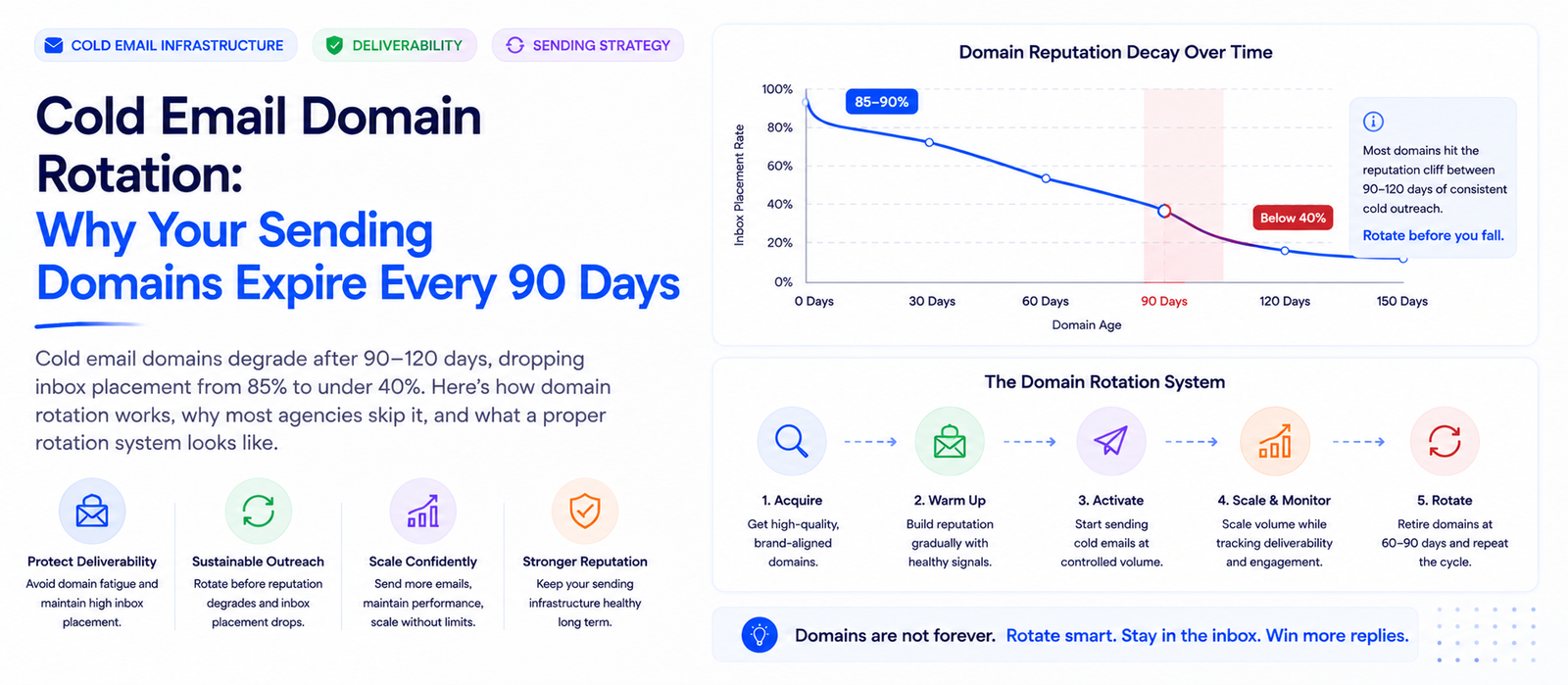
Email infrastructure setup — proper SPF, DKIM, and DMARC authentication, structured domain warmup, proactive domain rotation before the 90-day degradation window — is not a technical detail. It’s the prerequisite for every other investment in signal research, copy quality, and targeting precision to produce any return.
A sending domain that’s been flagged as a commercial sales sender by Gmail or Outlook is routing 40–60% of outreach to spam or promotions. That means nearly half of the emails with real, researched signals are landing where Jim will never see them. Signal quality cannot compensate for inbox placement failure.
Contact list verification protects deliverability from a different angle. Every hard bounce registers against the sending domain’s reputation. A list with 10% invalid contacts degrades fresh infrastructure significantly faster than it should. See our domain rotation guide for the full breakdown.
The signal is what earns the reply. The infrastructure is what ensures the signal has a chance to be read.
FAQ: Cold Email Reply Rate Questions Answered
Why do some cold emails get replies when most don’t? +
Cold emails that get replies are built on a real, specific observation about the prospect’s actual situation — not a templated value proposition applied to a broad audience. The reply comes from relevance: the prospect reads the email and thinks “this person actually looked at my situation.” Relevance is the product of research, not copywriting.
What makes a cold email feel personal versus generic? +
The difference is whether the observation in the email required actually looking at the specific prospect. A personalised email contains something that could only have been written about this person — a specific technical condition, a specific hiring pattern, a specific public statement they made. A generic email contains something that could have been written about anyone in their job title or industry. The reader can tell in about two seconds.
How important is the subject line for getting cold email replies? +
The subject line determines whether the email gets opened — which makes it important, but not the primary driver of replies. An email with an average subject line and a genuinely relevant observation will outperform an email with a great subject line and a generic pitch. Fix the observation first; optimise the subject line second. See our
Day 1 cold email guide for a full breakdown of subject line mechanics.
Can signal-based cold email be scaled, or does it only work one-to-one? +
It scales through segment-level personalisation. Identify a replicable signal that applies to a specific cohort of accounts — the same tech stack gap, the same hiring pattern, the same growth stage challenge — and write one email framework for that segment. That framework reads like individual research because it’s built on a real observation that genuinely applies to every account in the cohort. Account-level individual research is reserved for the highest-priority accounts.
What is the best length for a cold email? +
Short. Kevin’s email is six sentences, which is close to the ideal. For most B2B cold outreach, 75–150 words is the target range. Longer emails force the reader to work harder to extract the point — and cold prospects won’t do that work. Brevity is also a signal of confidence: you don’t need four paragraphs to justify the relevance if the relevance is real.
What are the best sources for cold email signals? +
Job postings (hiring patterns reveal operational priorities), technology stack data (current tools reveal gaps and transition opportunities), LinkedIn activity and company announcements (public statements signal challenges and changes), events and trigger moments (inflection points create buying windows), review sites and public forums (documented pain in the prospect’s own words), and third-party intent data. The most powerful signals combine multiple sources — a company actively hiring Salesforce admins who also recently posted about CRM migration challenges and has a VP of RevOps who joined six months ago is a different target than one with only a single signal.
How do I find signals if I don’t have a technical product? +
The signal type changes by domain; the discipline doesn’t. For non-technical offers, strong signals include: leadership changes that create a mandate for new approaches, funding rounds that open evaluation windows, hiring patterns that reveal operational gaps, public statements about challenges in the prospect’s own words, and competitive changes in the market the prospect operates in. Any real, specific observation about the prospect’s situation qualifies.
What is the difference between personalisation and a personalised template? +
A personalised template inserts data fields — company name, job title, recent news mention — into a structure that was written without looking at the prospect. Real personalisation contains an observation that required looking at this specific account: a specific tech stack configuration, a specific hiring pattern, a specific thing they said publicly. The reader can tell the difference in about two seconds.
How many follow-ups should I send after a signal-based first email? +
3–5 follow-ups over 14–21 days, each adding a new angle. A first follow-up might share a relevant case study. A second might reframe the consequence from a different stakeholder’s perspective. A third might ask a diagnostic question that stands alone. The signal-based first email earns the right to follow up — but only if the follow-ups continue to add value rather than just bumping the original ask. See our
guide on why outbound campaigns fail for the complete sequence framework.
What should I do if I don’t know how to find signals for my ICP? +
Start with job postings for roles that reveal operational priorities related to your offer. Then layer in technographic data to understand the tool environment. Then look at LinkedIn activity from decision-makers at target accounts for public statements about challenges. If you need the signal research done systematically — not just for one account but for your full ICP universe —
AI-powered lead research is built exactly for this: surfacing the observable signals that make first-line personalisation possible without manual research per contact.
Konnektys Team
B2B Growth & Outbound Specialists
Konnektys builds and operates outbound revenue engines for B2B companies — from ICP definition and LinkedIn prospecting to AI-powered lead research, email infrastructure, and fully managed outbound campaigns.
The Takeaway That Matters
Kevin’s email is six sentences long. It took less than two minutes to write.
The research behind it — finding the right account, identifying the specific technical signal, knowing what that signal implies about the problem and its consequences — took longer. Possibly much longer.
That’s the uncomfortable truth about signal-based outreach. The part that’s hard isn’t the writing. It’s the work that happens before the writing. And most teams skip it, not because they don’t understand its value, but because they don’t have a system that makes it feasible at the volume they need.

 Konnektys TeamMarch 16, 2026 · 10 min read · Cold Email Strategy