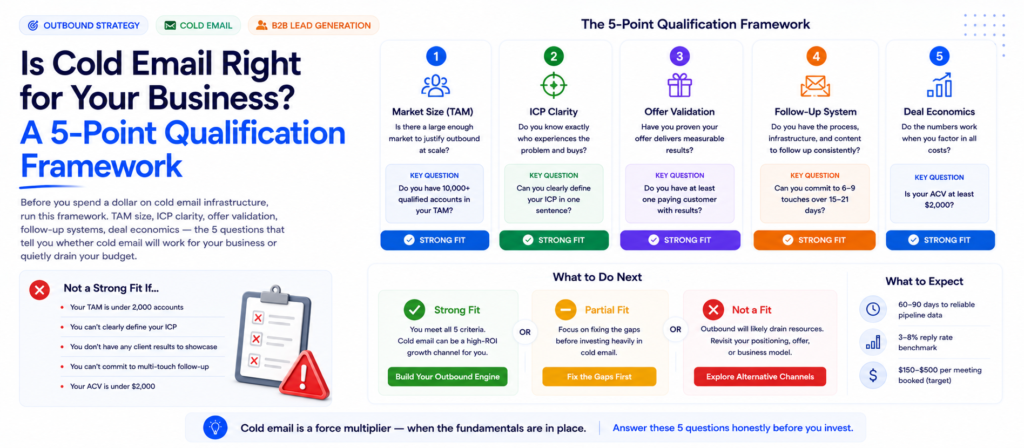
Is Cold Email Right for Your Business? A 5-Point Qualification Framework

Most businesses jump straight into cold email without asking the one question that matters most: is this channel actually right for us? For a significant number of companies, the honest answer is no — not yet, or not at all. Run this framework before you spend a dollar.

Konnektys TeamMay 10, 2026  ·  11 min read  ·  B2B Outbound Strategy
Cold email for business lead generation

Cold email has a reputation problem — and it earned it honestly.

Most cold email campaigns fail. Not because the channel doesn’t work, but because companies deploy it before they’ve built the foundations that make it work. They treat cold email as a demand generation tool when they haven’t validated demand. They send to everyone who matches a job title filter when they can’t articulate who their ideal customer actually is.

The result is predictable: low reply rates, wasted budget, burned domain reputation, and a conclusion that cold email “doesn’t work for our industry.” It does work. Just not for companies that skip the qualification step.

This framework exists to answer one question before any of the tactical decisions: should you be running cold email at all?

Why Most Cold Email Programmes Fail Before They Start

There’s a version of cold email failure that happens during execution — bad copy, poor deliverability, weak sequences. Those are fixable. The more expensive failure is structural: companies building and running cold email programmes that were never going to work because the prerequisites weren’t in place.

The five failure modes that kill cold email before it starts:

A market too small to sustain volume
Cold email requires enough addressable accounts to test, iterate, and find what works. A TAM of 500 companies doesn’t give you that runway.
An ICP too vague to target
“B2B companies with 50+ employees” is not an ICP. When you can’t describe exactly who you’re selling to and why, every email reads like it was written for everyone — which means it resonates with no one.
An unvalidated offer
Cold email does not create demand for products or services that haven’t yet proven they solve a real problem. It surfaces and accelerates existing demand.
No follow-up system
The majority of cold email replies come from follow-up touchpoints, not the first email. Teams that send one email and wait have abandoned most of their potential pipeline by default.
Economics that don’t support the channel
Cold email has real costs — infrastructure, data, tooling, copywriting, management. If the deal size doesn’t justify those costs, the programme will never show a return regardless of how well it’s executed.
If any of these five conditions apply, the answer to “should we run cold email?” is: not yet.

Point 1: Is Your Total Addressable Market Big Enough?

Cold email is a volume-dependent channel. Not because you should send to everyone — you shouldn’t — but because you need enough accounts to test angles, iterate on messaging, segment by persona, and still have runway left when a segment doesn’t convert.

✓ SCALABLE
10,000+
Room to test angles, segment, A/B experiment, and build repeatable learnings. Cold email becomes a true channel at this scale.
⚠ VIABLE
2,000–5,000
Possible but spray-and-pray is off the table. High personalisation, signal-based targeting, and multi-stakeholder outreach required.
✕ NOT READY
Under 1,000
Cold email is almost certainly the wrong primary channel. A badly executed campaign burns bridges with a meaningful slice of your entire market.

How to know your actual TAM: “Mid-market SaaS” is not a TAM. Your TAM is a count — the number of companies that meet your precise ICP criteria (industry, headcount, geography, tech stack, revenue) that exist in the market today. Market research and TAM analysis is how you establish that number with confidence before committing to a channel that depends on it.

If your TAM is too small, the fix isn’t to squeeze cold email harder. It’s to either expand the ICP criteria thoughtfully, explore adjacent segments, or switch to outreach approaches that work at lower volumes.

Point 2: Can You Describe Your ICP in One Sentence?

Your Ideal Customer Profile is the operational foundation of every cold email campaign. Not just for targeting — for copy, for objection handling, for what signals indicate buying readiness, for what the first line of every email should reference.

The test: write one sentence in this format — “We help [specific role] at [specific company type] who [specific problem] achieve [specific outcome].”

If that sentence takes more than two drafts and still runs over 20 words, your ICP needs work before your outreach begins.

What a precise ICP unlocks:

Targeting precision
You know exactly which contacts to include and exclude — not just by job title, but by seniority, company stage, tech stack, and buying context. Contact list building against a precise ICP produces a materially different list than one built against broad filters.
Messaging resonance
When you know exactly who you’re writing for, you can reference their specific situation — the problems that are live for them right now, the language they use internally, the objections they’re likely to raise. Generic copy is a symptom of a generic ICP.
Signal relevance
Buying signals only mean something when you know what signals matter for your specific ICP. A funding round is highly relevant if you sell to growth-stage companies building out their sales function. It’s irrelevant if you sell compliance software to established enterprises.
Deliverability protection
Sending to the wrong people generates spam complaints. Spam complaints damage domain reputation. Domain reputation damage kills deliverability. A precise ICP — and the email finding and verification that produces clean, matched contact data — is an infrastructure decision as much as a targeting one.
The common ICP trap: teams define the ICP once at the start and never revisit it. The ICP should evolve based on what’s actually converting. The companies that replied, booked meetings, and closed deals are telling you something about who you should be targeting more of. Feed that data back in.

Point 3: Has Your Offer Already Made Someone Money?

Cold email amplifies existing demand — it does not create it. This is one of the most consequential misunderstandings about the channel.

If you haven’t yet validated your offer through warm channels — referrals, network introductions, direct sales conversations with people who already trust you — then cold email is not the right environment for that validation. Cold email will tell you very quickly if the offer doesn’t resonate. But it will tell you through silence and irrelevance rather than the honest feedback you’d get from a warm prospect.

Validation through cold email is expensive, slow, and hard to interpret. A 1% reply rate from cold outreach could mean the offer is wrong. It could mean the targeting is wrong. It could mean the copy is wrong. It could mean the infrastructure is broken. You can’t separate those variables cleanly until you know the offer works.

The standard for offer validation before cold outreach:

  • At least one client who paid at or near full price and received a measurable result. Not a free pilot. Not a heavily discounted trial. A commercial transaction. That transaction gives you a real outcome, a real client category, a real proof point.
  • A clear outcome statement in two sentences or fewer. Not a feature list. Not a capability description. A specific transformation: “We helped [type of company] go from [before state] to [after state] in [timeframe].”
What validation is not: a few people saying “that sounds interesting” in a discovery call. Interest is not validation. Signed contracts are validation.

Point 4: Can You Follow Up Consistently?

The data on this is consistent: most cold email replies don’t come from the first touch. 60–80% of replies in a cold email sequence come from follow-up emails — typically the second, third, or fourth touchpoint.

A single email sent to a cold prospect is not a cold email programme. It’s a one-off message with a small chance of landing at the exact moment the prospect happens to be thinking about your category. Most of the potential pipeline in any outbound effort lives in the follow-up layer — and most teams leave it on the table.

What a proper follow-up system actually requires:

1
A structured multi-touch sequence
Typically 4–6 touchpoints over 15–21 days for B2B cold outreach. Each follow-up needs a different angle — not the same ask repeated in different words. Day 1 might be relevance. Day 4 might be a case study. Day 7 might be a question that stands alone. Day 10 might be a breakup email that creates urgency.
2
Automated sequencing with engagement triggers
Follow-ups that fire based on opens, clicks, and reply behaviour — not just fixed time delays — consistently outperform purely time-based sequences. A prospect who opened three times without replying warrants a different follow-up angle than one who hasn’t opened at all.
3
Reply handling speed
A prospect who replied on a Tuesday and didn’t hear back until Friday has cooled significantly. Replies to cold outreach should be handled within 24 hours — ideally faster.
4
CRM integration and pipeline tracking
Interested prospects who don’t immediately book a call need to be tracked, not forgotten. A CRM data enrichment layer that keeps contact and company data current ensures warm prospects are reached with accurate information when you follow up weeks or months later.
The infrastructure question: Can you maintain this consistently for 90+ days across multiple campaigns running simultaneously? If the honest answer is “not without dedicating someone full-time to it,” that’s an argument for end-to-end managed outbound rather than an in-house build. The difference between a cold email programme and a cold email experiment is operational consistency.

Point 5: Do the Deal Economics Actually Work?

Cold email has real, recurring costs. Before building the programme, run the maths on whether the economics support the channel at your deal size.

The full cost stack for a properly run cold email programme:
  • Domain procurement and rotation (3–5 domains per 1,000 daily sends, replaced every 90 days)
  • DNS setup, warmup tooling, and inbox placement monitoring
  • Contact data — list building, enrichment, and verification against your ICP
  • Sequencing and CRM tooling
  • Copywriting and ongoing sequence optimisation
  • Management time for monitoring, iteration, and reply handling
ACV RangeVerdictNotes
$2,000+ ACV✓ Works wellHealthy return even at modest conversion rates. Baseline threshold for cold outreach sustainability.
$500–$2,000 ACV⚠ PossibleRequires tight targeting, low overhead, and above-average conversion. Every inefficiency shows up as negative ROI.
Sub-$500 ACV✕ Rarely worksUnit economics don’t hold. Inbound content, paid acquisition, or product-led growth will consistently outperform on ROI.
Run this calculation before you start:
1Estimated cost per booked meeting (total monthly programme cost ÷ meetings booked per month)
2Close rate on cold-sourced meetings
3Average deal value
4Resulting revenue per dollar of outbound spend — if below 3–4×, the programme needs structural improvement or the channel isn’t right

The Compliance Question Nobody Asks First

Before infrastructure, before copy, before targeting — there is a legal question that determines whether cold email is even permissible in your target market. Cold email regulations vary significantly by geography, and the consequences of non-compliance range from reputation damage to significant financial penalties.

RegulationGeographyCold Email StanceStrictness
CAN-SPAMUnited StatesPermitted with clear sender ID, physical address, functioning unsubscribePermissive
GDPREU / EEARequires legitimate interest basis or consent; not automatically prohibited but needs legal reviewRestrictive
CASLCanadaRequires express or implied consent; among the strictest frameworks globallyVery Strict
PECRUnited KingdomPost-Brexit UK framework; similar to GDPR in spirit with UK-specific guidanceRestrictive
The practical implication: if your TAM spans multiple geographies, you need a compliance layer that handles region-specific consent, opt-out mechanics, and data retention. This isn’t an optional refinement — it’s table stakes for operating the channel sustainably.

The Hidden Costs Most Teams Don’t Budget For

The visible costs of cold email are easy to estimate. The hidden ones are where most budget plans break down.

Domain lifecycle costs

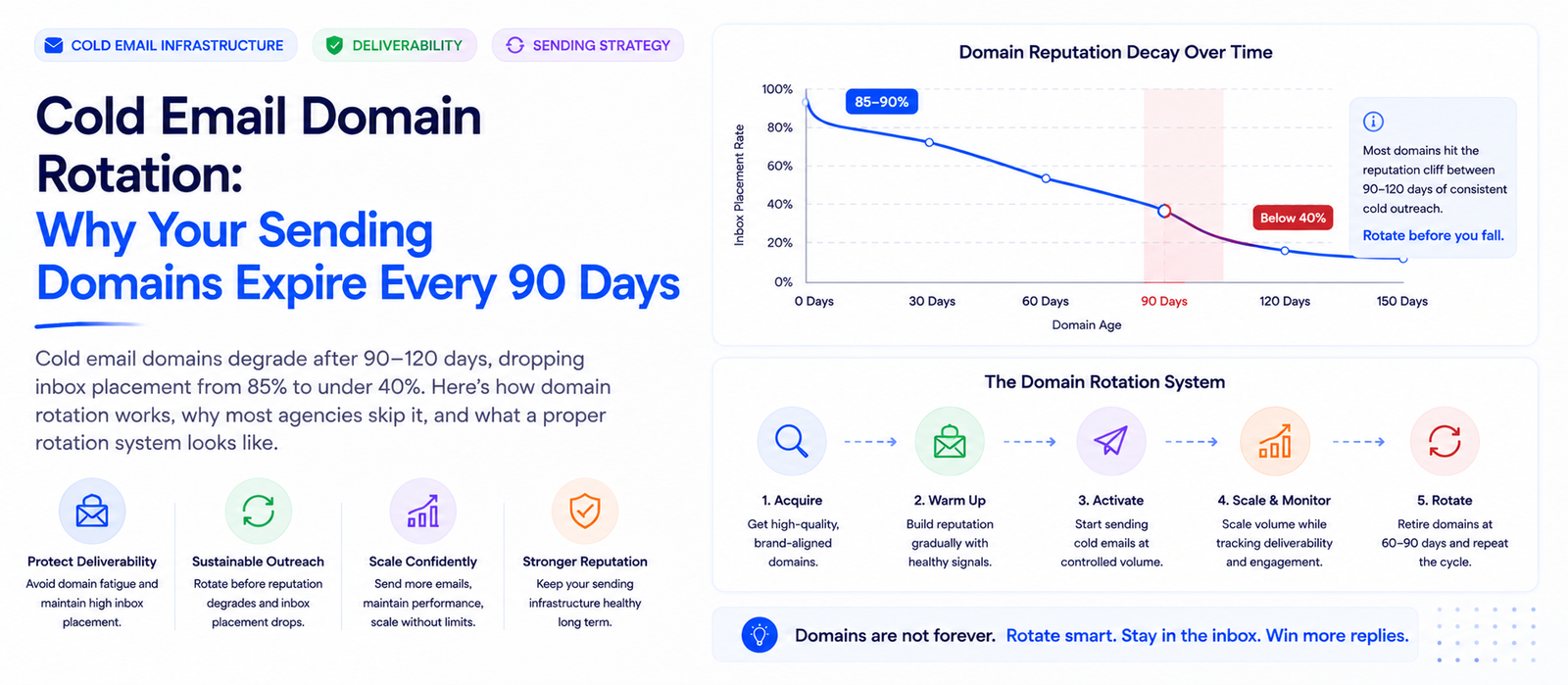
Sending domains degrade after 90–120 days — inbox placement falls from 85% to under 40% as providers fingerprint the domain. Replacing domains on a fixed 90-day rotation is an ongoing operational cost most teams don’t factor in at the start. See our full breakdown of domain rotation.

List decay

B2B contact data decays at approximately 25–30% per year. A list verified six months ago has meaningful inaccuracy. Email finding and verification is a recurring cost of running the channel accurately, not a one-time exercise.

CRM debt

Stale records — contacts who have changed roles, outdated firmographic data, duplicate entries — generate unnecessary bounces and underperformance. CRM cleaning before launching a campaign pays for itself in deliverability protection.

Management and iteration time

Cold email programmes that don’t iterate don’t improve. Subject line testing, sequence restructuring, ICP refinement, new angles for stale segments — this is ongoing analytical work. Teams that “set and forget” see reply rates decay steadily over months.

Opportunity cost of poor deliverability

A programme running at 40% inbox placement instead of 85% isn’t generating 45% fewer replies — it may be generating 60–70% fewer. The invisible cost of degraded infrastructure is not a missed reply rate; it’s an entire pipeline segment that never existed.

When Cold Email Isn’t the Answer

Failing one or more of the five qualification checkpoints doesn’t mean outbound is off the table. It means a different approach is likely to produce better results.

TAM too small
High-touch manual outreach combining personalised email, LinkedIn connection and messaging, direct phone calls, and warm introductions. At low volume, the relationship-building investment per account is justified. LinkedIn outreach as a primary channel — rather than a supplement to email — often works better when the market is this small.
Offer not yet validated
Inbound content marketing, community participation, and warm network activation. Get the offer in front of people who will give you honest feedback, iterate until you have proof it works, then consider cold outreach.
Deal size too low
Inbound SEO and content, paid search and social, product-led growth, or referral programmes. Channels with lower cost-per-acquisition that scale on volume rather than high-touch personalisation.
ICP not yet clear
Spend time on AI-powered lead research and customer discovery before building lists. Interview existing customers about why they bought, what alternatives they considered, and what would have made them faster to decide.
No follow-up capacity
Either build the operational infrastructure before launching (sequence tooling, CRM integration, reply handling process) or work with a managed outbound partner. A partial cold email programme — one email per prospect with no follow-up — is not a cold email programme. It’s expensive noise.

The Verdict: Your Cold Email Readiness Score

Run through each checkpoint and score yourself honestly:

Checkpoint✓ Pass⚠ Caution✕ Not Ready
TAM size10,000+ companies2,000–5,000Under 1,000
ICP clarityOne precise sentenceNeeds refinementCan’t articulate it
Offer validationPaying clients, proven resultsOne paying clientNot yet validated
Follow-up systemFull sequence + CRMPartial systemSingle email only
Deal economics$2,000+ ACV$500–$2,000Under $500
All 5 pass
Cold email has genuine potential to become a significant, repeatable growth channel. Build the right infrastructure and data layer to support it.
3–4 pass
Identify the specific gaps and fix them before launching. Proceeding with known gaps produces faster failure with more spend attached.
2 or fewer pass
Cold email is likely not the right channel at this stage. Invest in the prerequisites first — TAM definition, ICP sharpening, offer validation — then reassess.
The honest summary: the channel is rarely the problem. The missing prerequisites are.

FAQ: Cold Email Qualification Questions Answered

Is cold email effective for B2B lead generation? +
Yes — when the prerequisites are in place. Cold email is one of the highest-ROI outbound channels for B2B companies with a clear ICP, a validated offer, a TAM of 10,000+ companies, and deal sizes above $2,000 ACV. Without those foundations, it generates activity but not pipeline.
What TAM size do you need for cold email to work? +
A minimum of 2,000 qualified accounts to make cold email viable, and ideally 10,000+ to make it scalable. Below 2,000, each contact is too precious to risk on mass sequencing — high-touch manual outreach consistently outperforms at that market size.
Should I validate my offer before running cold email? +
Yes. Cold email is an amplification tool, not a discovery tool. You need at least one paying client who received a measurable result before cold outreach — this gives you a proof point, an outcome statement, and evidence that demand exists. Without validation, cold email will expose the gap but not help you fill it.
What reply rate should I expect from cold email? +
A well-structured campaign targeting a precise ICP with verified contacts and strong copy should generate 3–8% reply rates. Below 2% almost always signals an ICP problem, a messaging problem, a deliverability problem, or some combination of all three. Above 8% means you’ve found a high-performing angle worth scaling.
Is cold email legal? +
It depends on geography. In the US, CAN-SPAM permits commercial B2B cold email with specific compliance requirements. In the EU, GDPR requires a legal basis (legitimate interest or consent) for each contact. In Canada, CASL requires express or implied consent. Get legal advice specific to your target markets before running cold outreach at scale.
What does cold email infrastructure actually cost? +
A properly run cold email programme — including domain procurement and rotation, DNS setup and monitoring, verified contact data, sequencing tooling, and management — typically costs several hundred to a few thousand dollars per month depending on volume. A realistic target for a well-optimised programme is $150–$500 per meeting booked.
Can I run cold email in-house or do I need an agency? +
In-house is viable if you have dedicated resource with experience in cold outbound — infrastructure management, copywriting, list building, and follow-up handling all at once. Without that combination of skills and bandwidth, the hidden costs (poor deliverability, missed follow-ups, degraded sequences) usually outweigh the savings.
How long before cold email produces results? +
Most properly built cold email programmes take 60–90 days to produce reliable pipeline data. The first 30 days involve infrastructure setup, domain warmup, and initial sends at cautious volume. Weeks 5–8 produce enough reply data to identify what’s working. By day 90 you should have a clear ICP-message fit baseline and a baseline conversion rate to project against.
What is the minimum deal size for cold email to make economic sense? +
A minimum ACV of $2,000 is the practical threshold where cold email unit economics work reliably. At $500–$2,000 ACV it is possible with tight targeting and low overhead. Below $500 ACV, inbound, paid acquisition, or product-led growth will almost always produce better ROI.
What is the difference between cold email and spam? +
Legally, spam is unsolicited commercial email that violates applicable regulations — missing opt-out mechanisms, deceptive subject lines, false sender information. Practically, spam is irrelevant outreach sent to poorly targeted contacts with no genuine personalisation. Cold email done properly is targeted, relevant, personalised to a real business context, and compliant with applicable law.
How do I know if my ICP is specific enough for cold email? +
You should be able to write one sentence describing exactly who you help, with what problem, and to what outcome — in 20 words or fewer. If the sentence requires qualifiers (“it depends on…”), your ICP needs more precision. The test in practice: could two different people, given the same ICP definition, build the same contact list?

Konnektys Team

B2B Growth & Outbound Specialists

Konnektys builds and operates outbound revenue engines for B2B companies — from ICP definition and LinkedIn prospecting to AI-powered lead research, email infrastructure, and fully managed outbound campaigns.

Ready to Build Cold Email That Actually Converts?

If you passed the framework, the next step isn’t buying a sequencing tool. It’s building the infrastructure, data layer, and execution system that makes everything downstream work.

TAM analysis and ICP definition, verified contact list building, email infrastructure setup, and fully managed cold email and LinkedIn outreach — with domain rotation, deliverability monitoring, and ongoing sequence optimisation built in by default.

If you’re not sure where you stand on the five-point framework, talk to us first. If cold email isn’t right yet, we’ll tell you — and tell you what is.

Share this article:

Related articles

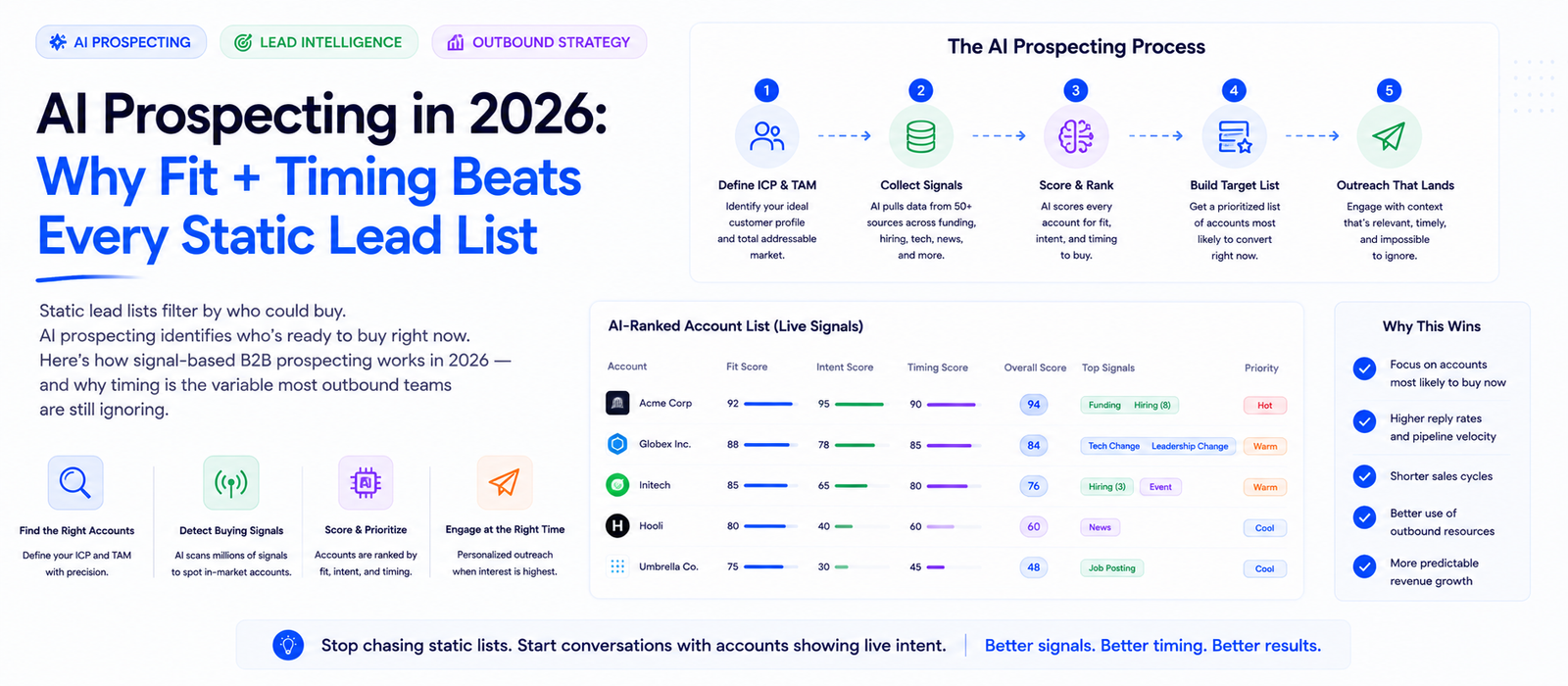
AI Prospecting in 2026
AI Prospecting

AI Prospecting in 2026: Why Fit + Timing Beats Every Static Lead List

Konnektys Team · 17 May, 2026
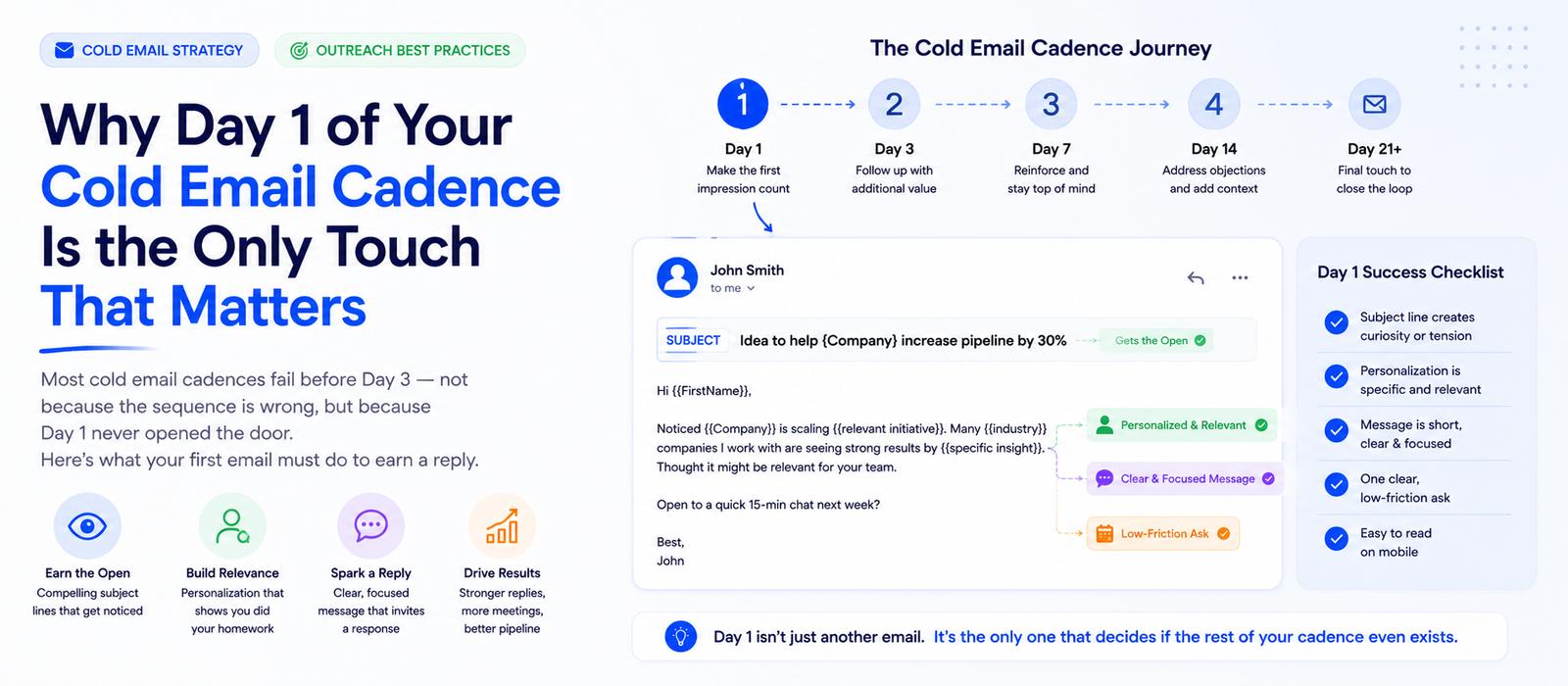
Why Day 1 Makes or Breaks Your Cold Email Cadence
Cold Email Strategy

Why Day 1 Makes or Breaks Your Cold Email Cadence

Konnektys Team · 6 Jun, 2026

Cold Email Domain Rotation
Cold Email Infrastructure

Your Cold Email Domain Has a 90-Day Shelf Life

Konnektys Team · 23 May, 2026

Scroll to Top