
6 Cold Email Mistakes That Are Quietly Killing Your Reply Rates
Most cold email advice is tactics — use this subject line, try this AI prompt, send at this time. But after reviewing thousands of outbound campaigns, the biggest performance problems almost never come from minor optimizations. They come from fundamental messaging mistakes — many of which have become accepted “best practices.” Here are six worth reconsidering, and the fix for each.
 Konnektys TeamJune 17, 2026 · 11 min read · Cold Email Strategy
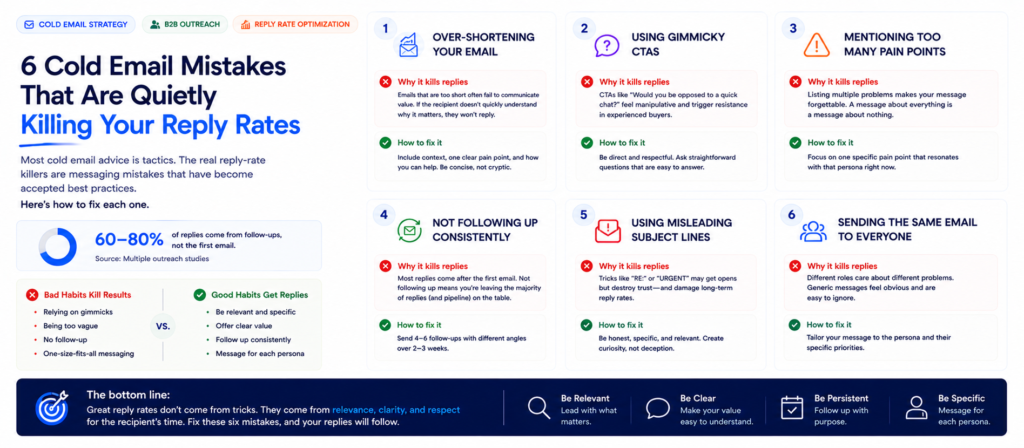
Most cold email advice focuses on tactics. Use this subject line. Try this AI prompt. Send at this time. Add this personalization token.
After reviewing thousands of outbound campaigns, a clear pattern emerges: the biggest performance issues rarely come from minor optimizations. They come from fundamental messaging mistakes — and the awkward part is that many of these mistakes have become accepted best practices in the outbound world. Some even sound counterintuitive to undo.
Avoiding them won’t instantly double your reply rates. But it will fix the structural problems that subject-line testing and send-time optimization can’t touch — and in a crowded inbox, that’s often the difference between getting ignored and getting a response.
Here are six cold email habits worth reconsidering.
Why Tactics Aren’t the Problem
Before the six mistakes, it’s worth understanding why teams keep reaching for tactics when the real problems are structural.
Tactics are visible, testable, and feel actionable. A subject line is right there to be rewritten. A send time is a setting to be adjusted. A personalization token is a variable to be added. So when reply rates are low, teams instinctively reach for the levers they can see and pull immediately.
The fundamental messaging mistakes — vague value, the wrong CTA, scattered focus, no follow-up, persona-blind copy — are harder to see because they’re embedded in how the email was conceived, not in any single setting. They don’t show up in an A/B test of two subject lines. They show up as a flat reply rate that doesn’t improve no matter how many tactics get tested.
This is the same pattern we describe in our breakdown of why outbound campaigns fail: copy optimization is the last mile, and it can’t compensate for structural problems upstream. The six mistakes below are upstream problems wearing the costume of copy choices.
Mistake 1: Making Your Emails Extremely Short
A common belief in cold email is that shorter always performs better. That’s only partially true.
Nobody wants to read a 500-word sales pitch from a stranger — that part is correct. But many reps take the advice too far and send emails so short they fail to communicate any meaningful value. A three-sentence email that says “Hi, we help companies like yours grow revenue, worth a quick chat?” is short, but it gives the prospect nothing to evaluate. There’s no reason embedded in it to reply.
An effective cold email needs three core elements:
- •A relevant trigger or context — why you’re reaching out to this person, now
- •A specific business problem — the issue you understand they’re likely facing
- •A potential solution or outcome — what changes if the problem gets solved
If your message is missing one of these simply to hit a lower word count, you’re trading clarity for brevity — and clarity is what earns the reply.
The goal isn’t the shortest email possible. It’s the shortest email that still communicates enough value to justify a response. Sometimes that’s four sentences. Sometimes it’s eight. The right length is determined by how much it takes to make the relevance land — not by an arbitrary word target.
This connects directly to the structure of a strong first touch. Our Day 1 cold email cadence guide breaks down how to fit trigger, problem, and outcome into a tight, high-impact opener without either padding it or stripping out the substance.
Mistake 2: Using Reverse-Psychology CTAs
You’ve seen these before:
Reverse-Psychology CTAs
“Would you be opposed to learning more?”
“Would it be crazy to explore this?”
“Should I close your file?”
Direct Questions
“Is this a priority for your team this quarter?”
“Would it make sense to discuss how other companies are approaching this?”
“Open to a brief conversation?”
These CTAs became popular because they can, in isolation, lift response rates. The problem is that prospects now recognize exactly what you’re doing. Most executives receive dozens of sales emails every week, and they identify these patterns instantly. A CTA designed to manufacture a response through a psychological nudge reads, to an experienced buyer, as a sales tactic — which raises their guard rather than lowering it.
Rather than relying on psychological tricks, create genuine interest. When your offer is relevant and your message is credible, you don’t need clever wording to earn a reply. Simple, direct questions work better.
Clarity outperforms gimmicks — especially with the senior buyers who’ve seen every gimmick already. A direct question respects the prospect’s intelligence, and respecting their intelligence is itself a differentiator in an inbox full of manipulation tactics.
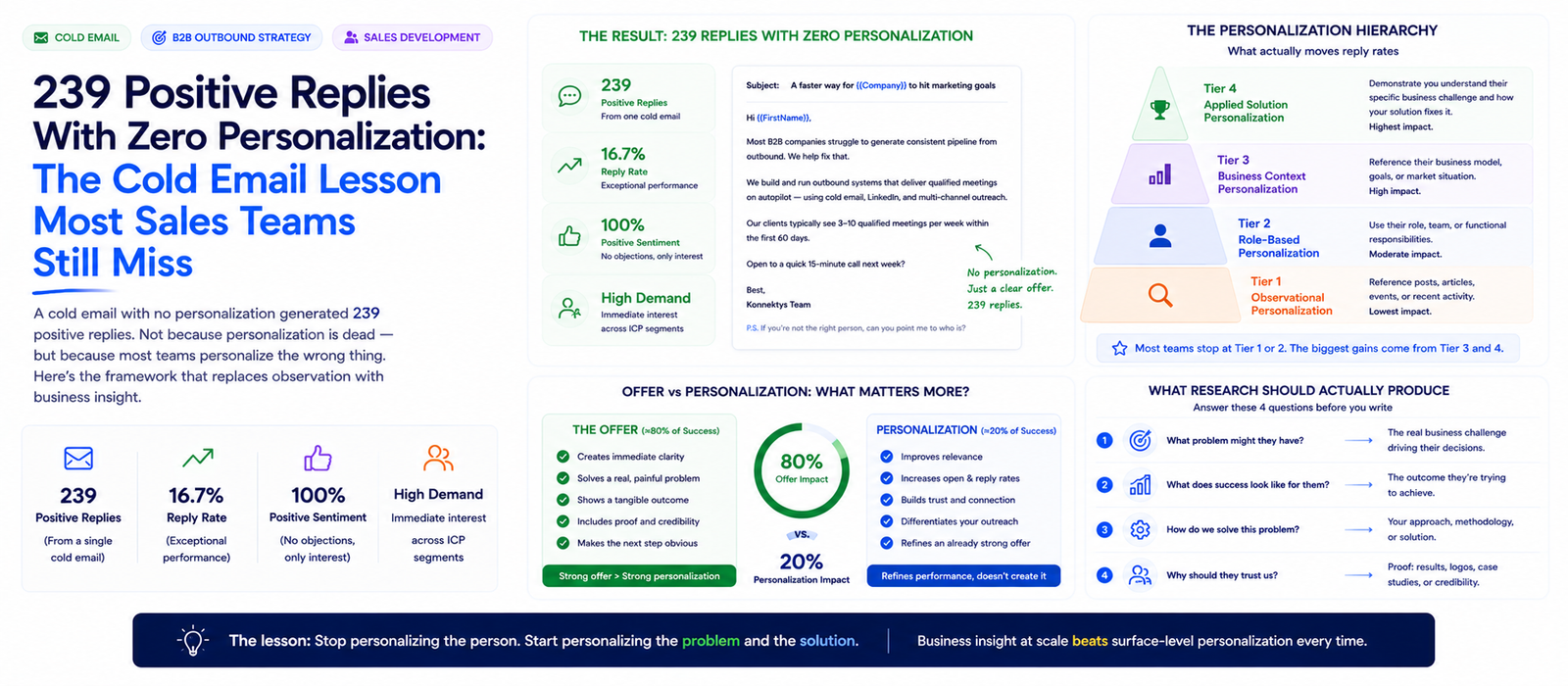
The deeper point: a gimmick CTA is what teams reach for when the offer underneath isn’t strong enough to stand on its own. If you find yourself needing a clever closing line to manufacture a reply, the problem is usually the offer, not the CTA — a dynamic we explore in why a cold email with zero personalization generated 239 replies.
Mistake 3: Mentioning Too Many Pain Points
Many cold emails try to solve every possible problem at once. The result usually reads like this:
“We help companies improve lead generation, increase conversion rates, reduce costs, streamline operations, improve retention, accelerate growth, and enhance customer experience.”
The sender hopes that one of these will resonate. Instead, the email becomes forgettable — because a message about everything is a message about nothing. The prospect can’t form a clear picture of what you actually do or why it matters to them specifically, so they form no picture at all and move on.
Seven Pain Points
Forces the prospect to figure out which one applies to them. Busy people don’t do that work — they delete.
One Pain Point
The prospect can immediately recognize it as theirs — or not. One problem, one impact, one conversation.
Strong cold emails focus on a single problem and explore it in enough depth to feel relevant. One pain point. One impact. One conversation. That’s usually enough — and it’s far more effective than a comprehensive list of capabilities.
The reason focus works is cognitive: a specific, single problem is something the prospect can immediately recognize as theirs or not theirs. A list of seven problems forces them to do the work of figuring out which one you’re actually talking about — and busy people don’t do that work. They delete.
Choosing the right single pain point for each prospect is where targeting precision matters. The pain point that lands is the one that’s actually live for that persona right now — which is why AI-powered lead research and signal data like hiring intent and technographic signals matter: they tell you which single problem is most relevant to each account, so you don’t have to hedge by listing all of them.
Mistake 4: Not Following Up
This remains one of the most expensive mistakes in outbound sales.
Many reps invest significant time researching prospects, crafting emails, and building lists — then send a single message and move on. The reality is simple: people are busy. They miss emails. They postpone responses. They forget. A lack of response rarely means a lack of interest.
60–80% of total replies in high-performing campaigns
come from follow-up touches — not the first send.
That’s why follow-ups are essential. A campaign that stops at one email is structurally abandoning most of its potential pipeline by default.
A thoughtful follow-up sequence increases visibility without increasing acquisition cost — you’ve already done the research and built the list; the follow-up is nearly free leverage on that investment. The key is adding value with each touch rather than repeatedly asking “just following up.” A strong sequence uses each touch for a different angle: a relevant case study, a reframed version of the problem, a standalone diagnostic question, a soft breakup email.
The operational challenge is consistency. Manual follow-up is the first thing to slip when a rep gets busy — which is exactly when the pipeline needs it most. This is where automation earns its place: cold email and LinkedIn outreach run as a managed, sequenced program ensures every prospect gets the full follow-up cadence, every time, regardless of how busy the team is. For the full sequence framework, see our analysis of why outbound campaigns fail, where follow-up structure is one of the seven core layers.
Mistake 5: Using Misleading Subject Lines
Subject lines like “URGENT,” “RE:,” “FWD:,” and “Quick question” are designed to create false curiosity or mimic an existing conversation. They may increase opens in some cases — but they damage trust the moment the prospect realizes they’ve been misled. And a prospect who feels manipulated in the subject line reads the email itself with their guard up, which suppresses the reply rate the open was supposed to improve.
The purpose of a subject line isn’t to trick someone into opening. It’s to accurately preview the value inside. Good subject lines are relevant, honest, and specific. They create genuine curiosity — tension or interest tied to something real — rather than fake urgency or fabricated familiarity.
Misleading
“RE: Our call”
“URGENT — action needed”
“FWD: introduction”
Honest & Specific
A subject tied to a real problem the prospect has — tension or curiosity the email actually delivers on.
Trust is difficult to earn and easy to lose. Sacrificing it for a marginally higher open rate is a bad trade, because the open is worthless if the email that follows has already lost the prospect’s goodwill before the first sentence.
This doesn’t mean subject lines should be boring. A subject line that creates real tension or genuine curiosity — tied to a problem the prospect actually has — outperforms both the misleading gimmick and the bland descriptor. Our Day 1 cadence guide breaks down how to write subject lines that earn the open honestly: tension or curiosity that the email actually delivers on.
Mistake 6: Sending the Same Message to Every Persona
One of the biggest mistakes in B2B outreach is assuming everyone inside a company cares about the same thing. They don’t.
A CFO evaluates success differently than a CRO. A VP of Marketing has different priorities than a Head of Operations. A founder thinks differently than a department manager. Yet many outbound campaigns send identical messaging to all of them — and identical messaging means that, at best, it’s relevant to one persona and noise to the rest.
Effective cold email starts with understanding the recipient’s role. For each persona, ask:
- •What are their KPIs?
- •What outcomes are they responsible for?
- •What problems keep them from achieving those outcomes?
- •What language do they use internally?
CFO Lens
Cost and risk — same offer, framed around budget efficiency and risk mitigation.
CRO Lens
Pipeline and growth — the exact same offer, framed around revenue impact and conversion lift.
The more your messaging aligns with the recipient’s specific role, the more relevant it becomes — and relevance drives responses. A message that speaks to a CFO’s cost-and-risk lens lands differently than the same message rewritten for a CRO’s pipeline-and-growth lens, even when you’re selling the exact same thing.
This requires persona-level segmentation built into the campaign from the start — which depends on knowing who’s actually in the buying group at each account, and what each of them cares about. Contact list building against a precise ICP identifies the right personas at each target account, and market research and TAM analysis maps the distinct priorities of each role so the messaging can be tailored rather than blasted uniformly. Persona-blind messaging is, at its root, a targeting problem before it’s a copy problem.
The Common Thread: Relevance Over Tactics
Look closely at all six mistakes and the same root cause appears in each:
1
Over-shortening sacrifices the relevance that justifies a reply
2
Gimmick CTAs substitute manipulation for genuine relevance
3
Too many pain points dilutes relevance into vagueness
4
No follow-up abandons relevance after a single touch
5
Misleading subject lines trade relevance for a hollow open
6
Persona-blind messaging ignores what makes a message relevant to each recipient
Every one of these is a failure of relevance dressed up as a tactical choice. And that’s the deeper lesson: cold email performance is not primarily a tactics problem. It’s a relevance problem. The teams chasing the next subject-line hack or AI prompt are optimizing the layer that matters least, while the relevance layer — targeting, focus, persona alignment, follow-up — sits unaddressed.
Fix relevance, and the tactics start mattering at the margins where they actually belong. Ignore relevance, and no tactic will save the campaign. This is the same hierarchy we lay out across the Konnektys content cluster — from why cold email gets replies to why most B2B companies miss 60% of their market: relevance is built upstream, and copy is the final, smallest refinement on top of it.
What Actually Improves Cold Email Performance
Cold email success isn’t about finding a secret tactic. It’s about avoiding the common mistakes — and the best-performing campaigns tend to follow a simple, unglamorous formula:
- •Focus on one specific problem rather than listing every capability
- •Speak directly to a particular persona rather than a generic “you”
- •Demonstrate credibility through specific results rather than vague claims
- •Follow up consistently with value-adding touches rather than “just checking in”
- •Be clear rather than clever — direct questions over psychological gimmicks
- •Prioritize relevance over volume — the right message to the right person beats more messages to anyone
None of these are revolutionary. But together they create a significant advantage, because the majority of competing campaigns are making at least three of the six mistakes simultaneously.
The infrastructure that supports this formula matters too. A perfectly relevant, persona-aligned, well-sequenced email still needs to reach the inbox — which depends on email infrastructure setup with proper domain rotation, and email finding and verification to keep bounce rates from degrading deliverability. As our domain rotation guide explains, even the best message is invisible if it lands in spam. Getting the messaging right and the infrastructure right are both required — neither compensates for the other.
FAQ: Cold Email Reply Rate Mistakes Answered
What is the most common cold email mistake?
+
Are short cold emails always better?
+
Do reverse-psychology CTAs like “would you be opposed to” work?
+
How many pain points should a cold email mention?
+
Should I use subject lines like “RE:” or “URGENT” to increase opens?
+
Why shouldn’t I send the same email to everyone at a company?
+
What actually improves cold email reply rates the most?
+
How long should a cold email follow-up sequence be?
+
Is cold email reply rate a copy problem or a targeting problem?
+
What’s a good cold email reply rate?
+
The Bottom Line
Most cold email campaigns fail because they’re too generic, too broad, or too focused on tactics instead of relevance.
Avoiding these six habits won’t instantly double your reply rates. But it will help you build stronger messaging, create more meaningful conversations, and outperform the majority of outbound campaigns competing for your prospect’s attention — most of which are making at least half of these mistakes right now.
In today’s crowded inbox, that’s often the entire difference between getting ignored and getting a response.
Be clear, not clever. Focused, not comprehensive. Persona-specific, not generic. And persistent, not one-and-done.
Relevance wins. It always has.
Konnektys Builds Outbound Systems Designed Around Relevance From the Ground Up
ICP and persona definition, AI-powered lead research, verified contact lists, email infrastructure, and fully managed cold email and LinkedIn outreach with persona-aligned messaging and consistent follow-up built in.
- Why Tactics Aren’t the Problem
- Mistake 1: Making Your Emails Extremely Short
- Mistake 2: Using Reverse-Psychology CTAs
- Mistake 3: Mentioning Too Many Pain Points
- Mistake 4: Not Following Up
- Mistake 5: Using Misleading Subject Lines
- Mistake 6: Sending the Same Message to Every Persona
- The Common Thread: Relevance Over Tactics
- What Actually Improves Cold Email Performance
- FAQ: Cold Email Reply Rate Mistakes Answered
- The Bottom Line
Want messaging built around relevance instead of these six habits? We’ll build the targeting, persona alignment, and follow-up sequences from the ground up.
Talk to Konnektys →Related articles
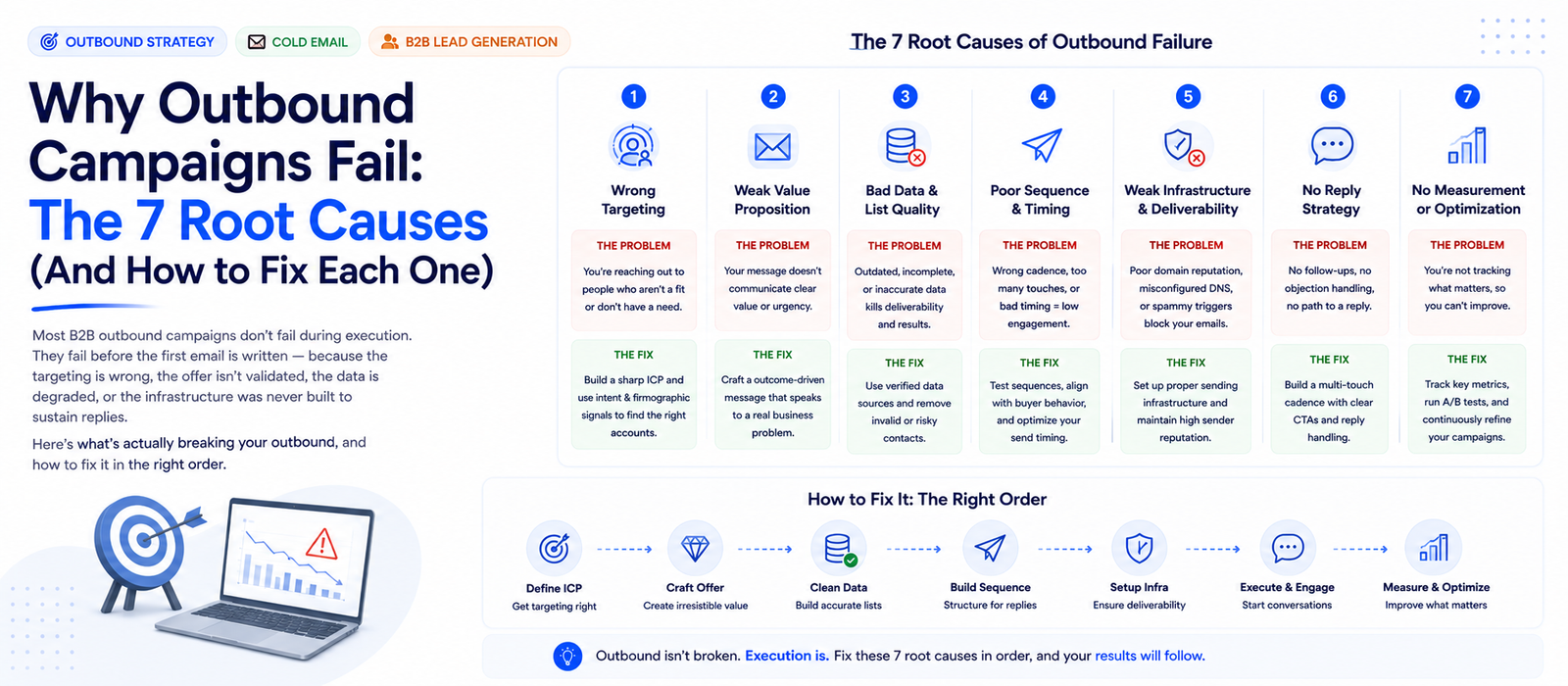
Why Outbound Campaigns Fail: The 7 Root Causes (And How to Fix Each One)
Konnektys Team · 7 Jun, 2026