
Stop Tweaking Clay Tables. Start Talking to Prospects.
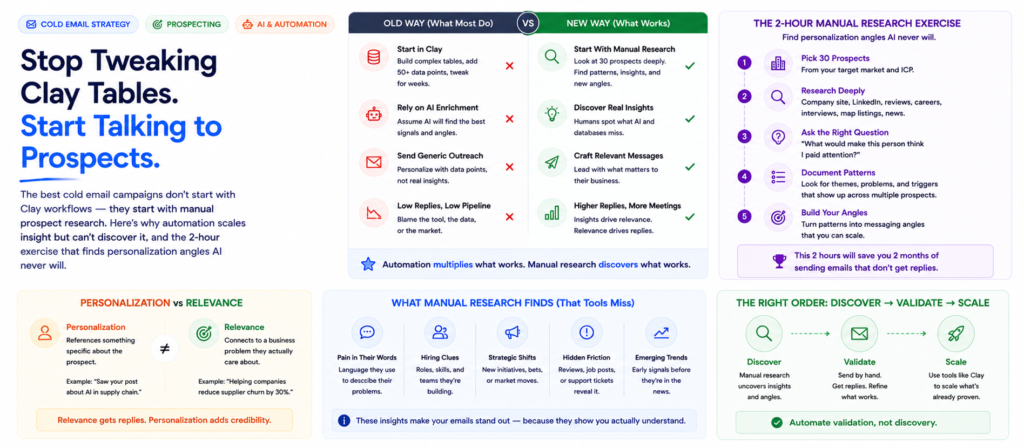
Clay and AI enrichment tools are genuinely powerful — but most teams use them to discover messaging instead of scaling messaging that already works. That’s backwards. No amount of automation compensates for irrelevant messaging, and the fastest way to learn what resonates isn’t a workflow. It’s manual outreach.
 Konnektys TeamMay 30, 2026 · 10 min read · Cold Email Strategy
The promise sounds irresistible. Feed prospect data into an AI-powered workflow. Generate hyper-personalized emails automatically. Book meetings at scale.
To be clear upfront: this is not an argument against Clay, or against AI enrichment tools generally. They’re powerful. Used correctly, they help outbound teams enrich data, automate research, and run campaigns at a scale that would otherwise require an army of SDRs.
But there’s a mistake we see companies make repeatedly: they use Clay to discover messaging instead of scaling messaging that already works.
That’s backwards. And it’s the difference between a tool that multiplies a proven strategy and a tool that helps you send more ineffective emails faster.
The Biggest Cold Email Mistake in 2026
Most teams spend weeks building workflows before they’ve proven what prospects actually care about.
They buy data. They build enrichment waterfalls. They write AI prompts. They test dozens of personalization variables. And then they wonder why reply rates stay stubbornly average.
The problem isn’t the technology. The problem is that no amount of automation can compensate for irrelevant messaging. Automation is a multiplier — and multiplying something that doesn’t work produces more of something that doesn’t work, at greater cost and greater speed.
Before you scale outreach, you need to understand what resonates with your market. And the fastest way to learn that is not through automation. It’s through manual outreach — sending emails by hand, watching what gets responses, and noticing the patterns that explain why.
This is the same diagnostic principle we describe in our breakdown of why outbound campaigns fail: teams optimize the visible, tunable layers (workflows, prompts, enrichment variables) while the actual problem — irrelevant messaging built on insight nobody validated — sits untouched underneath.
Clay Is a Scaling Tool, Not a Research Tool
The most successful cold email campaigns usually follow a specific sequence:
Identify a target audience — a defined segment with shared characteristics and shared problems
Research prospects manually — actually look at individual companies and people, not just database fields
Send emails by hand — write and send individually, watching what lands
Observe what gets responses — identify which angles, framings, and observations generate replies
Turn winning insights into repeatable systems — and only now, automate
Too many teams skip steps two through four entirely. They jump from “identify a target audience” straight to “build the Clay workflow,” assuming AI will discover the winning personalization for them.
It won’t — and the reason is structural. AI enrichment tools are working with the same publicly available information that every competitor’s tools are working with. They pull from the same data providers, scrape the same LinkedIn profiles, reference the same funding databases. If the underlying insight isn’t valuable, automating it doesn’t make it valuable. It just helps you send more emails built on the same generic foundation everyone else is using.
Automation amplifies whatever you feed it. Feed it a proven, validated messaging angle and it scales a winning strategy. Feed it an unvalidated guess and it scales a guess. The tool is identical in both cases. The input is everything.
Why the Best Personalization Comes From Pattern Recognition
One of the most overlooked advantages of manual prospecting is that it lets you notice patterns — patterns that don’t appear in a spreadsheet, aren’t available through standard enrichment providers, and that most competitors never discover precisely because they’re not looking manually.
A concrete example
While researching a particular niche, we noticed something unusual: many business owners in that segment had uploaded photos of the views from their offices to their public profiles and map listings.
That wasn’t a field available through any data provider. It wasn’t a standard enrichment variable. It wasn’t something an AI prompt would naturally prioritize, because it isn’t a structured data point — it’s a human observation about what these people apparently cared about.
But it was relevant. These business owners had invested real time and money choosing those office locations and then chose to show them off publicly. Mentioning the view wasn’t generic personalization — it was meaningful, because it referenced something the prospect had visibly invested in and was visibly proud of. And it generated better engagement than any standard enrichment variable did.
The insight didn’t come from automation. It came from paying attention — from a human looking at enough individual prospects to notice a recurring theme that no structured data field would ever surface.
This is the core limitation of automated personalization: it can only personalize on the variables it has access to, and those variables are, by definition, the same ones available to everyone. The angles that genuinely differentiate come from observation — and observation requires a human in the loop, at least at the discovery stage.
This doesn’t mean abandoning data. Once you know which signals matter, AI-powered lead research can systematise the collection of those signals across your entire ICP universe. The point is that the manual research comes first — it tells you what’s worth collecting at scale. The automation comes second, scaling the collection of an insight you’ve already validated.
Why Manual Research Still Matters
When you manually review a meaningful number of prospects, you begin to see recurring themes that never show up as a structured data field:
- •Similar challenges expressed in similar language across the segment
- •Similar achievements the segment tends to highlight publicly
- •Similar hiring patterns that signal similar operational priorities
- •Similar growth initiatives appearing across companies at the same stage
- •Similar customer complaints surfacing in reviews and public forums
- •Similar positioning strategies — and the gaps those strategies leave
Over time, these observations become messaging angles. The messaging angles become campaigns. The campaigns become systems. The manual work creates the foundation; the technology amplifies it.
This is why manual research isn’t a primitive precursor to “real” automated prospecting — it’s the irreplaceable discovery layer that makes the automated layer worth building. Skip it, and you’re automating without knowing what you’re automating toward.
There’s also a compounding benefit: the patterns you discover manually feed directly into how you define and refine your ICP. The recurring challenges, the shared positioning gaps, the common buying triggers — these are exactly the inputs that sharpen an ICP from a firmographic description into a genuine understanding of who buys and why. Market research and TAM analysis formalises this — turning the qualitative patterns you notice in manual research into a structured, scalable ICP definition.
The 2-Hour, 30-Prospect Research Exercise
If your current campaigns aren’t performing the way you’d like, here’s a specific exercise that consistently surfaces better personalization angles than any prompt-tuning session.
Choose 30 prospects from your target market.
Spend two hours doing nothing except research and writing.
For each prospect, visit:
- •The company website — especially the about page, the careers page, and any recent announcements
- •The prospect’s LinkedIn profile and recent posts
- •Press releases and news mentions
- •Customer reviews on G2, Capterra, Trustpilot, or industry-specific review sites
- •The careers page — what they’re hiring for reveals what they’re prioritizing
- •Podcasts and interviews the prospect or their leadership has appeared in
- •Google Maps listings — including, as the example above showed, the photos
- •Industry directories and community pages
As you go, look for details that reveal priorities, decisions, investments, or challenges. And ask the right question:
“What would actually make this person think I paid attention?”
Not: “What variable can I insert into an email template?”
The difference between those two questions is the difference between personalization that earns a reply and personalization that gets recognized as automated and deleted. The first question produces meaningful observation. The second produces the “Saw your recent LinkedIn post” opener that prospects have learned to ignore — a pattern we break down in detail in our analysis of why a cold email with zero personalization generated 239 replies.
By the end of two hours across 30 prospects, you’ll have noticed at least one or two recurring patterns — angles that apply not just to one prospect but to the whole segment. Those patterns are the raw material for a campaign. And critically, you discovered them by paying attention, not by configuring a workflow.
Relevance Beats Personalization
One of the biggest misconceptions in cold email is that personalization alone drives replies. It doesn’t. Relevance does.
You can reference a prospect’s hometown, their favourite sports team, or their most recent social post — and still get ignored. The reason is simple: none of those details necessarily connect to a business problem. They prove you looked. They don’t prove the email is worth responding to.
Personalization
References something specific about the prospect. Proves you looked. Doesn’t, by itself, prove the email is worth a reply.
Relevance
Connects to a business problem the prospect actually cares about. This is what drives the reply — personalization is the supporting evidence.
The best personalization supports a relevant business conversation. It provides context, demonstrates understanding, and earns attention — but relevance is what ultimately drives the response. Personalization is the supporting evidence; relevance is the argument.
This is why the office-view observation worked while a generic “congrats on the new office” would have fallen flat. The view reference connected to something the prospect cared about and led into a relevant conversation. A generic location reference would have just been another observation in a crowded inbox.
Manual research is what makes relevance possible — because relevance requires understanding the prospect’s actual business situation, and that understanding comes from looking, not from inserting a variable. The same principle drives our entire approach to signal-based cold email: the email that earns a reply is built on a real, specific observation that demonstrates genuine understanding — not a template with a personalization token dropped in.
Build the Insight First, Automate It Second
Once you’ve identified a pattern that consistently resonates — through manual research and hand-sent outreach — that’s exactly when automation becomes valuable. Now the tool is multiplying a proven strategy instead of guessing at one.
At that point, you can:
- •Build enrichment workflows that collect the specific signal you’ve validated matters
- •Create scalable research processes that surface the pattern across your full ICP universe
- •Use AI to generate first drafts based on the framework you’ve proven works
- •Automate segmentation so the right angle reaches the right cohort
- •Personalize at volume — because you now know what’s worth personalizing on
This is where platforms like Clay become genuinely powerful. The enrichment waterfall is collecting a variable you’ve validated. The AI prompt is generating copy based on a framework you’ve tested. The segmentation is splitting your list by criteria you’ve confirmed matter. Every part of the automation is amplifying a proven input rather than manufacturing an unproven one.
The order of operations is everything:
discovers the insight
validates the insight
scales the validated insight
Reversing steps one and three — automating first, validating later — is the mistake that leaves teams with sophisticated workflows producing average reply rates.
Where Automation Genuinely Earns Its Place
Manual research is irreplaceable at the discovery stage. But once the insight is validated, manual work becomes the bottleneck — and that’s exactly where automation and managed infrastructure earn their place. Specifically:
Scaling signal collection
The pattern you discovered manually — whether it’s a hiring trend, a tech stack signal, an office-view photo, or a positioning gap — needs to be collected across thousands of accounts, not thirty. AI-powered lead research and web and LinkedIn data scraping systematise the collection of the signal you’ve validated, across your entire ICP universe.
Building and verifying the list
A validated angle needs a clean, accurate list of accounts that match the segment it applies to. Contact list building constructs the list against your refined ICP, and email finding and verification ensures the contacts are deliverable — so the validated message reaches real inboxes rather than burning sender reputation on dead addresses.
Enriching with structured signal data
Once you know which signals matter, technographic data, hiring intent data, and events and buyer intent data can layer the structured versions of those signals onto every account at scale — adding the “why now” timing layer to the “why relevant” insight you discovered manually.
Executing at volume through proper infrastructure
A validated, scaled, signal-enriched campaign needs to actually reach the inbox. Email infrastructure setup — secondary domains, warmup, rotation — and cold email and LinkedIn outreach execution turn the validated insight into a running, scalable program. As our domain rotation guide explains, even a brilliantly relevant message dies in the spam folder if the sending infrastructure is degraded.
Keeping the CRM accurate as the program scales
CRM data enrichment and CRM cleaning ensure that the pipeline generated by the scaled campaign lands in an accurate, trackable system — so the conversion data feeds back into refining the insight further.
The full model: humans discover and validate the insight; automation and infrastructure scale it. End-to-end B2B lead generation runs this complete loop — combining the human discovery layer with the automated scaling layer, so the insight you validate doesn’t stay trapped at 30 prospects.
FAQ: Manual Research vs Automated Prospecting Answered
Should I use manual prospect research or automated tools like Clay?
+
Why doesn’t AI find the best personalization angles?
+
What is the difference between personalization and relevance in cold email?
+
How do I find personalization angles that actually improve reply rates?
+
When should I start automating my cold email outreach?
+
Is Clay worth using for cold email?
+
How many prospects do I need to research manually before automating?
+
Does manual research scale?
+
What signals should I look for in manual prospect research?
+
How does manual research connect to ICP definition?
+
The Bottom Line
Most outbound teams don’t have an automation problem. They have an insight problem.
Before spending another week optimizing prompts, building enrichment waterfalls, or testing data providers, spend time with prospects. Research them manually. Write emails yourself. Look for the patterns that no structured data field will ever surface. Identify what genuinely matters to your audience.
Then use automation to scale those discoveries — at which point tools like Clay become exactly as powerful as they promise to be.
The best cold email campaigns aren’t built by software. They’re built by understanding people first, and using software to reach more of them.
Discover the insight manually. Validate it by hand. Then automate the scale. In that order.
We Find What Resonates With Your Market — Then Build the System to Scale It
Konnektys combines the human discovery layer with the automated scaling layer — from AI-powered lead research and signal-based data enrichment to verified contact lists, email infrastructure, and fully managed cold email and LinkedIn outreach.
- The Biggest Cold Email Mistake in 2026
- Clay Is a Scaling Tool, Not a Research Tool
- Why the Best Personalization Comes From Pattern Recognition
- Why Manual Research Still Matters
- The 2-Hour, 30-Prospect Research Exercise
- Relevance Beats Personalization
- Build the Insight First, Automate It Second
- Where Automation Genuinely Earns Its Place
- FAQ: Manual Research vs Automated Prospecting Answered
- The Bottom Line
Already validated what resonates? We’ll build the system to scale it — enrichment, lists, infrastructure, and outreach.
Talk to Konnektys →Share this article:
Related articles
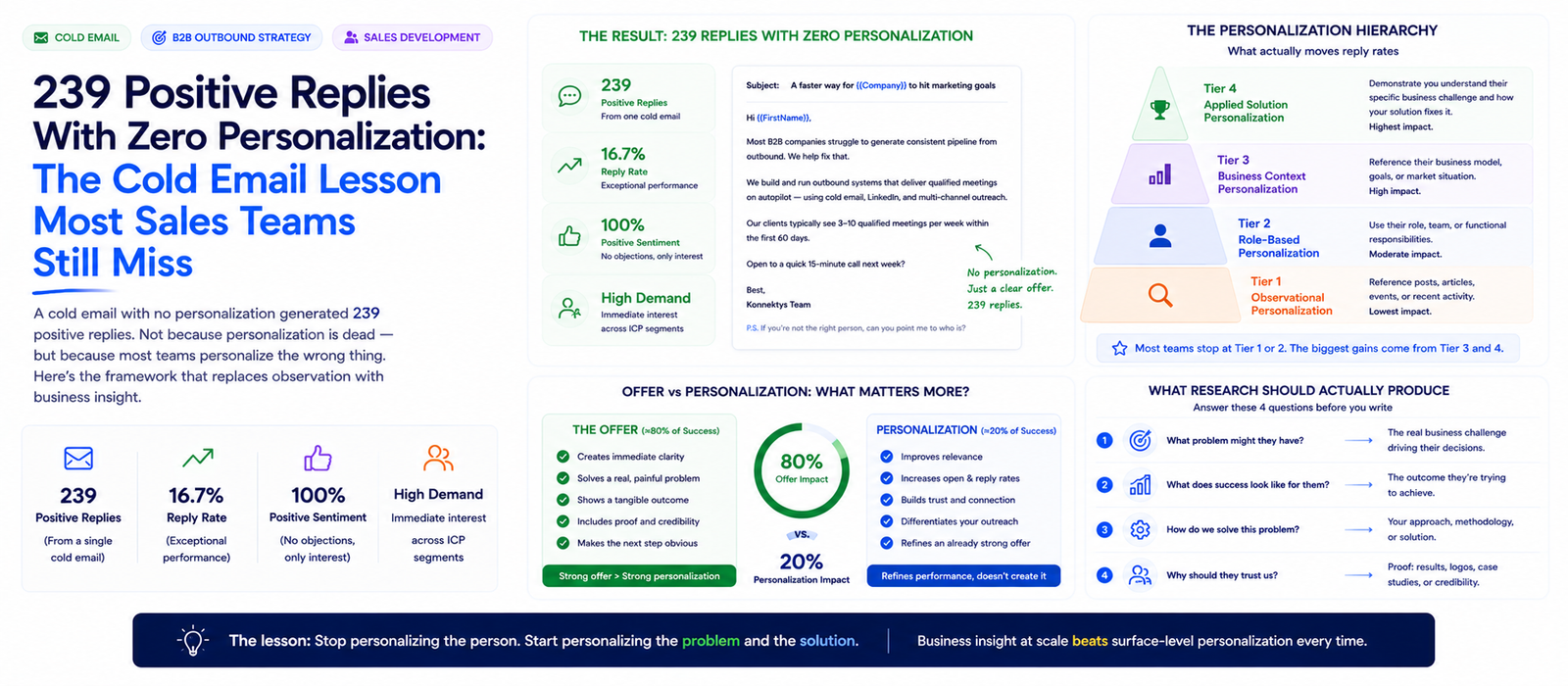
239 Positive Replies With Zero Personalization: The Cold Email Lesson Most Sales Teams Still Miss
Konnektys Team · 8 Jun, 2026
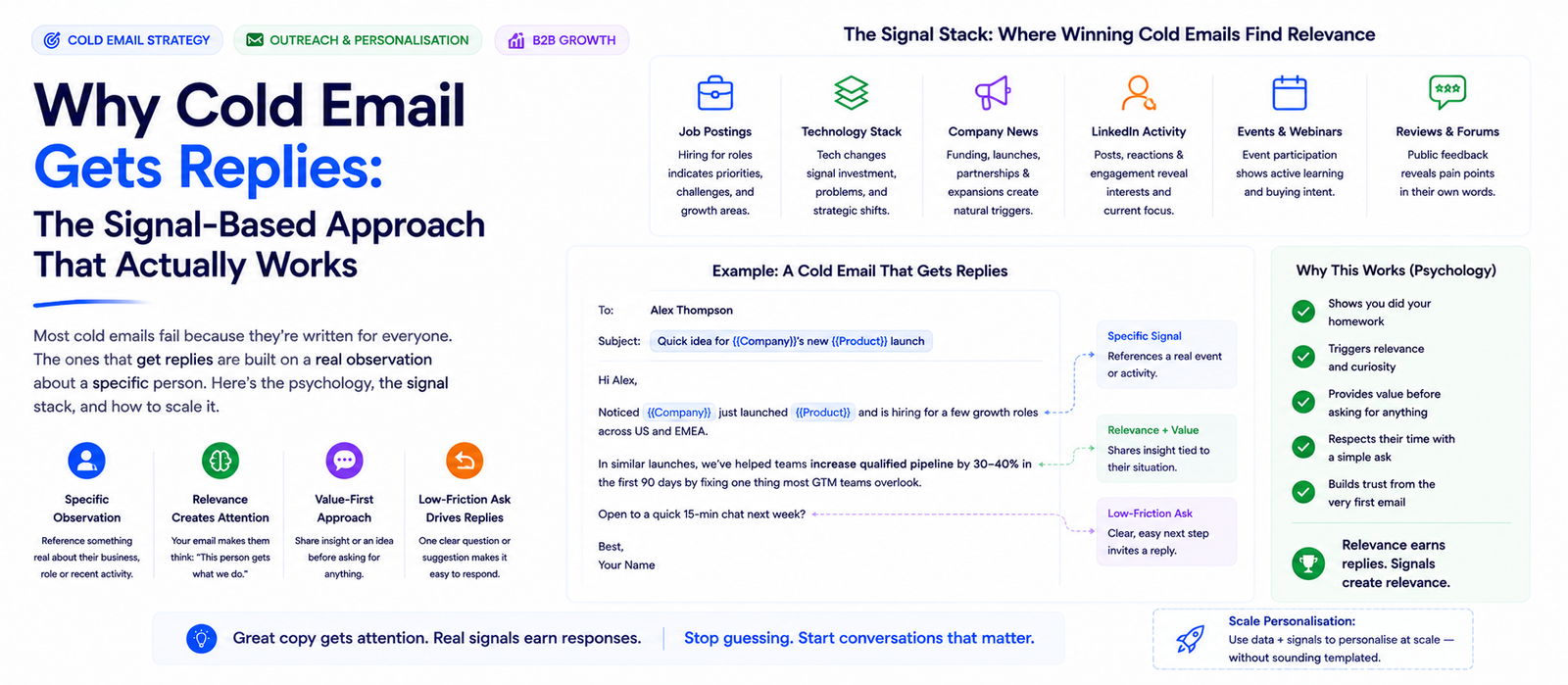
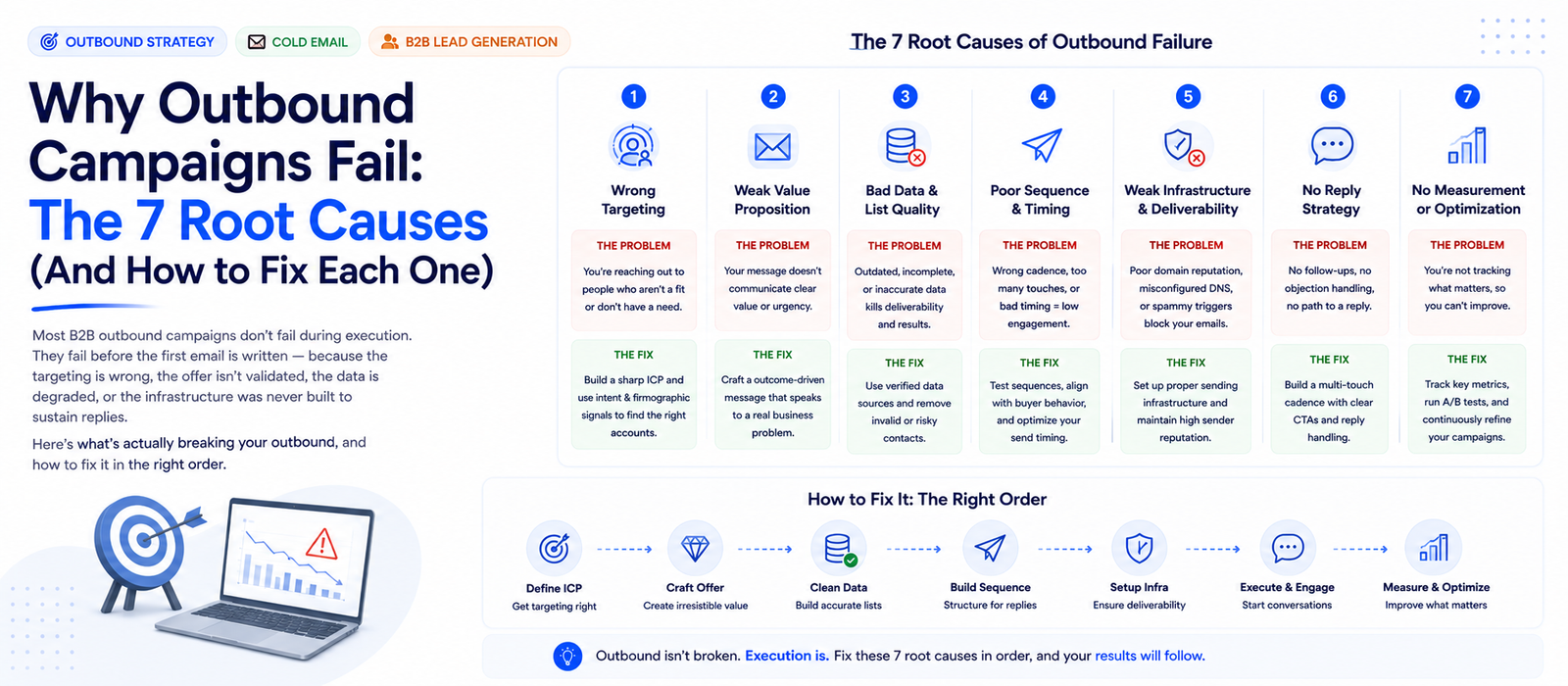
Why Outbound Campaigns Fail: The 7 Root Causes (And How to Fix Each One)
Konnektys Team · 7 Jun, 2026