
Why Most Cold Email Advice Is Outdated: The New B2B Outbound Playbook for 2026
If you’ve been running cold outreach for more than a couple of years, you’ve probably noticed something uncomfortable: the tactics that used to fill your calendar with meetings now barely move the needle. The teams getting real results in 2026 aren’t sending more emails — they’re running a fundamentally different playbook, built around relevance, account context, and operational discipline rather than copywriting tricks.
 Konnektys TeamJune 15, 2026 · 18 min read · Cold Email Strategy
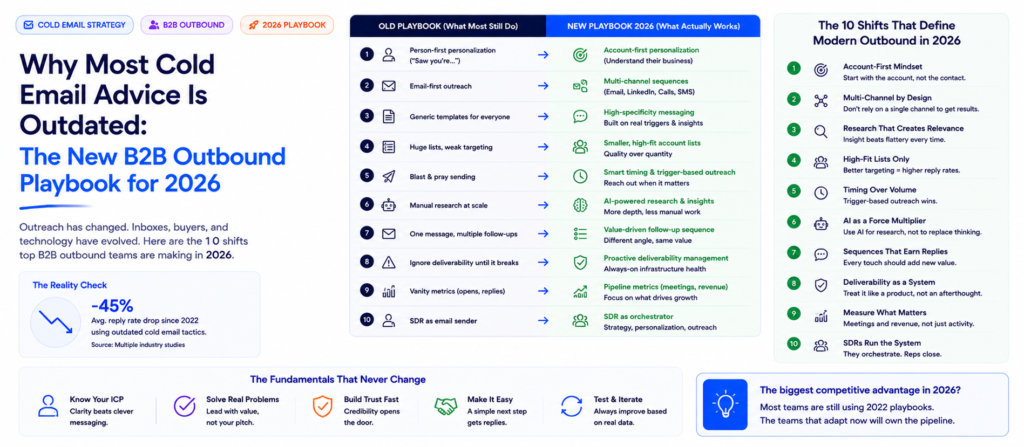
If you’ve been running cold outreach for more than a couple of years, you’ve probably noticed something uncomfortable: the tactics that used to fill your calendar with meetings now barely move the needle. Reply rates have flattened. “Personalized” emails get ignored. AI-written openers feel obviously AI-written. And the advice circulating on LinkedIn, in cold email courses, and inside most SDR playbooks still describes a world that doesn’t exist anymore.
Here’s the uncomfortable truth: most cold email advice is outdated, not because the underlying psychology of buyers has changed, but because everyone is now using the same tactics. When every rep mentions a LinkedIn post, every AI tool writes “congrats on the growth,” and every list is built the same generic way, the entire category of advice collapses into noise. Buyers have learned to filter it out instantly. If your numbers have been sliding for no obvious reason, it’s worth reading why cold email results suddenly drop — the cause is rarely the email itself.
The teams getting real results in 2026 aren’t sending more emails. They’re not investing in flashier subject lines or more aggressive sequences. They’re running a fundamentally different playbook — one built around relevance, account context, and operational discipline rather than copywriting tricks.
This guide breaks down exactly what that new playbook looks like across ten critical areas of outbound: personalization, AI personalization, prospecting, data, email openers, follow-ups, deliverability, AI usage, outreach strategy, and competitive advantage. For each area, we’ll look at the old approach that no longer works, the new approach that does, and how to put it into practice — whether you’re running outbound in-house or evaluating an end-to-end B2B lead generation partner to do it for you.
The Real Problem: It’s Not Personalization, It’s Relevance
Before diving into the ten shifts, it’s worth pausing on the single insight that ties all of them together.
Most inboxes aren’t suffering from a lack of personalization. They’re suffering from a lack of relevance.
This distinction matters enormously, because the last few years of cold email advice have been almost entirely focused on personalization — adding a prospect’s name, referencing their company, mentioning something they posted, or having AI generate a custom opening line for every contact. All of that effort goes into making the email feel tailored.
But personalization and relevance are not the same thing. Personalization is about the surface: does this email mention something specific to me? Relevance is about substance: does this email give me a reason to care, right now, about what’s being offered?
Personalization gets attention.
Relevance earns the reply.
A prospect can tell within seconds whether an email reflects genuine understanding of their situation or just a mail-merge field populated with their first name and company. Mentioning a recent LinkedIn post they made might trigger a flicker of recognition, but if the actual offer has nothing to do with a real problem they’re facing, that recognition evaporates immediately. The email gets the same fate as every other “personalized” template: archived, ignored, or marked as spam.
Relevance, on the other hand, doesn’t require flattery or surface-level mentions at all. A relevant email can open with zero personalization and still land harder than the most “customized” template, because it demonstrates that the sender understands something true and timely about the recipient’s business — a trigger event, a structural pattern, a problem that’s likely showing up right now based on the account’s situation. One real campaign proved this in dramatic fashion — see how cold email personalization generated 239 replies with almost no personalization for the full breakdown.
This is the foundation for everything else in the new playbook: shift the effort from making emails look personal to making the underlying targeting and research actually relevant.
The 10 Shifts Defining Modern Cold Email
Let’s walk through each of the ten areas where the old playbook and the new playbook diverge — and why the new approach consistently outperforms the old one.
1. Personalization: From Surface Mentions to Real Reasons
Old Approach
Mentioning a LinkedIn post.
New Approach
Explaining why you’re reaching out.
For years, “personalization” in cold email meant referencing something public about the prospect — a recent post, a job change, a company announcement. The logic was simple: if a prospect sees that you noticed something about them specifically, they’ll feel seen and be more likely to engage.
The problem is that this tactic became so common that it stopped signaling anything. Prospects now recognize “I saw your recent post about X” as a templated opener, often generated by AI scanning their LinkedIn activity in bulk. Rather than feeling flattered, many recipients feel slightly unsettled — it reads as surveillance rather than connection.
The new approach skips the flattery entirely and gets straight to the point: a clear, specific explanation of why you’re reaching out now, to this person, about this topic. This might reference a trigger event (a new hire, a funding round, a tech stack change, a job posting that signals a gap), but the framing is different. Instead of “I noticed you posted about X, which made me think of Y,” the new approach says, “I’m reaching out because [specific situation] usually means [specific challenge], and we help companies in that exact spot with [specific outcome].”
This shift requires more upfront research — you need actual insight into the account’s situation, not just a scrollable social feed. But it produces emails that read as legitimate business outreach rather than a personalization template with the blanks filled in. The 239-reply campaign referenced above is a good real-world example: the gains came from relevance, not from cosmetic personalization.
2. AI Personalization: From Flattery to Relevance Triggers
Old Approach
“Congrats on the growth.”
New Approach
A reason to care right now.
As AI tools became standard in outbound, “AI personalization” became shorthand for generating a unique opening line for every prospect — usually some variation of congratulating them on something. Congrats on the new role. Congrats on the funding round. Congrats on the product launch. Congrats on the headcount growth.
This tactic worked for a brief window because it was novel. AI made it cheap to generate thousands of these lines, and for a while, the slight customization was enough to stand out. But once every outbound team adopted the same approach, “congrats on the growth” became as recognizable — and as ignorable — as “hope you’re doing well.”
There’s also a deeper issue: a congratulatory opener doesn’t actually give the recipient a reason to care about what comes next. It’s social lubrication, not substance. The prospect reads “congrats on the Series B” and waits for the inevitable pivot — “…and that’s why you should buy our software.” The congratulation becomes a tell that a sales pitch is coming, which primes the reader to skim and discard.
The new approach uses AI differently: not to generate a flattering line, but to identify why this moment matters to the prospect’s business. A funding round isn’t just something to congratulate — it’s a signal that the company is likely to scale its team, adopt new tools, or restructure its go-to-market motion. The email that wins doesn’t say “congrats on the funding” — it says something closer to “companies that just raised a Series B usually hit [specific operational bottleneck] within the next two quarters, and here’s how we help with that.”
This is the difference between AI personalization that performs for the sender (look how customized this is!) and AI personalization that performs for the recipient (this is relevant to what I’m dealing with). This shift is also why AI prospecting in 2026 looks so different from how teams used AI just a year or two ago.
3. Prospecting: From Giant Lists to Tiny Converting Lists
Old Approach
Building giant lead lists.
New Approach
Building tiny lists that actually convert.
For most of the last decade, outbound success was framed as a numbers game. More contacts in the database meant more emails sent, which meant more replies, which meant more meetings. Tools that could scrape tens of thousands of contacts in an afternoon were marketed as the key to scaling pipeline.
The math behind this approach made sense when deliverability was forgiving, inboxes were less crowded, and recipients hadn’t yet been trained to ignore generic outreach. None of those conditions hold anymore. A list of 50,000 loosely-matched contacts, blasted with generic messaging, now produces poor reply rates, high spam complaints, and damaged sender reputation — actively making future outreach harder.
The new approach inverts the equation. Instead of asking “how many contacts can we add to this list,” the question becomes “which 100–300 accounts are showing real signals that they need what we offer, right now?” These tiny lists are built using a combination of AI-powered lead research, hiring intent data, events and buyer intent data, and technographic data append — layering in signals like recent technology adoption, hiring patterns, funding events, and behavioral intent to identify accounts where the timing genuinely lines up with the offer.
A tiny list built this way will almost always outperform
a giant list on every meaningful metric.
A tiny list built this way will almost always outperform a giant list on every meaningful metric: reply rate, meeting-booked rate, and ultimately, revenue per email sent. It also protects your sending infrastructure — fewer, better-targeted emails generate fewer spam complaints and better engagement signals, which compounds into better deliverability over time.
This doesn’t mean volume doesn’t matter at all — it means volume should scale after you’ve proven the targeting and messaging works on a small, focused segment, not before. If you’re sourcing prospects directly from LinkedIn, the same principle applies — see how to find high-intent B2B leads on LinkedIn in two minutes for a practical example of small-but-relevant list building in action.
4. Data: From Verified Emails Only to Verified Emails Plus Direct Mobiles
Old Approach
Verified emails only.
New Approach
Verified emails plus direct mobile numbers.
Email verification became a standard part of outbound hygiene for good reason — sending to invalid addresses tanks deliverability and wastes sending capacity. For years, “verified email” was treated as the gold standard for prospect data quality.
But as inboxes become more crowded and filtered, email alone is an increasingly fragile channel. A prospect might have an inbox flooded with hundreds of outbound emails per week, most of which get auto-filtered or batch-deleted without ever being opened. Even a perfectly relevant, well-timed email can simply never be seen.
The new data standard pairs verified email addresses with direct mobile numbers, enabling a multichannel approach. This doesn’t mean cold-calling everyone — it means having the option to follow up via SMS, a brief call, or a messaging app when email engagement stalls. A prospect who hasn’t opened three emails might respond instantly to a short, relevant text message, simply because it arrives through a less saturated channel.
This is also where data enrichment matters: contact list building and email finding and verification, combined with phone number finding, gives outbound teams the flexibility to meet prospects wherever they’re most likely to respond — rather than betting everything on a single, increasingly noisy channel. For contacts where the only data point you start with is a personal email address, reverse email appending can fill in the rest of the profile, including a verified work email and mobile number.
5. Email Openers: From “Hope You’re Doing Well” to Observation-Led Openers
Old Approach
“Hope you’re doing well.”
New Approach
Starting with an observation.
This might be the single most universally despised opener in cold email history, and yet it persists — likely because it’s safe, generic, and easy to template at scale. The problem is that “hope you’re doing well” (and its many cousins: “hope this email finds you well,” “I wanted to reach out because…”) signals to the reader, within the first three words, that this is a templated email with nothing specific to say.
It also wastes the most valuable real estate in the email — the first line, which often determines whether the rest gets read at all, especially on mobile where preview text shows only a fragment of the message.
The new approach replaces this throwaway opener with an observation — a specific, factual statement about the recipient’s business, market, or situation that immediately signals relevance. This doesn’t have to be personal in the “I saw your post” sense; it can be about the account, the industry, or a pattern the sender has noticed across similar companies. For a deeper look at what actually makes someone stop and respond, see why cold email gets replies.
There’s a great example of this principle applied to product announcement emails, which often suffer from the same generic-opener problem. Consider two versions of the same announcement:
Before
“Hope you’re doing well. We just launched [Feature].”
After
“Your export just got 3x faster. Here’s what changed.”
Both sentences describe the exact same announcement. But the first one leads with the sender’s news — “we launched something” — while the second leads with the reader’s outcome — “this directly affects something you do.” The first line of any cold email or outreach message should answer the reader’s unconscious question — “why does this matter to me?” — before asking for anything in return.
This principle applies whether you’re sending a cold email, a follow-up, or a product update: describe the user’s result, not the sender’s update.
6. Follow-Ups: From Repetition to New Angles
Old Approach
Sending the same email five times.
New Approach
Introducing a new angle each touch.
The “just follow up, persistence pays off” advice isn’t wrong — most replies in outbound sequences come from follow-ups, not the first email. But the way most sequences implement persistence is broken: the same message, slightly reworded, sent again and again with phrases like “just bumping this to the top of your inbox” or “wanted to make sure you saw my last email.”
From the recipient’s perspective, this is exhausting. If the first email didn’t generate interest, repeating it — even politely — doesn’t address why it didn’t land. Maybe the angle wasn’t relevant. Maybe the timing was off. Maybe the value proposition didn’t match what they actually care about. Sending the same message again does nothing to fix any of those issues; it just adds to the pile of ignored emails.
The new approach treats each follow-up as an opportunity to introduce a genuinely new angle — not just new wording, but a different reason to care. A sequence might progress like this:
1
Touch 1: A specific observation about the account and a relevant reason to reach out.
2
Touch 2: A different angle — perhaps a related problem, a relevant case study, or a different stakeholder’s pain point.
3
Touch 3: Social proof — how a similar company solved a related challenge.
4
Touch 4: Urgency or timing — why this matters now versus later.
5
Touch 5 (break-up): A low-pressure close that gives the prospect an easy way to say “not now” while leaving the door open.
Each message stands on its own as a reason to respond, rather than functioning as a reminder of a message that already failed to resonate. The first touch carries an outsized amount of weight for how the rest of the sequence performs — see why day 1 makes or breaks your cold email cadence for why getting the opening touch right shapes everything that follows. This is also where AI-assisted research pays off across a sequence — different angles often require different pieces of account intelligence, which is exactly the kind of repetitive research work that AI tools can support efficiently when paired with human review.
7. Deliverability: From More Inboxes to Better Inboxes
Old Approach
More inboxes.
New Approach
Better inboxes.
When deliverability issues started affecting reply rates, the common fix was to scale up sending infrastructure — more domains, more inboxes, more daily sending capacity, spread across a growing fleet of mailboxes to keep per-inbox volume low and avoid spam triggers.
This approach can work in the short term, but it has a structural flaw: it treats deliverability as a volume problem rather than a reputation problem. Adding more inboxes without addressing the underlying signals that hurt sender reputation — low engagement rates, poor list targeting, weak domain warmup — just spreads the same reputation problems across a larger footprint. Eventually, providers like Google and Microsoft catch up, and entire domains or IP ranges get flagged. This is exactly why your cold email domain has a 90-day shelf life if it isn’t managed properly — reputation decays on a clock whether or not you’re paying attention to it.
The new approach focuses on building better inboxes rather than more of them: proper domain separation from the primary company domain, disciplined warmup periods before any cold sending begins, authentication protocols configured correctly (SPF, DKIM, DMARC), and — critically — sending only to lists that are likely to generate positive engagement (opens, replies, and forwards) rather than spam complaints or unsubscribes.
This connects directly back to the prospecting shift above: tiny, well-targeted lists naturally produce better engagement signals, which protects inbox reputation, which in turn means each inbox can sustain higher-quality sending over a longer period. Email infrastructure setup done correctly isn’t about brute-force scaling — it’s about building a sending foundation that stays healthy as volume grows, because the targeting and messaging earn positive engagement rather than triggering spam filters. If your numbers have dropped suddenly without an obvious cause, infrastructure decay is one of the first things worth checking — see why cold email results suddenly drop.
8. AI: From Email Writer to Opportunity Finder
Old Approach
AI writes the email.
New Approach
AI finds the opportunity.
The most visible use of AI in outbound over the past few years has been generative writing — tools that take a prospect’s name, company, and a few data points, and produce a fully written cold email. This promised massive scale: thousands of “personalized” emails generated and sent with minimal human involvement.
The result, predictably, is that AI-written cold emails have developed their own recognizable patterns — certain phrasings, structures, and transitions that experienced recipients (and increasingly, spam filters) can identify almost instantly. When everyone’s AI is trained on similar data and prompted in similar ways, the outputs converge, and “AI personalization” becomes just another flavor of generic template.
There’s a useful re-framing here: AI is a lot more useful when it finds the timing, not when it tries to sound clever. The real bottleneck in outbound isn’t writing — most experienced reps and marketers can write a solid email once they know what to say. The bottleneck is knowing what to say, which requires research: identifying which accounts are in-market, what’s changed recently, what problems they’re likely facing, and why now is the right moment to reach out.
This is where AI adds genuine leverage. AI excels at processing large amounts of unstructured information — news, job postings, technology stack changes, hiring patterns, social activity, funding databases — and surfacing patterns a human researcher would take hours to find manually. Tools that pull structured signals from web and LinkedIn data scraping are a good example of this — they feed AI the raw material it needs to do useful research rather than asking it to invent personalization from nothing. Once that research is done and a relevant angle is identified, writing the actual message becomes straightforward, and a human can write it (or heavily edit an AI draft) so it sounds like it came from a person, not a system.
Let AI do the homework.
Let a human write the note.
Research is where AI adds leverage; the final message still needs a human voice — both for authenticity and because subtle tone, phrasing, and judgment calls are exactly the things AI tends to get wrong in ways that are easy for recipients to spot. This is the core idea behind why content-assisted outbound is replacing traditional prospecting — the research layer is being rebuilt around AI, while the human layer stays firmly in place for the actual conversation.
9. Outreach Strategy: From Email-First to Account-First
Old Approach
Email-first.
New Approach
Account-first.
This shift might be the most structurally important of all ten, because it changes the order of operations for how outbound campaigns get built.
In an email-first approach, the starting point is the message: a team writes (or generates) an email template, then goes looking for contacts to send it to. The targeting is often broad — “VP of Sales at companies with 50–500 employees” — because the email itself isn’t built around any specific account context. It’s a one-size-fits-most message, and the list-building exercise is essentially “find people who fit this loose profile.”
Account-first outbound flips this order entirely. The starting point is research into a specific account: what does this company do, what’s changed recently, what’s their tech stack, what are they likely hiring for, what problems does their situation suggest they’re facing? Only after that research is done does the team think about messaging — and at that point, the message often writes itself, because the research has already surfaced the angle, the timing, and the relevant pain point. Building this kind of account universe usually starts with proper market research and TAM analysis, since you can’t prioritize accounts you haven’t mapped in the first place — and most companies are working from a far smaller map than they realize. In fact, most B2B companies miss 60% of their market simply because their account universe was never properly defined.
This isn’t just a philosophical preference — it changes everything downstream in practical terms. Once you understand the account, the email almost writes itself, and the timing gets easier to read. A rep who understands that an account just adopted a new CRM, is hiring three SDRs, and recently expanded into a new region doesn’t need a clever template — they have three concrete, relevant reasons to reach out, and they can pick whichever one is most timely.
Account-first outbound also naturally produces the tiny, converting lists discussed earlier, the relevance-driven personalization discussed in the first shift, and the AI-as-researcher workflow discussed above. It’s the organizing principle that ties the entire new playbook together — which is why it’s worth treating as the foundation of any outbound program redesign, whether that’s an internal rebuild or working with a partner on end-to-end B2B lead generation.
10. Competitive Advantage: From Better Copywriters to Better Operators
Old Approach
Better copywriters.
New Approach
Better operators.
For a long time, the differentiator between outbound teams that performed well and those that didn’t was framed almost entirely in terms of writing skill — the team with the sharpest copywriters, the best subject lines, the most clever hooks, would win.
Writing quality still matters, but it’s no longer the differentiator it once was. When AI tools can generate competent copy in seconds, and when every team has access to similar templates, frameworks, and “proven” email structures, copywriting skill stops being a meaningful edge. Everyone’s emails start to look — and read — roughly the same.
The new differentiator is operational: teams that can consistently execute the research, targeting, data hygiene, infrastructure management, and multi-angle follow-up processes described throughout this guide will outperform teams that simply have better writers working from worse inputs. A brilliantly written email sent to the wrong account, with stale data, from a poorly warmed-up domain, with no follow-up strategy, will still underperform a merely competent email sent to the right account, with accurate contact data, from a well-maintained sending infrastructure, with a thoughtful follow-up sequence.
If you compare top-performing outbound teams to average ones, the difference usually isn’t the email. It’s everything that happens before the email — the research, the targeting, the data, the infrastructure, and the process discipline to execute all of it consistently, week after week, across hundreds of accounts. This is also why so many outbound campaigns underperform despite good intentions — for a closer look at where things typically break down, see the real reason outbound campaigns fail.
This is the core argument for “better operators” over “better copywriters”: operational excellence across the entire outbound system compounds, while copywriting cleverness alone does not. And operational excellence isn’t something you bolt on after hiring — it’s something you design before you scale the team. As outlined in build the system before you hire the person, the sequence matters: get the research, data, and infrastructure right first, then bring in the people to run it.
Putting the Playbook Into Practice: A Step-by-Step Approach
Understanding the ten shifts is one thing — implementing them is another. Here’s a practical sequence for rebuilding an outbound program around the new playbook.
Define your account-first criteria.
Before writing a single email, identify the signals that indicate an account is worth pursuing — funding events, hiring patterns, technology adoption, leadership changes, or industry-specific triggers relevant to your offer. Market research and TAM analysis is the foundation everything else builds on.
Build a small, signal-rich list.
Rather than pulling thousands of contacts that loosely match a job title and company size, build a focused list of accounts that match your trigger criteria. This typically combines technographic data append, hiring intent data, events and buyer intent data, and AI-powered lead research to surface accounts in-market right now.
Layer in multichannel contact data.
For each account, identify the right contacts and enrich them with both verified email addresses and direct mobile numbers, so your team has flexibility across channels.
Research before writing.
For each account, use AI tools to surface the relevant trigger, pattern, or pain point — then have a human translate that research into a message. The first line should describe an observation about the account’s situation, not a greeting.
Build a multi-angle follow-up sequence.
Map out 4–5 touches, each with a distinct angle — different pain points, proof points, or framings — rather than repeating the same message.
Audit your sending infrastructure.
Make sure domains are properly separated, warmed up, and authenticated. Match your sending volume to what your list size and engagement rates can sustainably support — see email infrastructure setup for a structured approach.
Keep your data clean on an ongoing basis.
Contact data decays quickly — job changes, company moves, and email changes happen constantly. Ongoing CRM data enrichment and CRM cleaning keep your targeting accurate over time, rather than letting list quality erode campaign after campaign.
Treat LinkedIn as a parallel channel, not a backup.
Pair email outreach with cold email and LinkedIn outreach for the same accounts — a multichannel touch from someone who has also engaged with relevant content on LinkedIn reinforces relevance far more than email alone.
Each of these steps reinforces the others. Better targeting produces better engagement, which protects deliverability, which means your messages actually reach inboxes, which means your research-driven angles actually get seen. The new playbook isn’t a single tactic — it’s a system where every component supports the next.
How Konnektys Builds the New Playbook for Clients
Everything described in this guide reflects how outbound actually works when it’s done well in 2026 — and it’s also, structurally, how Konnektys approaches client engagements. Rather than treating “cold email” as a standalone deliverable, Konnektys builds the full account-first system: research, targeting, data, infrastructure, and messaging, working together as one process rather than disconnected tasks handed off between tools and vendors.
End-to-end B2B lead generation
For teams that want this entire system built and run end-to-end — a fully managed outbound engine covering everything from account identification through to booked meetings.
Modernizing an existing program
For teams that already have outbound infrastructure but want to modernize their approach, the ideas in AI prospecting in 2026 and why content-assisted outbound is replacing traditional prospecting outline exactly how to integrate AI research tools into an existing process the right way — as a research layer, not a writing shortcut.
Market research and TAM analysis
For teams that suspect their current outbound motion has structural issues — list quality, deliverability, targeting, or process gaps — this identifies exactly where the old playbook is still embedded in current processes, and maps out what needs to change to align with the account-first, relevance-driven approach outlined here.
The throughline across all of these services is the same principle this entire guide is built on: the email is rarely the problem. The system that produces the email — research, targeting, data, infrastructure, and follow-up — is where the real difference between average and exceptional outbound performance is made.
FAQ: Cold Email Strategy 2026 Answered
Why doesn’t cold email work like it used to?
+
What is account-first outbound?
+
Should AI write my cold emails?
+
Is it better to build a giant prospect list or a small targeted one?
+
How many follow-up emails should be in a cold email sequence?
+
What’s the difference between verified emails and verified emails plus direct mobiles?
+
How does Konnektys help with modern cold email outreach?
+
The Bottom Line
The cold email advice that built careers in 2020 isn’t wrong because the principles behind it were flawed — it’s outdated because everyone adopted it at the same time, and saturation killed its effectiveness. Personalization, AI-generated openers, large lead lists, more sending inboxes, and copywriting-led strategies all worked when they were differentiators. They stopped working the moment they became the default.
The new playbook isn’t really “new” in a mysterious sense — it’s a return to a simpler idea: reach out to the right accounts, at the right time, with a real reason, through the right channel, and follow up with genuinely new value each time. What’s changed is the infrastructure available to execute that idea at scale — AI for research, better data for multichannel contact, and more disciplined approaches to deliverability and list-building.
Teams that rebuild their outbound motion around these ten shifts — relevance over personalization, tiny converting lists over giant ones, account-first over email-first, and operational excellence over copywriting flair — are the ones seeing outbound work again in 2026, while teams still running the old playbook wonder why their numbers keep declining.
If your current outbound process is built on the old rules, the good news is that the fix isn’t a new email template. It’s a new system. And if you’re still weighing whether outbound deserves a place in your growth strategy at all, is cold email right for your business is a useful starting point — and if your team has tried cold email before without results, the issue was very likely the system around the email, not the email itself.
Looking to Rebuild Your Outbound Program Around the Account-First Approach?
Explore end-to-end B2B lead generation, get your account universe mapped with market research and TAM analysis, or start with AI-powered lead research to build your first account-first list.
- The Real Problem: It’s Not Personalization, It’s Relevance
- The 10 Shifts Defining Modern Cold Email
- 1. Personalization: Surface Mentions → Real Reasons
- 2. AI Personalization: Flattery → Relevance Triggers
- 3. Prospecting: Giant Lists → Tiny Converting Lists
- 4. Data: Verified Emails → Emails + Direct Mobiles
- 5. Email Openers: “Hope You’re Well” → Observation-Led
- 6. Follow-Ups: Repetition → New Angles
- 7. Deliverability: More Inboxes → Better Inboxes
- 8. AI: Email Writer → Opportunity Finder
- 9. Outreach Strategy: Email-First → Account-First
- 10. Competitive Advantage: Copywriters → Operators
- Putting the Playbook Into Practice
- How Konnektys Builds the New Playbook
- FAQ
- The Bottom Line
Ready to rebuild your outbound around account-first, relevance-driven outreach? We’ll build or audit the whole system — research, data, infrastructure, and messaging.
Talk to Konnektys →Share this article:
Related articles
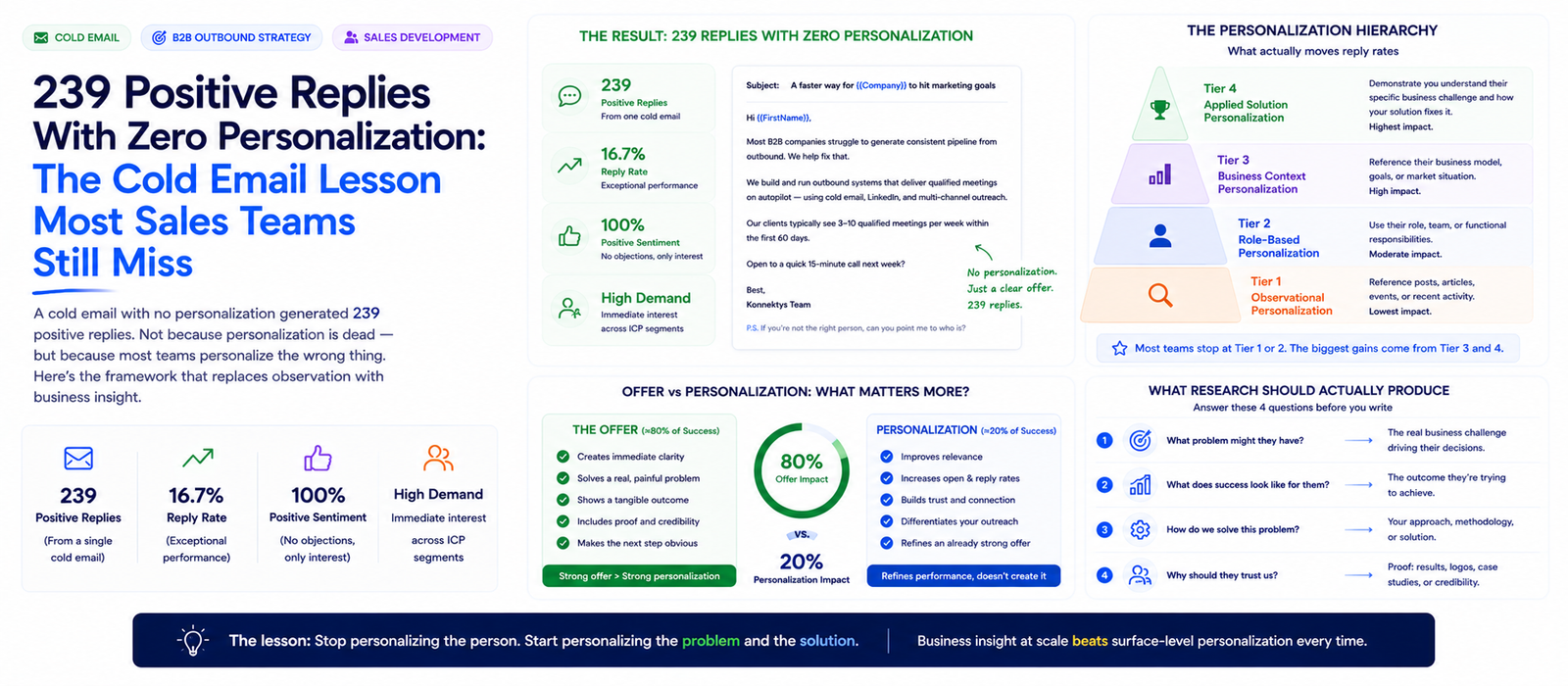
239 Positive Replies With Zero Personalization: The Cold Email Lesson Most Sales Teams Still Miss
Konnektys Team · 8 Jun, 2026
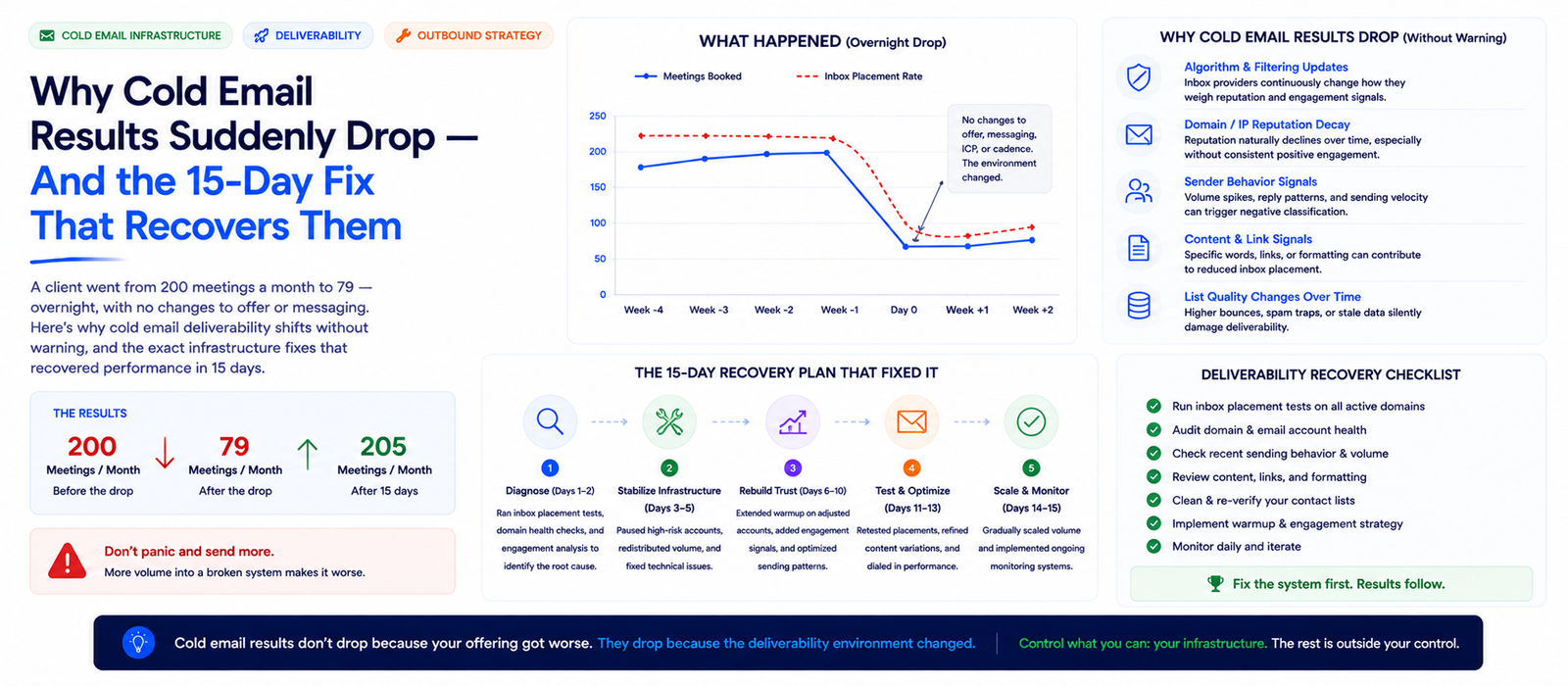
Why Cold Email Results Suddenly Drop — And the 15-Day Fix That Recovers Them
Konnektys Team · 9 Jun, 2026
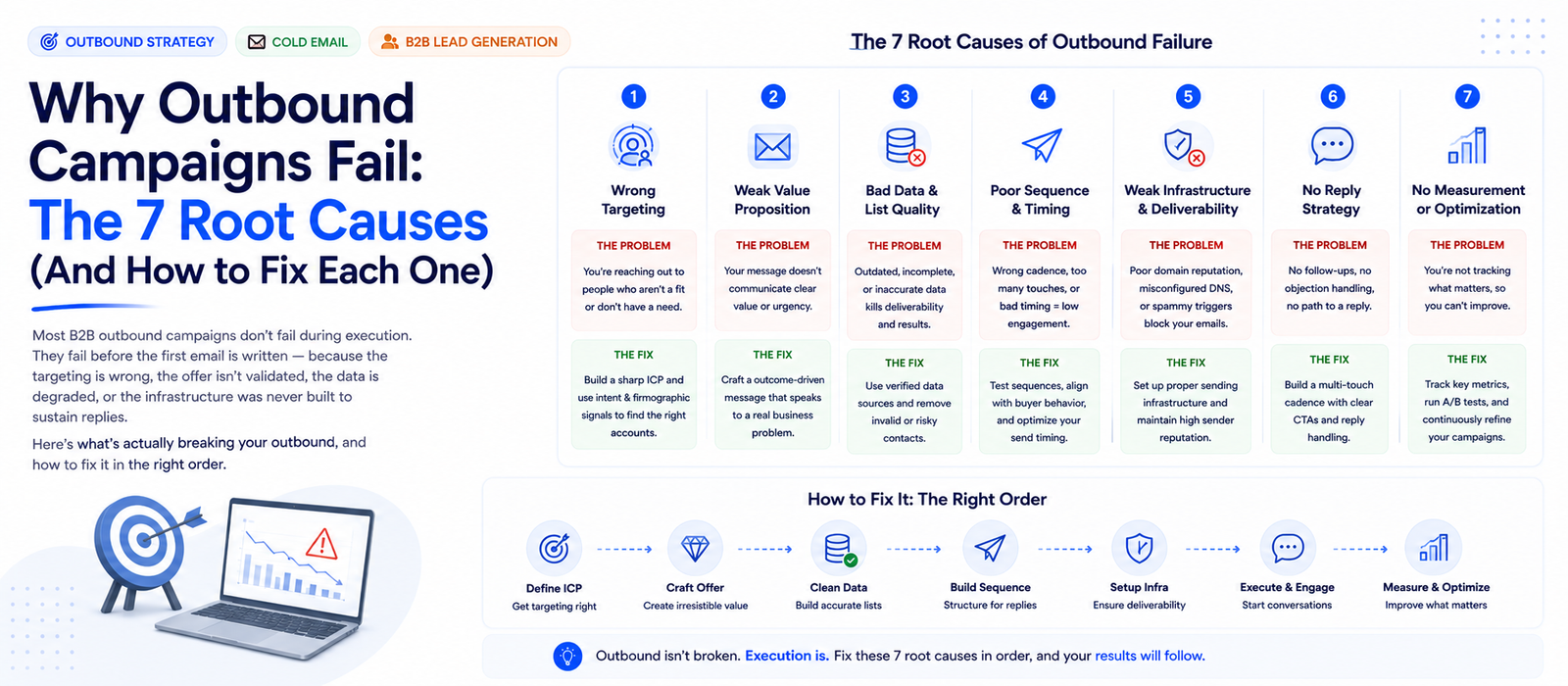
Why Outbound Campaigns Fail: The 7 Root Causes (And How to Fix Each One)
Konnektys Team · 7 Jun, 2026