Content-Assisted Outbound: Why It’s Replacing Traditional B2B Prospecting
Outbound is not dead. Cold email is not dead. But standalone outbound — sequences fired at strangers with no prior context — is getting weaker every quarter. The companies generating the most pipeline in 2026 are running a fundamentally different model: content-assisted outbound, where content builds familiarity and trust before the first outreach ever arrives.
 Konnektys TeamMay 19, 2026 · 8 min read
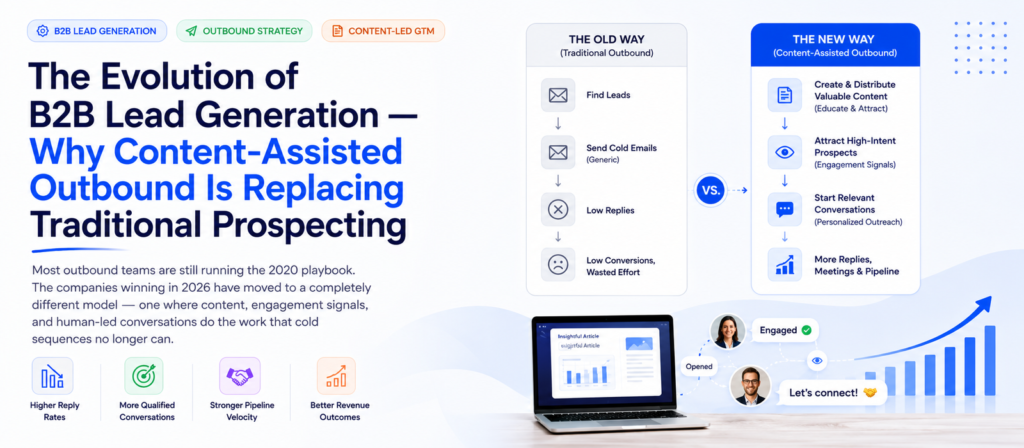
Lead generation has changed more in the last five years than it did in the previous fifteen. But most outbound teams are still running the 2020 playbook: buy a list, send cold emails, add AI-generated personalisation, launch sequences, hope for replies.
The problem is not that outbound stopped working. It’s that buyers changed — and the outbound model didn’t change with them.
Today’s B2B prospects are overloaded with outreach. They receive 80–120 cold emails per week, the majority recognisably templated within the first two sentences. They’re immune to AI-generated compliments about their LinkedIn profile. They’re sceptical of sequences that reference a funding round announced three months ago as though it’s news. And they are far more likely to trust and respond to someone they’ve already encountered than to a name appearing in their inbox for the first time with a pitch.
That last point — the trust gap between known and unknown — is the structural reason why content-assisted outbound is replacing traditional prospecting. It doesn’t abandon outbound. It changes the conditions under which outbound arrives.
Why Traditional Outbound Is Losing Ground
The decline in traditional outbound effectiveness is not a subjective impression. It has specific, structural causes that compound each other.
Data commoditisation
Every SDR team has access to the same databases — Apollo, ZoomInfo, Crunchbase, LinkedIn Sales Navigator. The companies at the top of every standard firmographic filter are the same companies on every competitor’s list. They are receiving the highest outbound volume from the most senders simultaneously. The “best” accounts in any market are also the most contested, the most fatigued, and the least likely to engage with another cold sequence.
Template recognition
Buyers have learned to identify cold outreach in the first sentence. “I noticed your company just raised a Series B” — templated. “I came across your profile and was impressed by your work in [industry]” — AI-generated. “Quick question about your outbound process” — transparent hook. The patterns that worked in 2020 are now the patterns that signal “delete immediately” in 2026.
Inbox competition
The volume of B2B cold outreach has grown dramatically, while inbox attention has remained flat. More outreach competing for the same limited attention produces a structural supply-demand imbalance. Open rates, reply rates, and meeting rates have declined across the board — not because individual campaigns got worse, but because the environment got louder.
Trust deficit
A cold email from a stranger asking for 15 minutes of time is a request that requires trust — trust that the meeting will be valuable, that the sender understands the prospect’s situation, that the time investment will produce something worth the opportunity cost. Without prior context, that trust doesn’t exist. And without trust, even a perfectly relevant email faces friction that warm outreach doesn’t.
These four causes are structural. They cannot be fixed by better subject lines, shorter emails, more personalisation, or different sequencing cadence. They require a different model — one where trust and context exist before the outbound arrives.
Era 1: The List-Based Playbook (2017–2020)
The classic outbound motion ran on a simple process: buy or scrape lead lists, send mass cold emails, run follow-up sequences, and optimise for volume. It worked extremely well at the time for specific, structural reasons. Inbox competition was relatively low. Most B2B companies hadn’t built outbound functions yet. Personalisation standards were minimal — “Hi {{FirstName}}, saw you work at {{Company}}” was genuinely sufficient to generate meetings. At open rates of 40–50% and reply rates of 8–12%, the volume game produced consistent pipeline without requiring precision targeting or sophisticated messaging.
What Worked
Low inbox competition, novel data access, minimal personalisation threshold. Volume alone produced consistent pipeline.
What Collapsed It
Every competitor adopted the same approach simultaneously. The competitive moat — exclusive data access — evaporated as every tool democratised it. Prospects became desensitised.
Era 2: The Automation-Led Stack (2020–2025)
LinkedIn scraping, data enrichment, AI-generated personalisation, multi-channel sequencing, buying intent signals, and workflow automation transformed what outbound teams could do at scale. Teams could target specific personas with ICP-matched filters, layer buying signals onto firmographic criteria, personalise messaging using AI referencing LinkedIn posts or product announcements, and trigger outreach based on engagement behaviour. Modern outbound stacks combining Sales Navigator, Clay, Apollo, Instantly, Lemlist, and AI enrichment represented a real leap in operational capability.
What Worked
Dramatically improved targeting, efficiency, and personalisation precision. Signal-based prioritisation. Operational sophistication.
What Collapsed It
Most outreach was still fundamentally cold. The trust problem didn’t improve. By 2025, trust had become the primary bottleneck on outbound performance — no operational sophistication substitutes for familiarity.
Why AI Personalisation Alone Isn’t Enough
This deserves its own section because it’s the most common misconception driving outbound strategy in 2026.
The dangerous assumption isn’t that personalisation is bad. It’s that better personalisation is the solution to declining reply rates.
What Prospects See Now
- ❌First line referencing their “recent post about pipeline velocity” — manufactured
- ❌Opener about “your impressive career trajectory” — template variable
- ❌Funding announcement from 3 months ago referenced as breaking news — late
- ❌AI-written compliment that reads as AI-written
What Content-Assisted Changes
- ✅Prospect already knows your name from content they’ve engaged with
- ✅First line references something they actually did — liked, commented, shared
- ✅Outreach arrives while the topic is live in their mind, not at a random interval
- ✅Sender recognition replaces stranger suspicion
Personalisation improves a cold message. Context makes the outreach not cold in the first place. One is a copy tactic. The other is a structural shift in how pipeline is built.
What Content-Assisted Outbound Actually Is
Content-assisted outbound is a GTM model where content serves as the warm-up layer for targeted outreach. It is not “post on LinkedIn and wait for inbound.” It is not “become an influencer.” It is not content marketing repackaged with a new name.
It is a systematic process with four components working together:
Publish insights, frameworks, and operational content on the channels your buyers use
Monitor who engages — likes, comments, shares, profile views, repeat visits
Identify which engagers match ICP criteria and are showing buying signals
Initiate outreach with context the prospect already recognises
The conversation is no longer fully cold. The prospect has seen your name. They’ve read your thinking. They may have engaged with your content publicly. When your outreach arrives, it feels like a continuation of a relationship that already exists in nascent form — not an interruption from a stranger asking for time.
Reply rates
Increase because the trust barrier has been partially lowered before the first touch
Meeting quality
Improves because content-engaged prospects arrive pre-qualified and context-aware
Sales velocity
Accelerates because the relationship has a head start — credibility already established
Deliverability
Improves because recognised senders get fewer spam reports — a positive feedback loop
The Four Pillars — In Operational Detail
The content layer is not about creating demand. It’s about creating recognisability — so that when your outreach arrives, the prospect’s brain registers familiarity rather than suspicion.
What to publish
Insights, frameworks, operational breakdowns, case study narratives, market observations. Not product marketing.
Where to publish
Channels your buyers actually use. For most B2B markets: LinkedIn primary. Consistency matters more than channel.
Quality standard
Good enough that someone who reads it remembers your name next week. One great post per week beats five generic ones.
For a breakdown of what makes written outreach resonate, see our guide on why cold email gets replies — the same signal-based personalisation principles apply to content-warmed outreach.
The content doesn’t just build trust. It generates data — specifically, engagement signals that tell you which prospects are paying attention before you’ve said a word to them directly.
Signals worth monitoring:
- 👍LinkedIn post engagement — likes, comments, shares — especially repeat engagement from the same person across multiple posts
- 👀Profile views — a prospect who views your profile after engaging with your content is exhibiting explicit curiosity
- 💌Newsletter opens and clicks — email engagement at the individual level
- 🎙Webinar or event attendance — high-investment engagement indicating active interest
- 📥Content downloads — willingness to enter a relationship
- 🌐Website visits from target accounts — especially repeat visits to services or case study pages
Web and LinkedIn data scraping monitors these signals systematically — tracking which individuals and companies are interacting repeatedly. When combined with hiring intent, buyer intent data, and technographic signals, the combined prioritisation is structurally stronger than either signal type alone.
Traditional outbound runs on a schedule: “send 500 emails Monday morning.” Content-assisted outbound runs on signals: “these 12 people engaged with content, match ICP criteria, and showed buying intent this week.”
The shift from schedule-based to signal-based outreach is the single biggest operational lever on reply rates — because it replaces random timing with contextual timing.
The Signal-Triggered Workflow
Content published on the regular cadence
Engagement signals captured and matched against ICP criteria
Engaged ICP-matching contacts routed to the outreach queue
Outreach triggered within 24–48 hours of the engagement signal
First line references the specific content: “Saw your comment on my post about [topic] — wanted to share something specific to your situation”
Anyone can scrape leads, enrich data, generate sequences, and automate follow-ups. Very few companies can build trust, create authority, and hold meaningful conversations at the right moment.
Research, enrichment, signal monitoring, queue prioritisation
Infrastructure — sending domains, warmup, sequencing, follow-ups
Conversations that build relationships and close deals
As our first SDR hire guide explains, the human element only works when the system around it is already built. SDRs operating within a content-assisted framework with signal-prioritised queues perform at a fundamentally different level from SDRs working cold lists.
The Content-to-Signal Pipeline: How It Works in Practice
Here is the end-to-end workflow, from content creation through to booked meeting, for a B2B company running content-assisted outbound.
Build the content foundation (Week 1–4)
Publish 2–3 times per week on LinkedIn (or your primary channel). Each post addresses a specific problem, framework, or insight relevant to your ICP. Not product marketing — thinking. The goal is that a VP of Sales or Head of RevOps sees your name repeatedly and associates it with useful, relevant content.
Monitor engagement (Ongoing)
Track who engages — not just total counts, but individual-level data. Which people liked, commented, or shared? Which match ICP criteria? Which show repeat engagement across multiple posts? Manual for small teams; systematic through web and LinkedIn data scraping at scale.
Cross-reference engagement with buying signals
An ICP-matching prospect who engaged with your content is interesting. The same prospect whose company just announced funding, hired a new VP of Sales, or posted for three SDR roles simultaneously is urgently interesting. AI-powered lead research layers buying signals onto engagement data to produce a prioritised queue ranked by both familiarity and intent.
Find verified outreach channels
For top-priority accounts — content engagement + buying signals — find verified email addresses and phone numbers. Email finding and verification ensures deliverable contact data. Phone number finding enables direct outreach for highest-priority accounts.
Execute signal-specific, context-aware outreach
The outreach references both content context and buying signal. “Saw your comment on my post about outbound ramp times — noticed your team is also hiring three SDRs right now. Wanted to share how we’ve helped similar teams avoid the system problem I described in that post.” Cold email and LinkedIn outreach executes this coordinated multi-channel sequence, with email infrastructure ensuring the warm message lands in the primary inbox.
CRM and pipeline tracking
Every engaged prospect enters the CRM with their engagement history, signal data, and outreach record. CRM data enrichment keeps records current. CRM cleaning removes noise. Pipeline from content-assisted outbound is cleaner by default because the top-of-funnel filter is more precise.
The Infrastructure That Makes Content-Assisted Outbound Possible
Content-assisted outbound has more moving parts than traditional cold outreach. Here’s what the infrastructure requires:
Content infrastructure
Consistent publishing cadence, content calendar aligned to ICP pain points, distribution strategy. For most B2B teams: LinkedIn primary, email newsletter and blog as secondary distribution.
Signal monitoring infrastructure
System capturing individual-level engagement data matched against ICP criteria. Manual via LinkedIn notifications at low volume; automation via scraping tools and CRM integration at scale.
Data infrastructure
TAM definition, verified contact lists, technographic data, and signal enrichment from hiring intent and event data.
Sending infrastructure
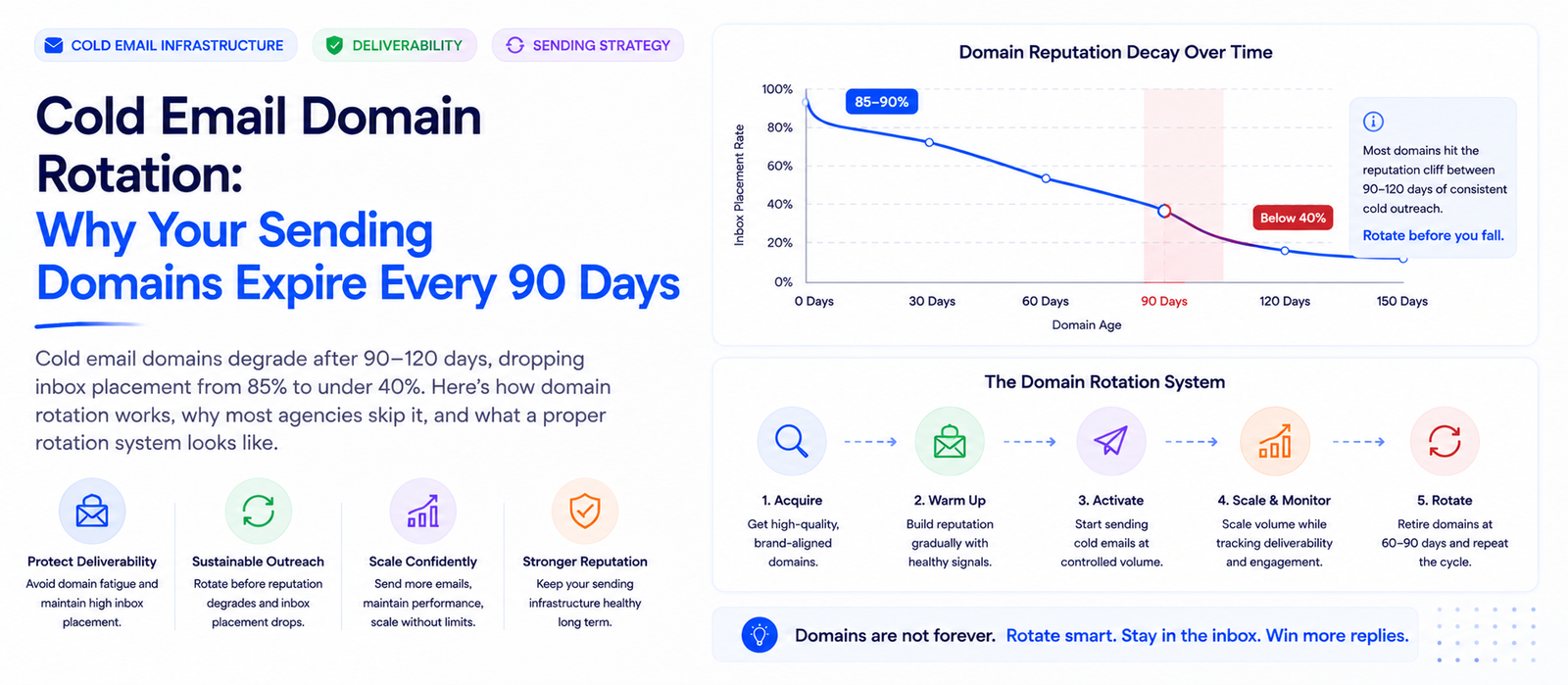
Secondary sending domains, warmup, domain rotation on a 90-day schedule, inbox placement monitoring. Content-assisted outbound produces warmer messages — but those messages still need to reach the primary inbox. Email infrastructure setup handles this layer.
Even warm outreach dies in the spam folder if the sending infrastructure is degraded. See our guide on why cold email stops working for the full technical breakdown of why infrastructure matters even for warm outreach.
What Changes in Outreach When the Prospect Already Knows You
The practical differences between cold outreach and content-warmed outreach are measurable across every metric:
| Metric | Cold Outreach | Content-Assisted Outreach |
|---|---|---|
| Open rates | Sender name triggers suspicion; subject line carries all the weight | Sender recognition triggers familiarity; opens on name alone |
| Reply rates | Full trust barrier in place; requires overcoming stranger friction | 2–3× higher; trust barrier partially lowered before first touch |
| Meeting quality | First 10 minutes on “tell me about your company” | Conversation starts at a higher level; credibility pre-established |
| Sales velocity | Evaluation starts from zero trust | Head start: prospect already has a framework for your value |
| Deliverability | Unknown senders get more spam flags | Recognised senders get fewer flags; positive reputation cycle |
Common Mistakes When Implementing Content-Assisted Outbound
Mistake 1
Treating content as a separate function from outbound
Content-assisted outbound works because content and outreach are connected. When content is produced by a marketing team and outreach run by a sales team with no data exchange between them, engagement signals never reach the people doing the outreach. The content generates trust that nobody capitalises on.
Mistake 2
Publishing product content instead of insight content
Product announcements, feature updates, and company news build awareness with existing customers — not trust with prospects. The content that warms outbound demonstrates understanding of the prospect’s world: frameworks for solving problems they face, operational breakdowns they can learn from, perspectives on challenges they’re navigating.
Mistake 3
Waiting for inbound instead of using engagement as an outreach trigger
Content-assisted outbound is not inbound marketing. The content creates the signal. The outbound converts it. Publishing and waiting is not the model — publishing, monitoring, and proactively reaching out to engaged ICP-matching prospects is.
Mistake 4
Neglecting the infrastructure
Warm messages still need to reach the inbox. Domain rotation, list verification, CRM hygiene, and sending infrastructure are just as important in content-assisted outbound as in traditional cold outreach. The message is warmer. The infrastructure requirements are identical. As covered in our outbound failure analysis, infrastructure failure undermines every other investment.
Mistake 5
Expecting content to replace outbound instead of enhancing it
Content alone doesn’t fill pipeline. It creates conditions where outreach converts at a higher rate. The outbound still needs to happen — the sequence, the follow-up, the reply handling, the meeting booking, the CRM tracking. Content-assisted outbound is outbound with better inputs, not a replacement for outbound.
FAQ: Content-Assisted Outbound Questions Answered
What is content-assisted outbound?
+
How is content-assisted outbound different from inbound marketing?
+
Does content-assisted outbound replace cold email?
+
What kind of content works best for warming outbound?
+
How often do I need to publish content for this to work?
+
What engagement signals should I track?
+
How do I connect content engagement data to my outbound workflow?
+
Can content-assisted outbound work for small B2B teams?
+
How long does it take for content-assisted outbound to produce pipeline?
+
What infrastructure does content-assisted outbound require beyond traditional cold outreach?
+
The Model That Wins in 2026 and Beyond
Standalone cold outbound is not dying. It is becoming a commodity — a baseline capability that every competitor has, running on the same data, through the same tools, with the same AI-generated personalisation. When the commodity is available to everyone, it cannot be a competitive advantage for anyone.
Content-assisted outbound builds competitive advantage by adding a layer that competitors cannot easily replicate: trust built through consistent, useful content that makes outreach feel warm when it arrives.
Still Running Pure Cold Sequences
- →Reply rates declining
- →Acquisition costs rising
- →Pipeline quality eroding
- →Blaming copy, cadence, and tools for a structural problem
Running Content-Assisted Outbound
- →More pipeline with less outreach volume
- →Each touchpoint carries more trust and context
- →Warm conditions before outreach begins
- →Competitive moat competitors cannot easily replicate
The fix is not better cold outreach. It’s warmer conditions before outreach begins.
Build the Content-Assisted Outbound Engine
Konnektys builds outbound revenue engines that combine signal-based targeting with content-assisted outreach — from ICP and TAM analysis and AI-powered lead research to verified contact discovery, email infrastructure, and fully managed cold email and LinkedIn outreach.
See all services →- Why Traditional Outbound Is Losing Ground
- Era 1: The List-Based Playbook
- Era 2: The Automation-Led Stack
- Why AI Personalisation Alone Isn’t Enough
- What Content-Assisted Outbound Actually Is
- The Four Pillars — In Operational Detail
- The Content-to-Signal Pipeline
- The Infrastructure Required
- What Changes in Outreach
- Common Mistakes
- FAQ
Ready to build the content-assisted outbound engine? We’ll build and manage the full system for you.
Talk to Konnektys →Related articles
Share this article:
Your Cold Email Domain Has a 90-Day Shelf Life
Konnektys Team · 23 May, 2026