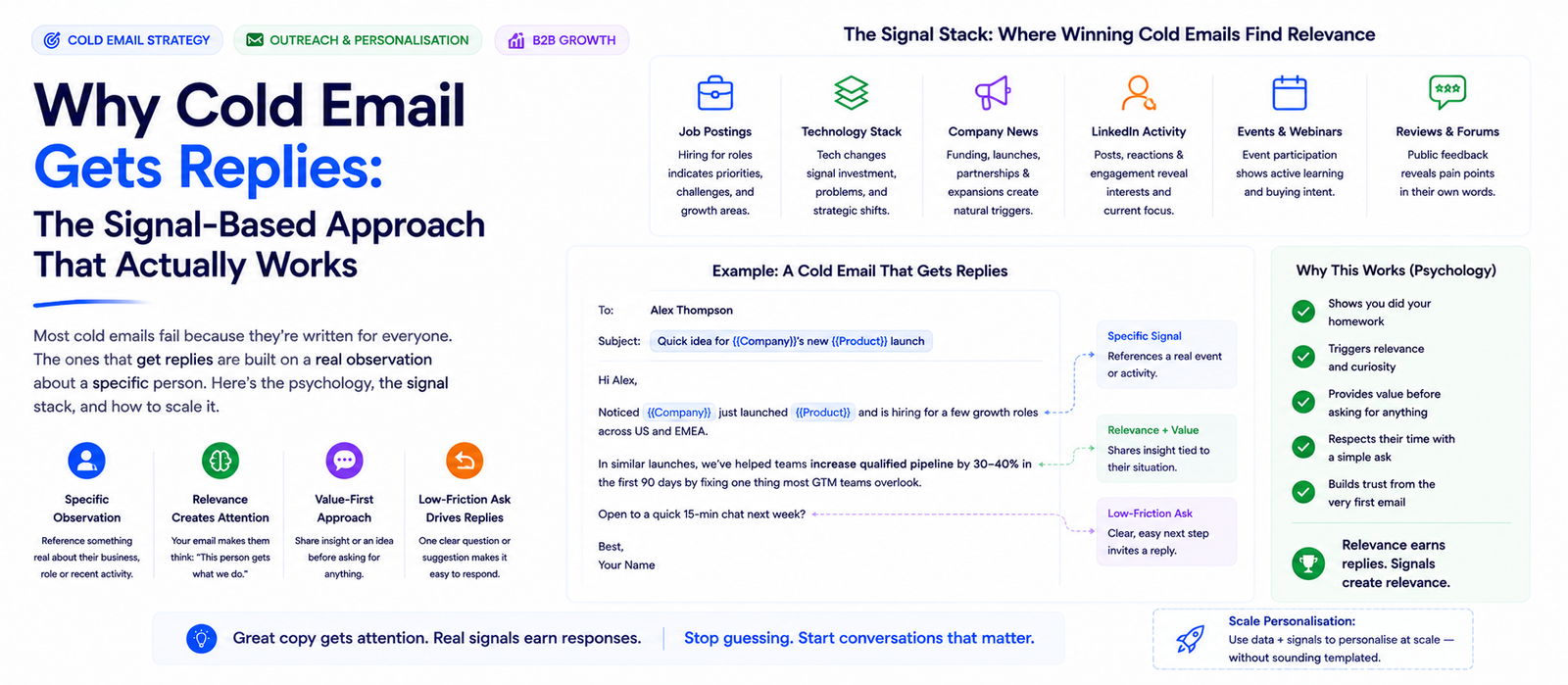
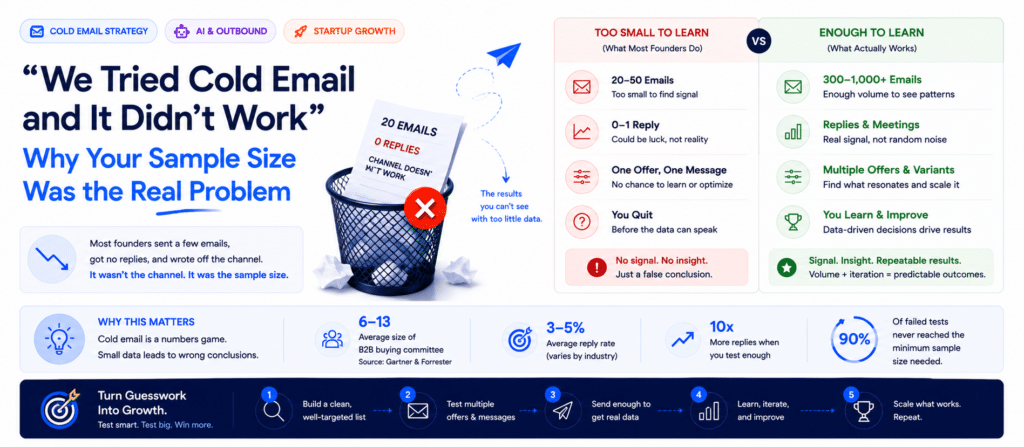
"We Tried Cold Email and It Didn’t Work" — Why Your Sample Size Was the Real Problem
Most founders who say cold email doesn’t work sent 20 emails and quit. Here’s why sample size, not the channel, is almost always the real problem — and what a fair test actually looks like.
 Konnektys TeamJune 29, 2026 · 10 min read · Cold Email Strategy
There’s a conversation I have with founders so often I could script it.
They tell me cold email doesn’t work. They tried it. So I ask the obvious follow-up: how many emails did you actually send? And the answer, more often than you’d think, is something like “around 20, back in 2024.”
Twenty emails. One time. A year and a half ago.
At that point I usually have to break some uncomfortable news. They haven’t tried cold email. They’ve heard of cold email. They sent a tiny handful of messages, got silence, and filed the entire channel under “doesn’t work for us.” Then they moved on, told other founders the same thing, and the myth spread a little further.
This matters because cold email is one of the most reliable customer acquisition channels available to B2B companies, and a huge number of teams have written it off based on a test so small it couldn’t have told them anything. The channel didn’t fail them. The experiment did. And the difference between those two things is worth understanding in detail, because once you see it, you stop quitting good channels for bad reasons.
The Short Answer
For anyone who wants the conclusion up front:
- •Cold email works, but it’s a volume-and-iteration channel, not an instant-result channel. A handful of emails tells you almost nothing.
- •Twenty emails is not a test. It’s not even enough data to know what’s broken, let alone whether the channel is viable.
- •A real test runs into the hundreds or low thousands of well-targeted emails across multiple offers and message variants, with the infrastructure and list quality to give those messages a fair shot.
- •Most “cold email doesn’t work” verdicts are really “we quit before the learning started” verdicts. The problem is sample size, not the channel.
The Double Standard Founders Apply to Outbound
Here’s the thing that always strikes me. Founders are some of the most patient, long-horizon people on earth right up until the moment they touch outbound.
The same person who will happily spend 18 months building a product before it earns a dollar, drop $50,000 on a website, and sit through hundreds of hours of meetings will send 20 cold emails, get no replies, and conclude within a week that the channel is broken. The patience that defines everything else about how they build evaporates the instant an email goes unanswered.
It’s a strange double standard, and it’s worth sitting with for a second. Nobody builds a product, ships version one, gets no traction in the first month, and announces that “software doesn’t work.” Nobody runs paid ads for two days, sees no conversions, and declares the entire concept of advertising a failure. We instinctively understand that those things need time, testing, and iteration. We give them room to develop.
Everything else
18 months + $50,000 on a website and product, before expecting a single sale. Considered completely normal.
Cold email
One afternoon sending 20 emails, no reply by end of week, declared a definitive failure. Yet outbound is often the cheapest and fastest of the three to start producing revenue.
Outbound rarely gets the same grace. It gets judged on a sample size that wouldn’t pass for a rounding error in any other part of the business. And the reason is partly psychological: sending a cold email feels cheap and fast, so people expect cheap and fast results. The effort feels small, so the patience feels unwarranted. But the economics of the channel don’t care how the effort feels. They run on numbers, and 20 is not a number that produces signal.
The Takeaway
If you’d give a new product or a new ad channel months to prove itself, outbound deserves at least a fair-sized test before you rule on it.
Why 20 Emails Tells You Nothing
Let’s get concrete about why such a small sample is useless, because “you didn’t send enough” sounds like a brush-off until you look at the actual mechanics.
Cold email reply rates, even for good campaigns, generally sit in the low single digits to low double digits depending on targeting, offer, and execution. Take a healthy positive-reply rate of, say, 5%. On 20 emails, 5% is one reply. One. And reply rates aren’t smooth and predictable at that volume; they’re lumpy. You could easily send 20 genuinely good emails to genuinely good prospects and get zero replies purely through variance — the same way you can flip a fair coin five times and get five tails. That outcome tells you nothing about the coin.
Now stack the other problems on top of that variance:
- •You haven’t tested enough offers. The offer — what you’re actually proposing and why someone should care — is usually the single biggest driver of cold email performance. With 20 emails you’ve tested exactly one offer, and you have no idea whether it’s the problem or not.
- •You haven’t tested enough messaging. How you frame the offer, your subject line, your opener, your call to action — all of it moves results. One version of one message is not a test of “messaging.” It’s a single data point with no comparison.
- •You haven’t collected enough data to know what’s broken. This is the real killer. Even when a small campaign fails, it fails silently. You don’t know if the problem was the list, the offer, the copy, the deliverability, or just bad luck, because 20 emails can’t generate the data you’d need to diagnose any of it.
That last point is the one founders miss most. When a small test fails, you don’t just lack results. You lack the diagnostic information that would let you fix it. A real campaign generates signal: which subject lines get opened, which offers get replies, which segments respond and which don’t, where prospects drop off. Twenty emails generate a shrug. You can’t iterate your way to success from a shrug.
The Takeaway
At tiny volumes, a failed campaign and a campaign that would have worked look identical. You can’t tell them apart, which means you can’t conclude anything.
The Survivorship Bias Hiding in “It Doesn’t Work”
Here’s the part that I find genuinely funny, in a slightly dark way.
If just one of those 20 emails had landed, if a single message had turned into a paying customer, that same founder would be telling everyone who’d listen that cold email is the best acquisition channel on the planet. One win and the verdict flips completely, from “doesn’t work” to “works incredibly well,” based on the same microscopic sample.
That’s the tell. It reveals that the conclusion was never really about the channel. It was about whether the dice happened to land well in a tiny number of rolls. A 20-email campaign that produces one customer and a 20-email campaign that produces zero customers are, statistically, almost the same campaign. The difference between them is mostly noise. But founders treat the two outcomes as opposite verdicts on whether outbound is viable for their business.
If a single lucky reply would have made you a believer,
your skepticism isn’t really about the channel.
It’s about a sample size too small to mean anything.
This is survivorship bias in real time. The teams that got an early lucky win become evangelists. The teams that didn’t become skeptics. Neither group actually tested anything, but both walk away with strong opinions, and those opinions shape how the next wave of founders thinks about the channel. The skeptics are louder, too, because “I tried it and it failed” is a more satisfying story to tell than “I didn’t try hard enough.”
Most channels look terrible if you quit before the learning starts. That’s not a fact about cold email. It’s a fact about how learning works. The early phase of any channel is where you’re paying tuition, gathering the data that tells you what to change. Quit during the tuition phase and all you’ve bought is a failed first attempt and a wrong conclusion.
The Takeaway
If a single lucky reply would have made you a believer, your skepticism isn’t really about the channel. It’s about a sample size too small to mean anything either way.
What a Real Cold Email Test Actually Looks Like
So if 20 emails isn’t a test, what is? Let me lay out what a fair, informative test actually involves, because the gap between “I sent some emails” and “I ran a real test” is wide, and most people have never seen the second thing done properly.
A genuine test has a few non-negotiable components.
Enough volume to produce signal
You need enough emails that your results reflect reality rather than variance. The exact number depends on your market and deal size, but as a rough frame, you’re looking at hundreds of well-targeted emails at an absolute minimum, and often well into the low thousands, before you can read the results with any confidence. That’s not because more is always better. It’s because below a certain threshold, the noise drowns out the signal entirely.
Multiple offers tested against each other
Since the offer drives so much of the outcome, a real test compares several. Maybe you lead with a specific result, then try a different angle that leads with a problem, then a third that leads with a relevant insight. You’re not just sending more of the same message. You’re learning which proposition actually resonates with this market, which is information you can’t get from a single version.
Multiple message variants per offer
Within each offer, you test the framing: subject lines, opening lines, length, tone, call to action. Small changes here produce meaningfully different results, and the only way to know what works for your audience is to run variants against each other and watch what happens.
Clean, well-targeted data underneath it all
This is where a lot of “tests” are doomed before the first send. If your list is full of wrong-fit prospects, outdated contacts, or unverified addresses, your campaign will underperform no matter how good the copy is, and you’ll wrongly blame the channel. A real test runs on a list built around your actual ideal customer profile, with verified contact data, so the messages reach the right people. Getting that foundation right is exactly what AI-powered lead research and email finding and verification exist to handle, and skipping it is one of the most common reasons early campaigns fail for reasons that have nothing to do with cold email itself.
Infrastructure that gives the emails a chance to land
Here’s the silent campaign-killer almost nobody accounts for: if your emails are landing in spam, your reply rate isn’t telling you anything about your message. It’s telling you about your deliverability. Sending cold email from an unwarmed domain, or from your primary company domain with no authentication set up, is a great way to get a 0% reply rate that has nothing to do with the quality of your outreach. Proper email infrastructure setup, with separate domains, warmup, and correct authentication, is what ensures your test is measuring the message and not the sending setup.
When all of those pieces are in place, you get a test that actually tells you something. You learn which offers land, which messages convert, which segments respond, and where the bottleneck is. And critically, even a “failed” version of this test is valuable, because it generates the diagnostic data that points you at the fix. That’s the opposite of the 20-email shrug.
The Takeaway
A real test isn’t just more emails. It’s enough volume, across enough variation, on clean data, through proper infrastructure, to produce signal you can actually learn from.
Cold Email as a Learning System, Not a Slot Machine
The mental model that trips people up is treating cold email like a slot machine: put a message in, hope a customer comes out, and if one doesn’t, the machine is broken.
The better model is to treat it as a learning system. Every batch of emails you send is a round of experiments that produces data. The first batch isn’t supposed to print money. It’s supposed to teach you something: this offer beat that one, this subject line doubled the open rate, this segment replied three times as often as that one. You take what you learned, adjust, and send the next batch better informed. Over a few cycles, performance climbs as your understanding of the market sharpens.
This is why the first few emails genuinely don’t tell you much. They’re the start of the learning curve, not a verdict. The team sending its 1,000th well-targeted, well-iterated email is operating with a body of knowledge the team that sent 20 emails simply doesn’t have. Same channel, completely different results, and the only variable that changed was whether they stuck around long enough to learn.
To make that concrete, picture three cycles:
Cycle one
Send 300 emails across three offers. Learn that the problem-led offer pulled twice the replies of the others, while one subject line quietly doubled your open rate.
Cycle two
Drop the weak offers, lead with the winner, roll out the better subject line, and split-test two new openers. Reply rate climbs because you removed what wasn’t working.
Cycle three
You’ve found the segment that responds best, you know which CTA books the most calls, and the campaign that looked dead on arrival in a 20-email test is now producing meetings every week.
None of that knowledge existed at email number 20. It was earned, cycle by cycle, by a team that didn’t quit during the tuition phase.
It also explains why outbound rewards operators over dabblers. The advantage goes to whoever runs the most disciplined learning loop: test, measure, adjust, repeat. That’s a process, and processes take time and reps to pay off. For teams that don’t want to spend months building that loop from scratch, a managed end-to-end B2B lead generation program is essentially renting a learning loop that’s already been built and refined across hundreds of campaigns.
The Takeaway
Judge cold email by what it teaches you over several cycles, not by what it pays out in the first one. The payout comes after the learning, not before it.
What to Actually Do Instead of Quitting
Reframe your first campaign as data collection, not revenue.
Set the expectation, internally and with anyone watching the numbers, that the first cycle exists to learn. This removes the pressure that causes premature quitting and lets you make decisions based on data instead of impatience.
Fix your foundation before you blame your copy.
Before assuming the message is the problem, confirm the basics are right: is your list well-targeted and verified, and is your sending infrastructure set up so emails actually land? A shocking number of “the message isn’t working” problems are really list or deliverability problems in disguise. Clean data through contact list building and a properly warmed sending setup remove those variables so you can trust what your results are telling you.
Test offers before you obsess over wording.
Since the offer matters most, run a few genuinely different propositions early rather than endlessly tweaking the punctuation on one. You want to find the angle that resonates before you polish the phrasing.
Give it enough volume to mean something.
Don’t read results off 20 emails, or 50. Get into the hundreds across your variants before you draw conclusions, so variance stops being the loudest voice in your data.
Watch the diagnostic metrics, not just replies.
Opens, reply rates by segment, and where prospects drop off all tell you what to fix. A campaign that “failed” on bookings but shows strong opens and weak replies is pointing you straight at the offer or call to action. That’s actionable. Total silence on 20 emails isn’t.
Layer in other channels rather than betting everything on email.
Outbound works best as a coordinated motion. Pairing email with cold email and LinkedIn outreach gives the same prospect more than one touchpoint and lifts overall response, which also means a single channel’s slow start doesn’t sink the whole effort.
When Cold Email Genuinely Isn’t the Right Fit
To be fair, cold email isn’t right for every business, and it’s worth being honest about that rather than pretending it’s a universal answer.
It tends to work best for B2B companies with a clear ideal customer profile, a reasonable deal size that justifies the effort, and a product or service that solves a recognizable business problem. It’s a harder fit for very low-ticket products where the economics don’t support the work, for purely consumer offerings, or for markets so tiny that there simply aren’t enough prospects to run a real test against.
But notice that none of those are “we sent 20 emails and got no replies.” Those are structural reasons rooted in your market and economics, and you can usually reason about them before you send a single email. If you’re unsure whether your business is a structural fit, that’s a question worth answering deliberately rather than discovering by accident through a tiny failed campaign. The resource on whether cold email is right for your business walks through those structural factors in more depth.
The point is to separate two very different questions. “Is my business a structural fit for cold email?” is answerable with analysis. “Does cold email work?” is answerable only with a real test. Conflating them — and answering the second with a 20-email sample — is how good channels get wrongly dismissed.
The Takeaway
There are real reasons cold email might not suit your business, but a tiny failed campaign isn’t one of them. Judge fit on structure, and judge performance on a real test.
Frequently Asked Questions
Does cold email actually work in 2026?
+
How many cold emails do I need to send before I know if it works?
+
Why did my cold email campaign get no replies?
+
Is 20 cold emails enough to test the channel?
+
Why do some founders say cold email doesn’t work?
+
What makes a cold email test fair and reliable?
+
Should I quit cold email if my first campaign fails?
+
How is cold email different from a slot machine?
+
The Bottom Line
The next time you hear yourself, or another founder, say cold email doesn’t work, ask the one question that cuts through the whole thing: how many emails did you send before you decided that?
If the answer is 20, or 50, or any number you could count on your fingers and toes, then the channel was never really tested. What got tested was patience, and it ran out before the data showed up. That’s not a verdict on cold email. It’s a verdict on the sample size, and the two get confused constantly.
Cold email rewards the teams that treat it as what it is: a channel that takes volume, iteration, and a solid foundation to work, and then works well for a long time once it clicks. The ones who quit at 20 emails never find that out. The ones who run a real test usually do.
Give Cold Email a Fair Test Before You Give It a Verdict
See how end-to-end B2B lead generation turns outbound into a tested, iterating system, or start with AI-powered lead research so your first real campaign runs on the right list from day one.
- The Short Answer
- The Double Standard Founders Apply to Outbound
- Why 20 Emails Tells You Nothing
- The Survivorship Bias Hiding in “It Doesn’t Work”
- What a Real Cold Email Test Actually Looks Like
- Cold Email as a Learning System, Not a Slot Machine
- What to Actually Do Instead of Quitting
- When Cold Email Genuinely Isn’t the Right Fit
- Frequently Asked Questions
- The Bottom Line
Ready to run a real test instead of a small one? We’ll build the list, the infrastructure, and the multi-offer campaign that gives the channel a fair shot.
Talk to Konnektys →Related articles
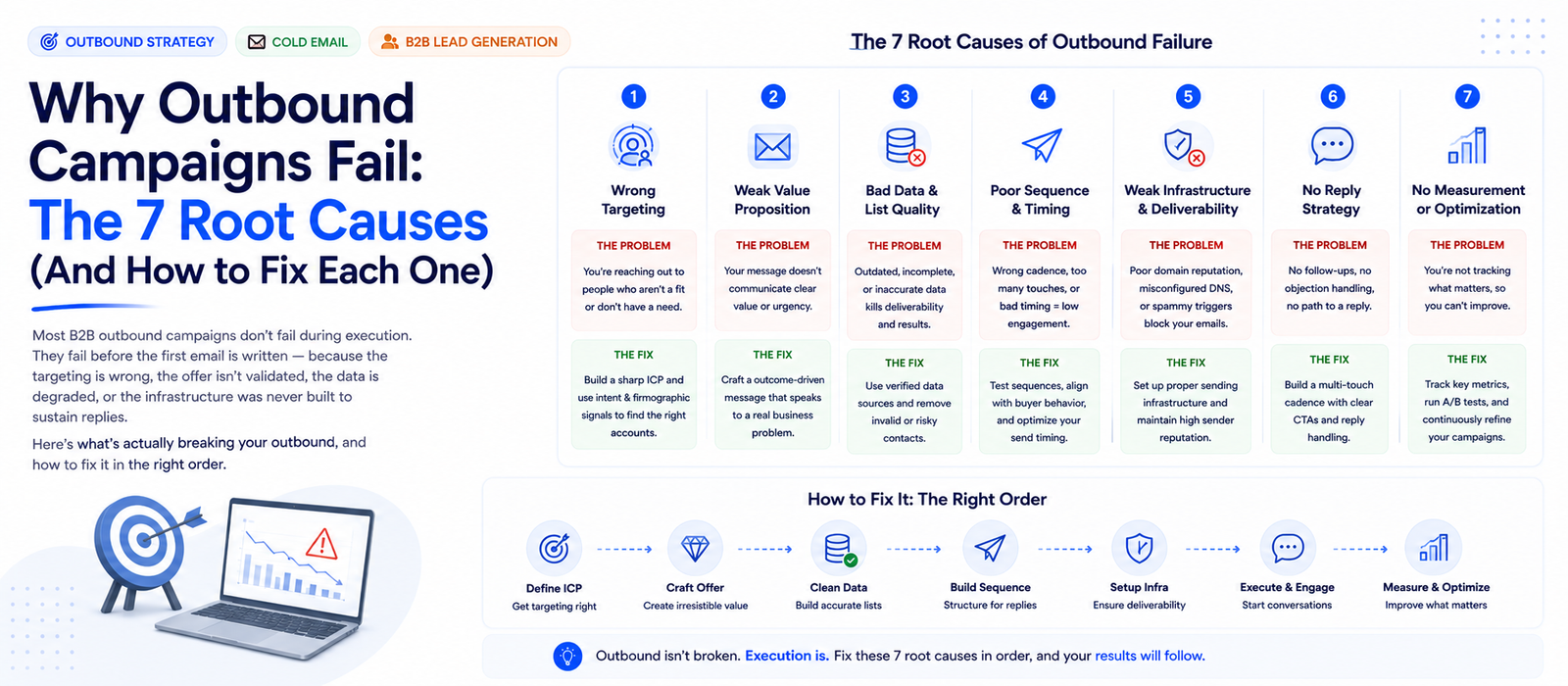
Why Outbound Campaigns Fail: The 7 Root Causes (And How to Fix Each One)
Konnektys Team · 7 Jun, 2026
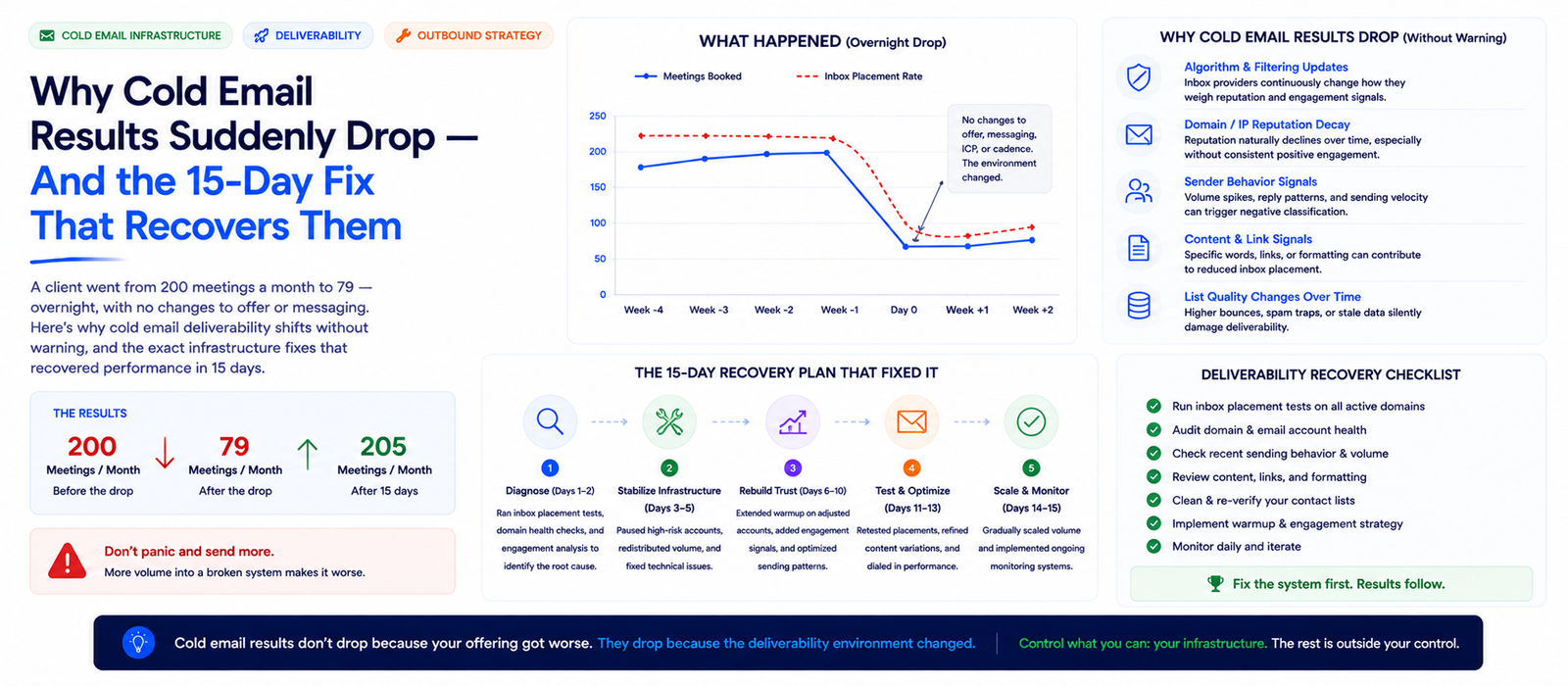
Why Cold Email Results Suddenly Drop — And the 15-Day Fix That Recovers Them
Konnektys Team · 9 Jun, 2026