
Why “200 Meetings a Month” Is the Wrong Thing to Brag About
Booking 200 meetings a month sounds impressive, but volume isn’t pipeline. A meeting is not revenue — it’s an opportunity to find out whether revenue is possible. Here’s how to tell a real outbound partner from a numbers factory, and which metrics actually predict closed deals.
 Konnektys TeamJuly 18, 2026 · 13 min read · Outbound Strategy
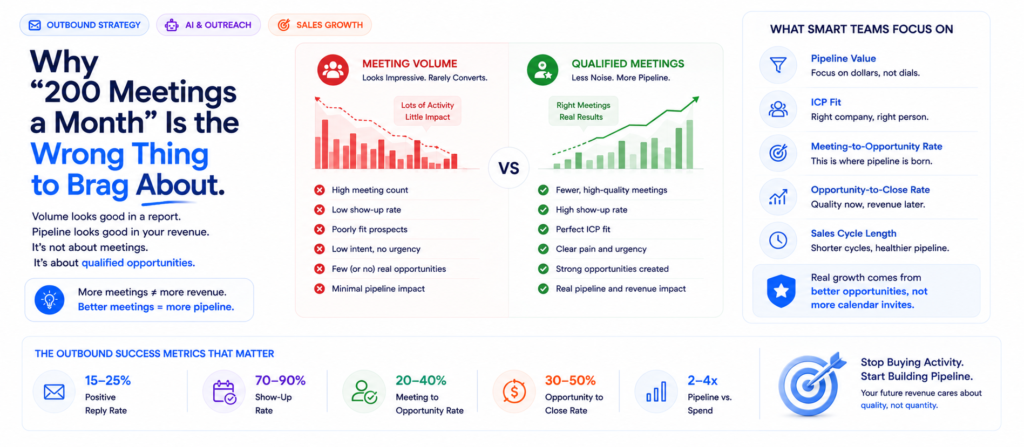
There’s a number that gets thrown around in outbound sales decks like it settles the argument on its own: meetings booked per month. 50. 100. 200+. It sits at the top of the pitch, bolded, sometimes with an exclamation point, as if the number alone tells you whether an agency is any good.
It doesn’t. Not by itself.
I’ve watched founders sign six-figure contracts with agencies that promised triple-digit meeting counts, only to sit through a quarter of demos with people who were never going to buy anything from anyone. The calendar filled up. The pipeline stayed empty. And by the time anyone noticed, three months and a chunk of budget were gone.
This isn’t a knock on volume. Volume matters — a sales team with zero meetings closes zero deals, and there’s no version of outbound that skips the “get in front of people” step. The problem is treating volume as the finish line instead of the starting line. A meeting is not revenue. A meeting is an opportunity to find out whether revenue is possible, and that opportunity is only worth something if the person on the other end of the call could plausibly buy.
If you’re evaluating a cold email agency, a B2B lead generation partner, or thinking about building an outbound motion in-house, this is the distinction that will save you more money than any pricing negotiation: the difference between an agency optimized for meetings booked and one optimized for pipeline created. They sound similar. They are not the same business.
The Uncomfortable Truth About Meeting Volume
Here’s something most outbound agencies won’t say out loud in a sales call, because it undercuts their own pitch: booking a large number of meetings is not actually that hard.
It requires three things, and none of them are rare:
- •Enough sending infrastructure. A large pool of warmed-up domains and inboxes, rotated properly so deliverability holds up under high send volume.
- •A large enough contact list. Not necessarily a good list — just a big one, scraped or purchased from a data provider, filtered loosely by job title and company size.
- •A high-volume, low-specificity message. Something generic enough to apply to thousands of people at once, with a call-to-action that makes booking a call frictionless — often too frictionless.
Put those three ingredients together and you can generate a meaningful number of “meetings booked” almost regardless of whether the prospects are a fit. The math is simple: send enough emails to enough people with a low-friction booking link, and a percentage of recipients — even ones who have no intention of buying, no budget, and no authority to make a purchasing decision — will click “yes” out of curiosity, politeness, or a mis-click.
That’s not a hypothetical. It’s a known failure mode in the industry, and it’s exactly why an agency can post a case study with a big meeting number and still have churned the client three months later. The meeting count was real. The buyers weren’t.
Key Point
A meeting is a lagging indicator of activity, not a leading indicator of revenue. Treating it as the primary success metric is like judging a fishing trip by how many times the line got wet, rather than how many fish came home.
Why “More Meetings” Can Actively Hurt You
It’s tempting to assume that even bad meetings are, at worst, neutral — a wasted 30 minutes, but no real harm done. In practice, low-quality meeting volume carries real costs, and they compound.
It burns your best resource: your closers’ time.
Every meeting with someone who isn’t a fit is a meeting your AE or founder isn’t spending with someone who could actually sign. If your best closer is doing six demos a week and three of them are with people who were never in-market, you’ve effectively cut their real selling capacity in half.
It skews your forecasting.
If your CRM is full of meetings that were never going to convert, your pipeline math gets distorted. Leadership sees a healthy top-of-funnel number and makes hiring, budget, and revenue projections based on it — projections that then miss, because the number was never real pipeline to begin with.
It damages your brand with the people who matter.
Cold outreach that’s cast too wide tends to land on people who are annoyed rather than intrigued. A prospect who takes a meeting they clearly weren’t a fit for, then sits through a pitch that has nothing to do with their actual problems, doesn’t forget that.
It masks the real signal you need.
The entire value of an outbound motion, beyond the meetings themselves, is what it teaches you about your market: which titles respond, which pain points land, which industries convert best. Junk meetings drown that signal in noise.
None of this means volume is bad. It means volume without qualification is a cost center dressed up as a KPI.
What “Qualified” Actually Means (and Why the Word Gets Abused)
“Qualified” is one of the most overused words in B2B sales, largely because it has no enforced definition. Every agency will tell you their meetings are qualified. Very few will tell you exactly what that means, and fewer still will show you the criteria in writing before you sign.
A genuinely qualified meeting typically satisfies a few conditions:
- •The company fits your Ideal Customer Profile. Right size, right industry, right tech stack or operational maturity — whatever your ICP actually defines, not a loosely adjacent approximation of it.
- •The person has relevant context or influence. They don’t need to be the final signer, but they should understand the problem you solve and have some role in evaluating or recommending a solution.
- •There’s an identifiable pain point. Something in their business, ideally something they’ve acknowledged themselves — in a reply, on a call, in content they’ve published — that your product or service plausibly addresses.
- •The timing is at least plausible. They’re not mid-way through signing with a competitor, not two months from a company-wide vendor freeze, and they didn’t just renew a three-year contract with someone else.
Notice what’s missing from that list: enthusiasm. A qualified meeting doesn’t require the prospect to be thrilled to talk to you. It requires them to be a legitimate potential buyer. Plenty of qualified meetings start lukewarm and warm up once the conversation gets specific — that’s normal. What’s not normal is a meeting where the prospect seems confused about why the call was booked in the first place.
If you’re vetting an outbound partner, ask them to define “qualified” in writing, tied to your specific ICP — not a generic template. Then ask how that definition gets enforced before a meeting goes on your calendar. A partner who’s actually doing this work will have real, specific answers, often supported by documented research workflows and a tight ICP definition process rather than a one-line filter on job title.
The Metrics That Actually Predict Revenue
If meeting count is a vanity metric on its own, what should you actually be tracking? The honest answer is that no single number tells the full story — you need a small stack of them, viewed together, because each one catches a different kind of failure.
Reply Rate (and What Kind of Replies)
Reply rate tells you whether your messaging and targeting are landing at all. But raw reply rate is a blunt instrument — a campaign can get a high reply rate purely from “not interested, please remove me” responses, which technically counts as engagement but signals nothing good. The number that matters is the positive reply rate: replies that indicate genuine interest, a request for more information, or an acknowledgment of the problem you’re addressing.
Show-Up Rate
Booking a meeting and having someone actually attend it are two different events, and the gap between them is one of the most under-discussed metrics in outbound. An agency that books meetings with low-intent prospects will often see no-show rates climb, because a prospect who clicked a calendar link out of curiosity has no real reason to show up when the day arrives. A healthy show-up rate — generally somewhere in the 70–85% range for well-qualified B2B meetings — is itself a strong proxy for lead quality.
Meeting-to-Opportunity Conversion
Of the meetings that happen, how many turn into a real, tracked opportunity in your CRM — meaning the prospect agrees to a next step, a proposal, a technical evaluation, anything that moves the relationship forward? This is where the “qualified” claim gets tested against reality. If an agency is delivering 100 meetings a month but only 8 of them convert to a next step, that 8% conversion rate is the number that should be driving the conversation, not the 100.
Opportunity-to-Close Rate and Sales Cycle Length
Of the opportunities created, how many actually close, and how long does it take? Outbound-sourced deals often have a different (usually longer) sales cycle than inbound, because the prospect wasn’t actively shopping when the conversation started. That’s normal — but worth tracking separately, because a partner whose meetings consistently produce long, stalled sales cycles that never close is a different problem than one whose meetings simply take a while to mature.
Pipeline Value Generated
Ultimately, the metric that ties everything together is dollar value: how much qualified pipeline (and eventually closed revenue) is being generated relative to the cost of the outbound program. A program that costs $8,000 a month and generates $40,000 in closed revenue over a quarter is working, even if the meeting count looks modest. A program that costs the same and generates $40,000 in pipeline value that never converts is not working, no matter how full the calendar looks.
Key Point
Track the metrics in the order they happen — leads contacted, positive replies, meetings booked, meetings held, opportunities created, deals closed — and watch where the biggest drop-off occurs. That drop-off point is where the real problem lives.
Why Some Agencies Optimize for the Wrong Number
It’s worth understanding why this problem exists, because it’s not usually malicious — it’s structural.
Meeting count is easy to measure, easy to report, and easy to compare across agencies in a sales pitch. Pipeline value and close rate are harder: they take longer to materialize, they depend partly on the client’s own sales execution, and they require a level of CRM integration and reporting that not every agency has built. So agencies gravitate toward the metric that’s simplest to sell, and clients reinforce that by asking “how many meetings can you get us?” rather than “what does a qualified opportunity look like for my business, and how will you find those specifically?”
There’s also a more direct incentive problem: agencies paid per meeting booked, with no clawback or quality gate, have essentially no financial reason to be selective. Every meeting is revenue for them, regardless of whether it produces revenue for you. That’s baked directly into a lot of standard agency pricing models, and it’s one of the first things worth asking about before signing anything: does this partner get paid the same amount whether the meeting is a strong fit or a coin flip?
When you come across a claim of very high monthly qualified-meeting volume, the right response isn’t automatic skepticism — it’s a specific, pointed set of questions.
The Questions to Ask Before You Sign
“What does a qualified meeting mean for my specific ICP, in writing?”
Not a generic definition. A definition tied to your firmographics, your buyer titles, and your actual pain points. If they can’t produce this before you’ve signed, they don’t have a repeatable process — they’re improvising per client.
“How do you build and verify your prospect lists?”
Ask where the data comes from, how often it’s refreshed, and what enrichment or verification happens before a contact enters a sequence. A list built from a single static data export six months ago behaves very differently from one that’s actively enriched with intent data, technographic signals, and verified contact details.
“What percentage of positive replies get filtered out before a meeting is booked?”
This is a revealing question, because agencies that do real qualification will have an actual number here — often somewhere between 20% and 50% of “interested” replies get disqualified after a closer look, because interest and fit are not the same thing. An agency with no filtering step will either dodge the question or claim every positive reply converts to a meeting.
“Can I see show-up rates and meeting-to-opportunity conversion from a comparable client?”
Case studies with meeting counts are marketing. Show-up rates and conversion rates are operations. A partner confident in their quality will have this data ready, ideally broken down by industry or company size.
“What happens if meetings aren’t converting to opportunities?”
This tests whether there’s a feedback loop. Good partners treat conversion data as a signal to adjust targeting, messaging, or qualification criteria mid-engagement. If the answer is “we just keep booking more meetings,” that’s a volume-first operation regardless of what the pitch deck says.
“How is the team compensated — flat fee, per meeting, or tied to conversion outcomes?”
This isn’t about finding the “right” pricing model; there’s no universally correct answer. But it’s worth knowing whether the incentive structure rewards selectivity or punishes it.
“What’s your actual sending and deliverability setup?”
Volume-first shops tend to run large numbers of loosely warmed inboxes to hit send targets. Ask about domain warmup practices, sending limits per inbox, and how they monitor deliverability and spam complaints — a poorly managed infrastructure is often a quiet tell that quality has taken a back seat to volume.
A Framework for Thinking About Trade-Offs
It would be dishonest to pretend this is a simple choice between “quality good, volume bad.” The right balance depends heavily on your business stage, sales capacity, and average deal size.
Early-stage company still validating your ICP
Some volume genuinely helps — you need enough data points to learn which segments respond and which messaging resonates, and being too narrow too early can starve you of the signal you need to refine targeting. A slightly higher volume of decently-qualified meetings, treated explicitly as a learning exercise, can be the right call.
Growth-stage company with a defined ICP and a capacity-constrained sales team
Quality should dominate the conversation almost entirely. Your closers’ time is expensive and limited, and every low-fit meeting is a direct tax on your best-performing asset.
High-velocity, low-ACV sales motion
A somewhat higher volume of moderately qualified meetings can make sense, because the cost of a wasted 20-minute call is lower and the win rate math works differently than it does for a six-figure enterprise deal.
Enterprise, long-cycle, high-ACV motion
Tight qualification isn’t optional — it’s the only thing that makes the economics work. A single wasted meeting with the wrong stakeholder at a target account can cost weeks of momentum you don’t get back.
Key Point
Know which metric your business stage and sales motion actually reward, and hold your outbound partner accountable to that metric specifically — not to whichever number looks best on a sales call.
What This Looks Like in Practice
Say a mid-market B2B software company hires an outbound partner promising 60 meetings a month. Three months in, the sales team reports that maybe 10 of those meetings a month turn into real second-stage conversations, and only 1 or 2 close per quarter. On paper, 60 meetings a month sounds like a strong top-of-funnel. In practice, the sales team is burning most of its bandwidth on calls that go nowhere, and the actual return on the outbound spend is thin.
Now compare that to a partner who commits to 15–20 meetings a month, built around a tightly defined ICP — specific company sizes, specific tech stack indicators, specific title combinations — with research-backed personalization on every outbound touch. If 8 of those 15 convert to real opportunities and 2–3 close per quarter, the second engagement is producing meaningfully more revenue with a third of the meeting volume and a fraction of the wasted sales time.
Volume-First Partner
60 meetings/month
~10 progress to next stage
1–2 close per quarter
Sales team burning bandwidth on calls that go nowhere
Quality-First Partner
15–20 meetings/month
~8 progress to next stage
2–3 close per quarter
More revenue, less wasted sales time
This is the pattern that shows up again and again once you actually track the full funnel instead of stopping at “meetings booked”: fewer, better-targeted conversations consistently outproduce a larger number of loosely qualified ones, especially once you account for the hidden cost of your sales team’s time.
Building (or Buying) an Outbound Motion That’s Actually Accountable
If you’re weighing whether to build this capability in-house or bring in a partner, the qualification question doesn’t go away either way — it just shifts who’s responsible for it.
An in-house SDR team gives you direct control over qualification criteria, but it also means you’re carrying the cost of hiring, training, infrastructure, and the ramp time before a new SDR is producing consistently qualified meetings — often three to six months before performance stabilizes.
A managed outbound partner can shortcut that ramp time, provided the partner treats qualification as a deliverable, not an afterthought. That means the infrastructure — cold email deliverability management, verified and enriched contact data, technographic and intent signals, CRM-integrated reporting — is built to support precision targeting from day one, rather than bolted on after volume complaints start coming in.
This is the premise behind how Konnektys approaches outbound: not as a numbers game measured by meetings booked, but as a revenue engine measured by qualified pipeline and closed deals. That means a defined ICP-qualification process before a single email goes out, contact-level personalization built from real research, and reporting that tracks the full funnel — replies, show-ups, opportunities, and revenue — not just the metric that’s easiest to put in a case study.
Key Takeaways
- •Meeting volume is easy to manufacture and easy to misread. A large number of booked meetings doesn’t tell you whether those prospects can actually buy.
- •Qualification should be defined in writing, tied to your specific ICP, before an outbound engagement begins — not left to a vague promise of “quality leads.”
- •Track the full funnel, not just the top of it: positive reply rate, show-up rate, meeting-to-opportunity conversion, opportunity-to-close rate, and pipeline value generated.
- •Ask how your outbound partner is compensated. Incentive structures that pay per meeting with no quality gate rarely produce disciplined qualification.
- •The right volume-to-quality balance depends on your sales motion, deal size, and stage — there’s no universal number, but there is a universal need for accountability to real outcomes.
- •Fewer, better-targeted conversations consistently outproduce a larger number of loosely qualified ones, once you account for the cost of your sales team’s time.
Frequently Asked Questions
What’s the difference between a booked meeting and a qualified meeting?
+
How many meetings should a cold email agency book per month?
+
What metrics should I track instead of just meeting count?
+
Why do some agencies focus so heavily on meeting volume?
+
Is a low show-up rate always a sign of bad lead quality?
+
What questions should I ask before hiring an outbound or cold email agency?
+
Can an agency realistically deliver both high volume and high quality?
+
How long does it take to know if an outbound program is actually working?
+
Closing Thought
The next time an agency opens a pitch with a meeting number, ask the follow-up question they’re hoping you won’t: of those meetings, how many turned into real pipeline, and how do you know? The honest answer tells you more about whether they’re a fit for your business than any number they lead with.
If you’re not sure whether your current outbound program is producing meetings or producing revenue, that’s worth a closer look before renewing anything.
Outbound Measured by Pipeline, Not Calendar Volume
Konnektys builds outbound programs around qualified pipeline, not calendar volume. If you want a second opinion on what your funnel is actually telling you, see how end-to-end B2B lead generation approaches the full funnel from ICP definition through to closed revenue.
- The Uncomfortable Truth About Meeting Volume
- Why “More Meetings” Can Actively Hurt You
- What “Qualified” Actually Means (and Why the Word Gets Abused)
- The Metrics That Actually Predict Revenue
- Why Some Agencies Optimize for the Wrong Number
- The Questions to Ask Before You Sign
- A Framework for Thinking About Trade-Offs
- What This Looks Like in Practice
- Building (or Buying) an Outbound Motion That’s Actually Accountable
- Key Takeaways
- Frequently Asked Questions
- Closing Thought
Sitting on a full calendar and an empty pipeline? We’ll tell you what your funnel is actually saying — and build the motion that fixes it.
Talk to Konnektys →Related articles
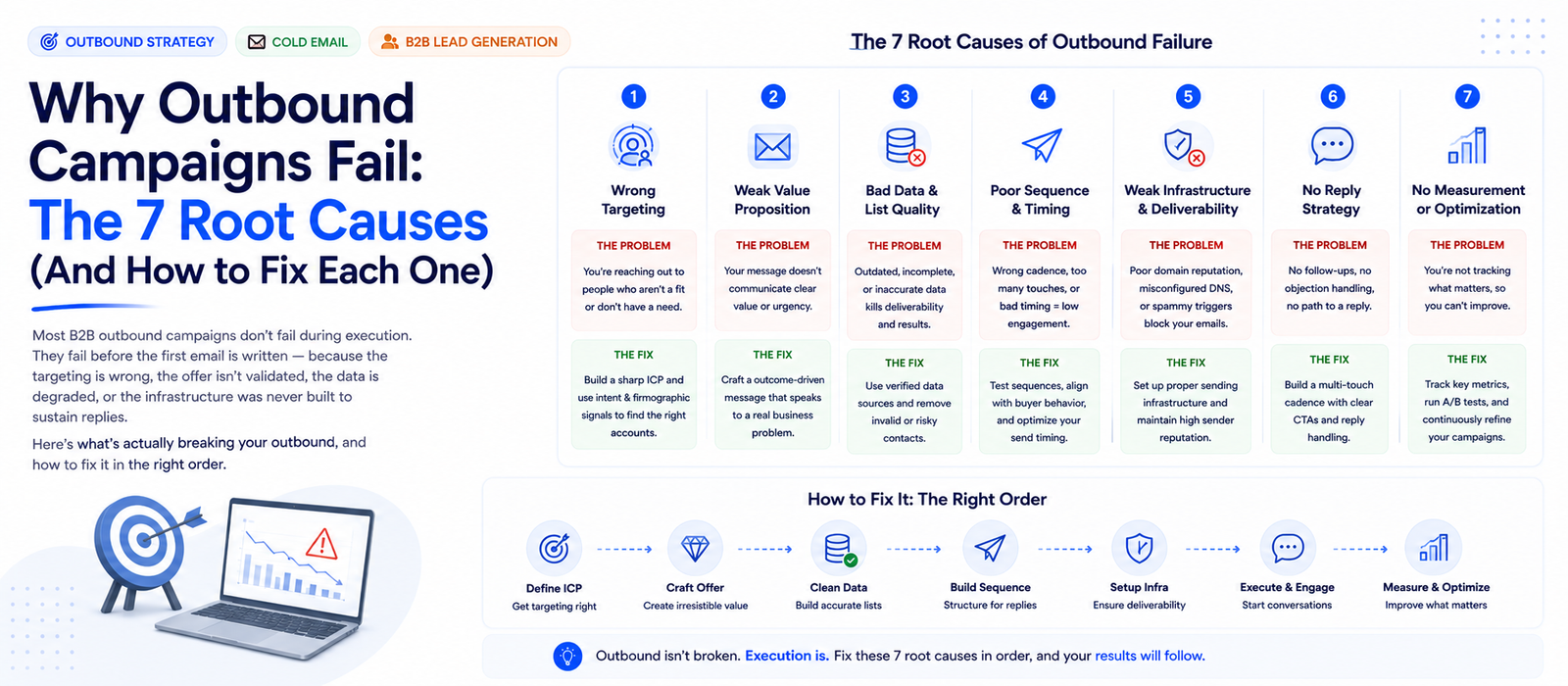
Why Outbound Campaigns Fail: The 7 Root Causes (And How to Fix Each One)
Konnektys Team · 7 Jun, 2026
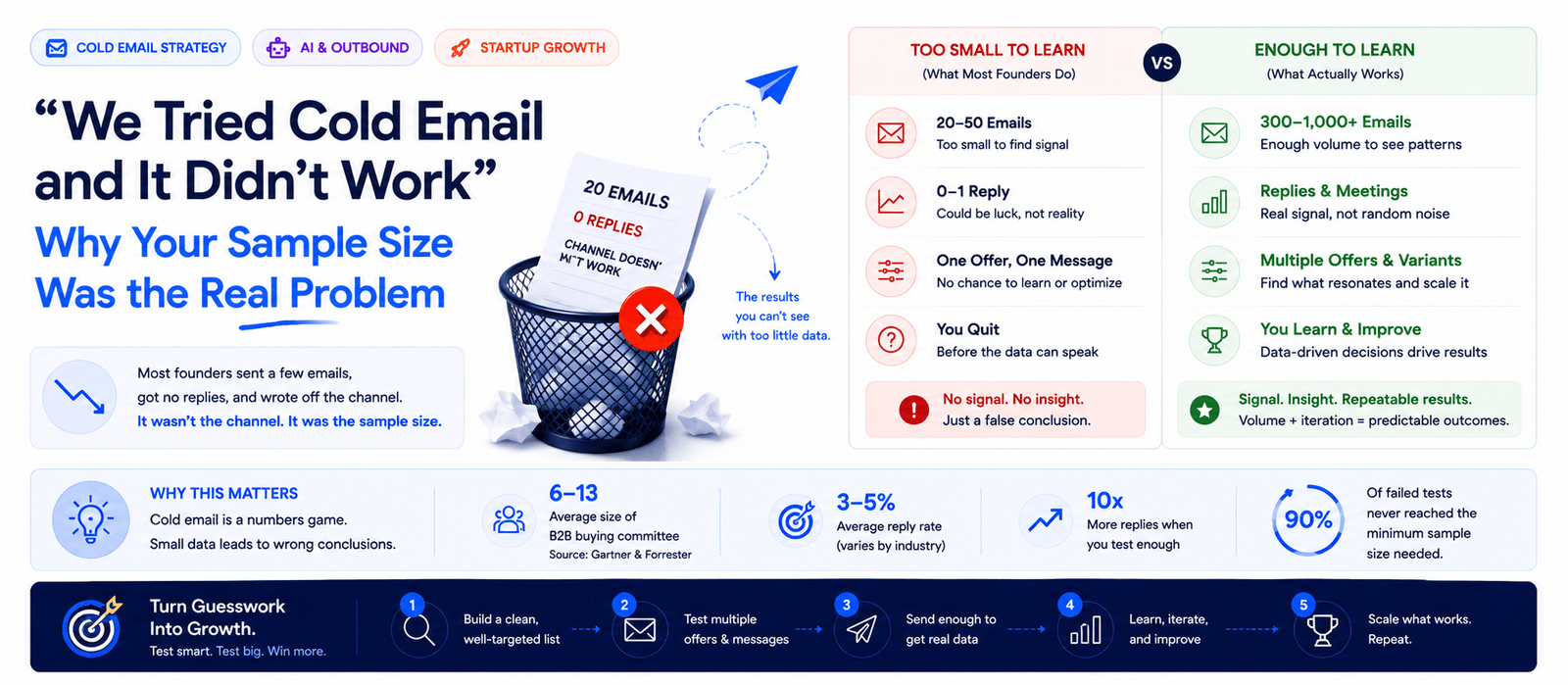
“We Tried Cold Email and It Didn’t Work” — Why Your Sample Size Was the Real Problem
Konnektys Team · 20 Jun, 2026
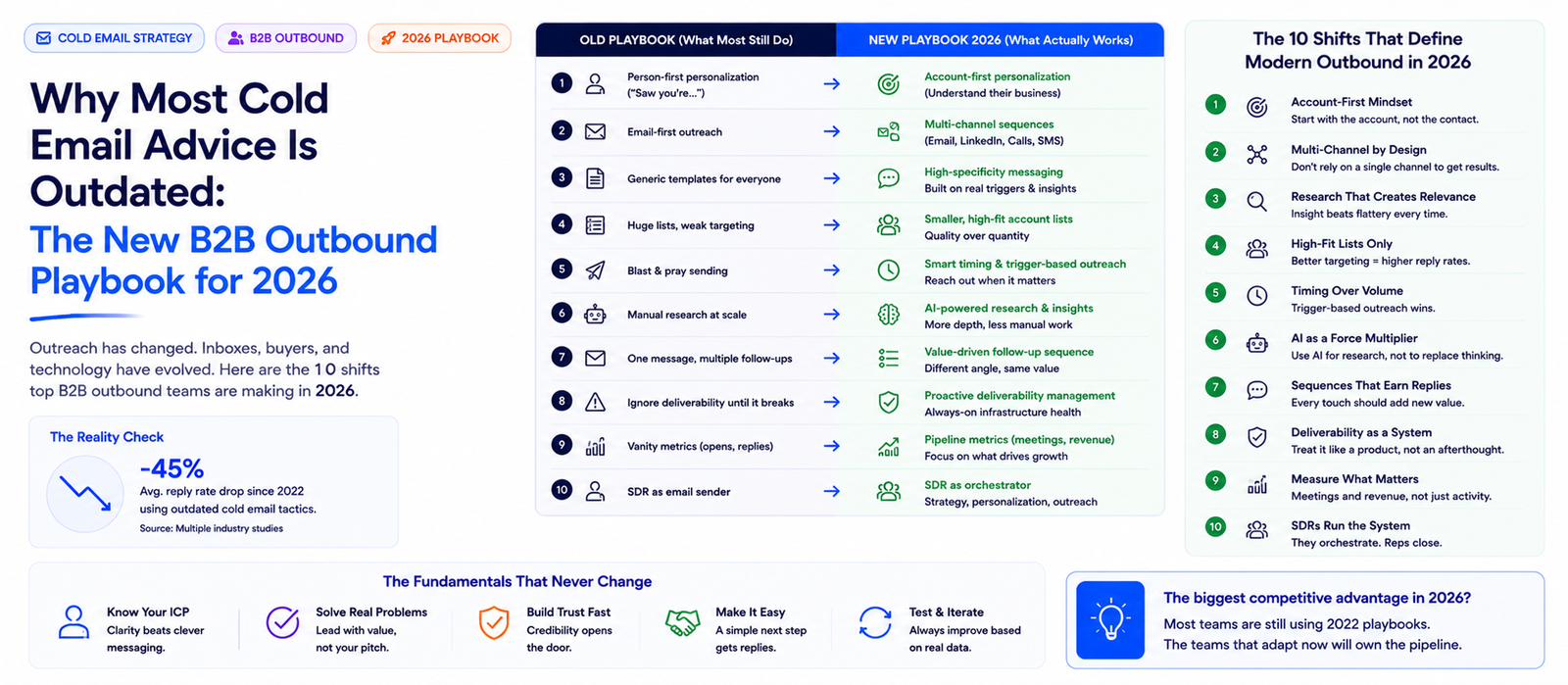
Why Most Cold Email Advice Is Outdated: The New B2B Outbound Playbook for 2026
Konnektys Team · 14 Jun, 2026