
Cold Email vs. LinkedIn Outreach: Why Email Is the More Forecastable Outbound Channel
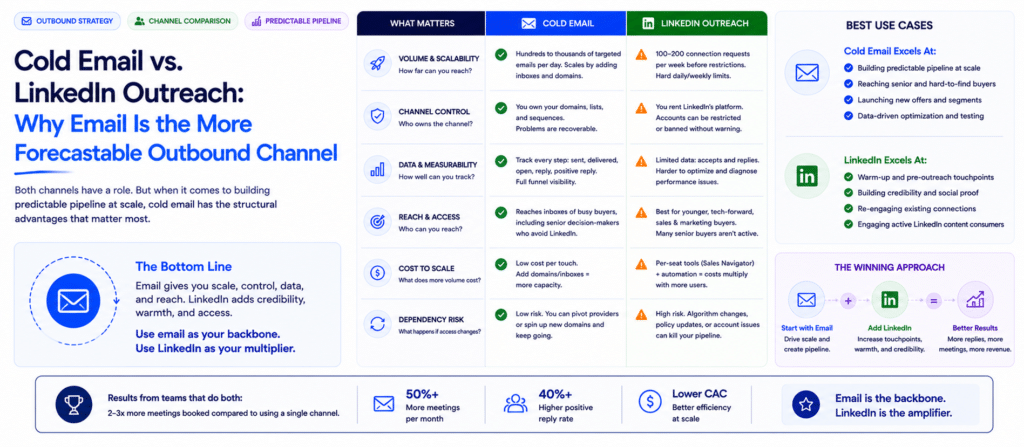
Cold email vs. LinkedIn outreach compared on volume, control, data, reach, and cost. If you’re choosing a backbone for outbound, cold email is the stronger pick — not because LinkedIn is bad, but because email gives you the things a forecastable revenue engine actually needs.
 Konnektys TeamJune 22, 2026 · 12 min read · Outbound Strategy
Every B2B team that does outbound eventually runs into the same fork in the road: where do you put your energy, cold email or LinkedIn? Both get talked about constantly, both have loud advocates, and both can absolutely book meetings. So the question isn’t really “which one works.” They both work. The question is which one you can build a predictable pipeline on, and that’s a different and more useful thing to ask.
I’ll give you my honest answer up front, because the rest of this article is going to defend it: if you’re choosing a backbone for outbound, cold email is the stronger pick. Not because LinkedIn is bad, but because email gives you the things a forecastable revenue engine actually needs. Volume you can dial up and down. A channel you own. Data clean enough to fix what’s broken. Reach into the inboxes of people who never open LinkedIn. And a cost structure that scales without bleeding you dry.
That doesn’t mean you should delete your LinkedIn account. The best outbound motions usually run both. But if you’re deciding which channel forms the reliable core of your pipeline and which plays a supporting role, the case for email being the core is strong, and it comes down to five structural advantages that have nothing to do with clever copywriting and everything to do with how each channel is built.
The Short Answer
For anyone who wants the comparison in one glance, here’s where cold email holds a structural edge over LinkedIn outreach:
Forecastable volume.
Email lets you send hundreds of targeted messages a day across multiple inboxes. LinkedIn caps you at roughly 100 to 200 connection requests a week before restrictions kick in, which makes the top of your funnel hard to model.
Channel ownership.
Your domains, lists, and sequences belong to you. A LinkedIn account can be throttled or suspended overnight, and there’s no appeal that brings your pipeline back fast.
Clean, measurable data.
Email gives you sent, delivered, open, reply, and positive-reply rates per campaign and per segment. LinkedIn’s reporting is thin by comparison, so you optimize half-blind.
Reach into inboxes LinkedIn can’t.
Many senior decision-makers barely touch LinkedIn but live in their email all day. Email meets them where they already are.
Cheaper, more systematizable scaling.
Adding email capacity costs far less than stacking per-seat Sales Navigator and automation tools, and the workflows are easier to repeat.
The detail behind each of these is where the argument actually gets convincing, so let’s go through them.
1. Volume You Can Forecast
Predictable pipeline needs predictable input. That sounds obvious, but it’s the single biggest reason email beats LinkedIn as a forecasting backbone, and it gets overlooked constantly.
Here’s the mechanics. With email, you can run multiple sending inboxes across multiple domains, each sending a controlled number of messages per day, and add more capacity whenever you want to scale up. If you know that 1,000 targeted emails a week produces a certain number of positive replies, and you want to double your pipeline, you add inboxes and send 2,000. The relationship between input and output is something you can actually model, because you control the input directly. Outbound becomes a dial you can turn.
LinkedIn doesn’t give you that dial. The platform caps connection requests at roughly 100 to 200 a week before it starts restricting your account, and those limits aren’t negotiable. They’re enforced by the platform to protect its user experience, and pushing against them gets you warnings, then restrictions, then suspension. So even if you’ve found a message that converts beautifully, you physically cannot scale the top of your funnel past LinkedIn’s ceiling. Your output is capped by the platform’s rules, not by your ambition or your budget.
This ceiling is fine if your goals are modest. If you only need a few meetings a month, LinkedIn’s limits won’t bother you. But the moment you need to forecast pipeline at any real scale, the cap becomes a hard problem. You can’t tell a board “we’ll generate X in pipeline next quarter” when your primary channel physically limits how many people you can reach, and that limit shrinks the more aggressive you get. Email has no equivalent wall. You scale by adding infrastructure, and the infrastructure is something you can plan, budget, and build in advance.
Walk through the math and the difference becomes obvious. Suppose your campaign produces a 3% positive-reply rate and one in four positive replies becomes a meeting.
Cold Email
2,000 well-targeted sends a week at the same rates produces roughly 60 positive replies and around 15 meetings. Want more? Add inboxes and send 4,000.
Capped at 200 touches a week, your absolute ceiling is around six positive replies and one or two meetings a week, and there is no legal way to push past it.
The conversion rates are identical in both cases. The only thing that changed is whether the channel let you scale the input, and that single variable is the difference between a pipeline you can grow on demand and one that’s stuck at whatever the platform allows.
Getting that infrastructure right is the whole game here, because volume without deliverability is just a faster way to land in spam. This is exactly where proper email infrastructure setup earns its keep, with separate sending domains, disciplined warmup, and correct authentication so that the volume you add actually reaches inboxes instead of triggering filters.
The Takeaway
Email gives you a top of funnel you can scale and forecast. LinkedIn hands you a ceiling you can’t move. If predictable pipeline is the goal, that difference alone is decisive.
2. You Own the Channel
This one is easy to ignore right up until the day it ruins your quarter.
When you run outbound on cold email, you own the assets. The domains are registered to you. The lists are yours. The sequences live in tools you control. If one provider gives you trouble, you can move. Nothing about your core outbound motion depends on the goodwill of a single platform that can change its mind about you without warning.
LinkedIn is the opposite. Your entire presence there exists at the platform’s discretion. LinkedIn can throttle your account’s reach, restrict your messaging, or suspend you outright, and it can do any of that overnight, often with an automated decision and no meaningful appeal. People who’ve built their whole outbound motion on LinkedIn have watched it vanish because an algorithm flagged their activity as too aggressive, or because of a change to the platform’s rules they had no say in. When that happens, the pipeline doesn’t slow down. It stops.
If your outbound lives entirely on a platform you don’t control,
your revenue is one policy change away from collapse.
Think about what that means for risk. If your outbound lives entirely on a platform you don’t control, your revenue is one policy change, one algorithm tweak, or one false-positive suspension away from collapse. That’s not a hypothetical for teams that have lived it; it’s a recurring story. And there’s no insurance for it, because the platform owes you nothing. You’re a guest, operating under rules that can shift whenever it suits the host.
Owning your channel doesn’t make email immune to problems. Domains can get burned, inboxes can land in spam, and providers do have their own rules. But the crucial difference is recoverability and control. If a domain has issues, you spin up new ones and keep going. If a provider disappoints you, you switch. The motion survives because you own the pieces. A suspended LinkedIn account, by contrast, takes your connections, your message history, and your reach with it, and waiting on a support queue is the only lever you have.
For any business serious about treating outbound as durable infrastructure rather than a fragile experiment, building it on assets you own is the safer foundation. Running it as part of a managed end-to-end B2B lead generation setup adds another layer of resilience, because the domains, deliverability, and sending capacity are actively maintained rather than left to degrade until something breaks.
The Takeaway
Building your pipeline on a platform you don’t control means a single decision you can’t influence can end it. Owning your channel keeps the engine in your hands.
3. Clean, Measurable Data at Every Step
You can’t fix what you can’t see, and this is where the gap between the two channels gets wide in a way that compounds over time.
Cold email is a measurement-rich channel. For every campaign and every segment, you can track the full funnel: how many emails sent, how many delivered, how many opened, how many replied, and how many of those replies were positive. That chain of metrics is diagnostic gold, because it tells you exactly where your funnel leaks. Low delivery rate? You have an infrastructure or list-hygiene problem. Good delivery but low opens? Your subject lines or sender reputation need work. Good opens but weak replies? Your offer or copy isn’t landing. Each metric points at a specific fix, so you can iterate with precision instead of guessing.
LinkedIn’s reporting is thin by comparison. You can see whether someone accepted a connection request and whether they replied, but the granular, per-step visibility that email gives you mostly isn’t there. You’re missing the equivalents of delivery and open data, which means when something underperforms, you’re left guessing at why. Was the message bad? Was the targeting off? Did they just not see it? LinkedIn won’t tell you, so you optimize half-blind, changing things based on hunches rather than evidence.
This difference matters enormously over the long run, because outbound improvement is cumulative. A channel where you can see exactly what’s broken lets you run a tight loop: measure, diagnose, fix, measure again. Each cycle makes the next campaign better. A channel where you’re guessing produces slower, noisier improvement, because half your changes are based on intuition that may be wrong. Over months, the team with clean data pulls steadily ahead, not because they’re smarter, but because they can see.
Consider how a single underperforming email campaign gets diagnosed. You pull the numbers and see 95% delivery, 22% open rate, but only a 1% reply rate.
Cold Email
Immediately you know the problem isn’t deliverability and it isn’t the subject line, since the email is landing and getting opened. The leak is in the body — the offer or the call to action isn’t compelling enough to earn a reply. So you test a stronger offer and watch that reply rate specifically.
Run the same scenario on a channel that only tells you “they accepted, they didn’t reply.” You have no idea whether they saw it, whether the opening line failed, or whether the offer fell flat, so you’re changing things blind and hoping.
The email funnel handed you a precise diagnosis; the thin-reporting channel handed you a mystery.
The quality of that data depends heavily on what’s underneath it. Metrics are only trustworthy if your list is clean and your targeting is sound, because garbage data produces garbage analytics no matter how good the reporting looks. This is why list quality work like AI-powered lead research and email finding and verification directly improves not just your results but your ability to read your results, and ongoing CRM cleaning keeps that signal from degrading as contacts go stale.
The Takeaway
Email shows you exactly where the funnel leaks so you can fix it. LinkedIn leaves you optimizing in the dark. Over time, visibility wins.
4. It Reaches the Decision-Makers Who Ignore LinkedIn
There’s a quiet assumption baked into LinkedIn outreach: that your buyer is on LinkedIn, checks it regularly, and will see your message. For a lot of senior decision-makers, none of that is reliably true.
Plenty of the people with real buying authority barely use LinkedIn. They might have a profile they set up years ago and rarely log into. They’re not scrolling the feed, they’re not reviewing connection requests, and a thoughtful note you spent time crafting can sit unseen indefinitely because they simply aren’t there to read it. Meanwhile, those same people are in their email inbox constantly, all day, because that’s where their actual work happens. Email is woven into their job in a way LinkedIn isn’t.
This is a structural reach advantage that has nothing to do with message quality. You can write the best LinkedIn message in the world, but if the recipient doesn’t open the app, it doesn’t matter. Email meets buyers in the channel they already live in. You’re not hoping they accept a request, then hoping they scroll back far enough to notice your message. You’re landing directly in the place they check by reflex.
It also tends to skew by seniority and industry in a way worth knowing.
Cold Email
The more reliable channel for traditional industries, operational roles, and senior executives whose time is too scarce for social feeds.
Works well for younger buyers and people in tech-forward, marketing, or sales roles — segments genuinely active on the platform.
If your ideal customer profile includes senior executives in traditional industries, leaning on LinkedIn means systematically missing a chunk of your market.
Knowing where your specific buyers actually pay attention is part of targeting them well in the first place, which is why mapping your audience through proper market research and TAM analysis and building accurate contact data through contact list building matters as much as the channel choice itself. The right channel is the one your buyer actually uses, and for senior decision-makers, that’s overwhelmingly the inbox.
The Takeaway
A message only works if it’s seen. Email reaches the buyers who never open LinkedIn, which for many B2B markets is a large and valuable share of the people you most want to reach.
5. It’s Cheaper to Scale and Easier to Systematize
The last advantage is the one finance teams care about, and it’s more lopsided than most people expect.
Scaling cold email means adding more sending capacity: more domains, more inboxes, more sequences. These are relatively cheap, and the cost per additional touch stays low as you grow. You’re mostly paying for infrastructure and tooling that doesn’t charge you per prospect reached. The marginal cost of sending the next thousand emails is small, which is exactly what you want from a channel meant to scale.
LinkedIn outreach carries a heavier cost structure. Doing it at any scale usually means a stack of per-seat tools: Sales Navigator licenses, plus automation software to handle outreach within the platform’s limits, often priced per user. As you add people to scale the effort, those per-seat costs multiply, and you’re still bound by the platform’s volume caps on top of paying more. You end up spending more to reach fewer people, which is the wrong direction for an engine meant to produce forecastable returns.
There’s a systematization angle here too. Lower cost per touch only matters if you can build repeatable workflows around it, and email lends itself to that. The process of building a list, loading a sequence, sending, measuring, and iterating is highly standardizable. You can document it, hand it off, and run it consistently across campaigns, which is what turns outbound from a series of one-off gambles into a dependable revenue process. LinkedIn’s manual, platform-constrained nature makes it harder to systematize to the same degree, because so much of it is gated by limits and account-level risk that don’t reduce cleanly to a repeatable playbook.
Put the cost and the repeatability together and you get the real prize: a channel where you can confidently predict that a given investment produces a given return, and where scaling up the investment scales up the return in a roughly knowable way. That predictability, more than any single tactic, is what lets a business plan its pipeline around outbound instead of hoping it works. Pairing the two channels through cold email and LinkedIn outreach lets you keep email as the scalable, systematized core while using LinkedIn selectively where it adds the most value, which is the combination most strong outbound teams land on.
The Takeaway
Email scales cheaply and systematizes cleanly, turning outbound into a forecastable process. LinkedIn’s per-seat costs and manual constraints make the same scale more expensive and less repeatable.
The Honest Counterpoint: Where LinkedIn Earns Its Place
I’d be doing you a disservice if I pretended LinkedIn had no role, because it does, and the smartest teams use it deliberately rather than dismissing it.
LinkedIn shines in a few specific situations. It’s strong for warm-up and credibility, because a prospect can see your profile, your content, and your mutual connections, which builds trust that a cold inbox can’t. It works well for buyers who genuinely are active on the platform, particularly in tech, sales, and marketing roles. And it’s effective as a second touch that reinforces an email, so the prospect sees a name they half-recognize land in two places, which lifts response rates beyond what either channel does alone.
The point of this article isn’t that LinkedIn is useless. It’s that LinkedIn makes a poor sole backbone for a forecastable pipeline, for all the structural reasons above, while email makes a strong one. The right mental model is email as the scalable, measurable, owned core of your outbound, with LinkedIn layered in as a complement that adds warmth and reaches the segments where it’s genuinely strong. Teams that frame it as a war between the two usually underperform teams that assign each channel the job it’s actually good at.
The Takeaway
Use email as the core and LinkedIn as a deliberate complement. The goal isn’t to pick a side; it’s to give each channel the role its structure suits.
How to Put This Into Practice
If you’re convinced email should anchor your outbound, here’s how to set it up so the structural advantages actually show up in your numbers.
Build sending infrastructure before you build volume.
Separate your cold-sending domains from your primary company domain, warm them properly, and configure authentication correctly. This is what lets you scale volume without torching deliverability, and it’s the foundation everything else sits on.
Start with a clean, well-targeted list.
The volume advantage is worthless if you’re emailing the wrong people. Build your list around your real ideal customer profile with verified contact data, so every email you scale up is actually reaching a fit prospect.
Instrument everything from day one.
Track sent, delivered, open, reply, and positive-reply rates per campaign and per segment from your very first send. The measurement advantage only pays off if you’re capturing the data, so set it up before you need it.
Run a real iteration loop.
Use the data to find the leak, fix it, and measure again. Test multiple offers and message variants rather than endlessly tweaking one. The compounding improvement is where email’s data advantage turns into actual pipeline.
Add LinkedIn as a coordinated second touch, not a separate silo.
For your best-fit accounts, layer a LinkedIn touch alongside the email so the prospect experiences a coherent, multichannel approach. Keep email as the scalable core and let LinkedIn do the reinforcing.
Treat it as a system, not a campaign.
The businesses that win with outbound run it as ongoing, documented, repeatable infrastructure. If building and maintaining that system in-house isn’t where you want to spend your time, that’s precisely what a managed program is for.
Frequently Asked Questions
Is cold email better than LinkedIn outreach?
+
How many cold emails can you send per day compared to LinkedIn messages?
+
Why is owning your outbound channel important?
+
What data can you track with cold email that you can’t with LinkedIn?
+
Does cold email reach senior decision-makers better than LinkedIn?
+
Is cold email cheaper than LinkedIn outreach?
+
Should I use cold email or LinkedIn for B2B outbound?
+
What do you need to scale cold email successfully?
+
Closing Thought
The cold email versus LinkedIn debate gets framed as a fight, but that framing is what trips most teams up. Both channels book meetings. The real question is which one you can build a forecastable pipeline on, and on that specific question, email’s structure wins. You can scale its volume, you own the channel, you can see exactly where it leaks, you reach buyers who never open LinkedIn, and you can do all of it cheaply and repeatably.
LinkedIn still belongs in the mix. It builds credibility, it reaches the buyers who are genuinely active there, and it reinforces email beautifully as a second touch. But as the backbone, the dependable core that your pipeline forecasts are built on, email is the safer and more scalable bet for the reasons that have nothing to do with luck and everything to do with how the channel works.
Build Outbound That Behaves Like a Forecastable Revenue Engine
See how end-to-end B2B lead generation turns email into a scalable, measurable core, or start with email infrastructure setup so the volume you build actually lands. Email gives you the dial. The rest is learning how to turn it.
- The Short Answer
- 1. Volume You Can Forecast
- 2. You Own the Channel
- 3. Clean, Measurable Data at Every Step
- 4. It Reaches the Decision-Makers Who Ignore LinkedIn
- 5. It’s Cheaper to Scale and Easier to Systematize
- The Honest Counterpoint: Where LinkedIn Earns Its Place
- How to Put This Into Practice
- Frequently Asked Questions
- Closing Thought
Want email to be your forecastable core, with LinkedIn layered in as a complement? We’ll build the infrastructure, the list, and the system.
Talk to Konnektys →Related articles
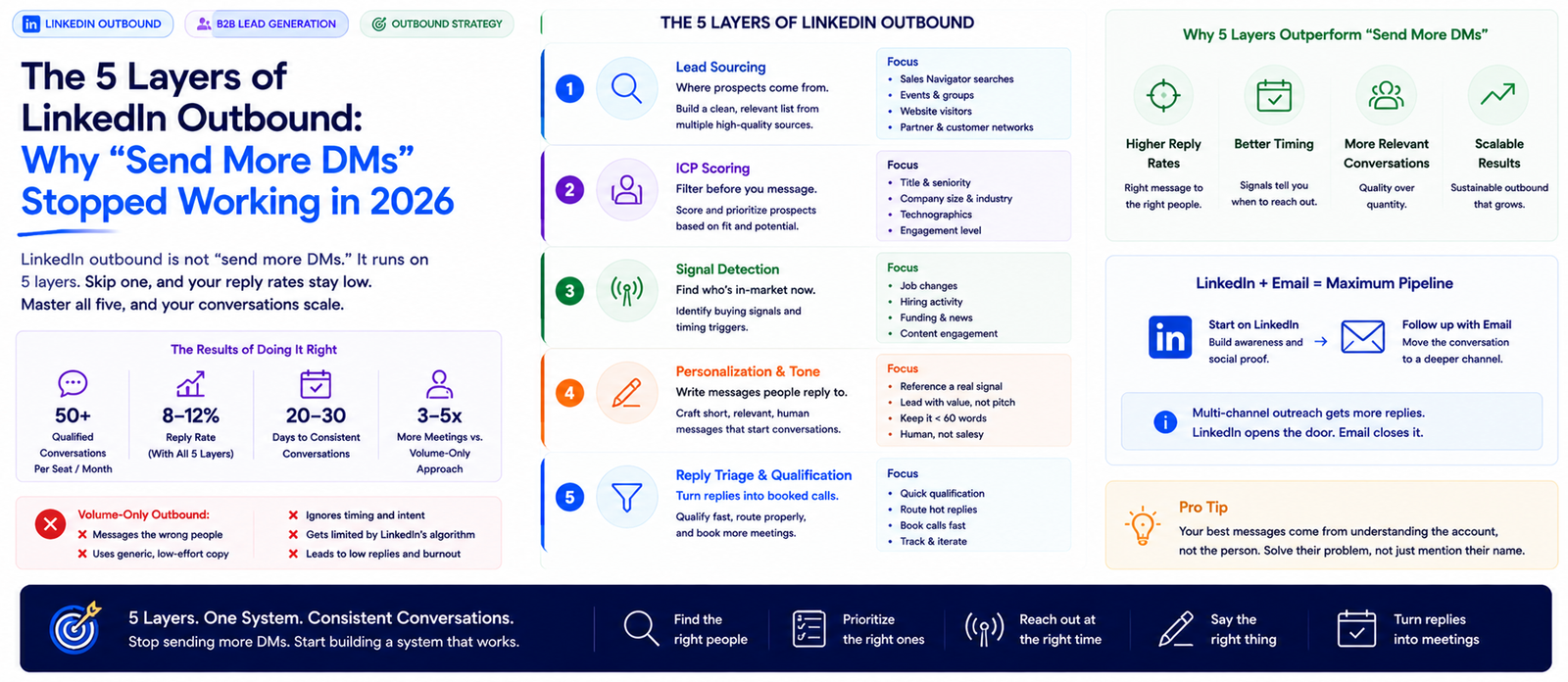
The 5 Layers of LinkedIn Outbound: Why “Send More DMs” Stopped Working in 2026
Konnektys Team · 18 Jun, 2026
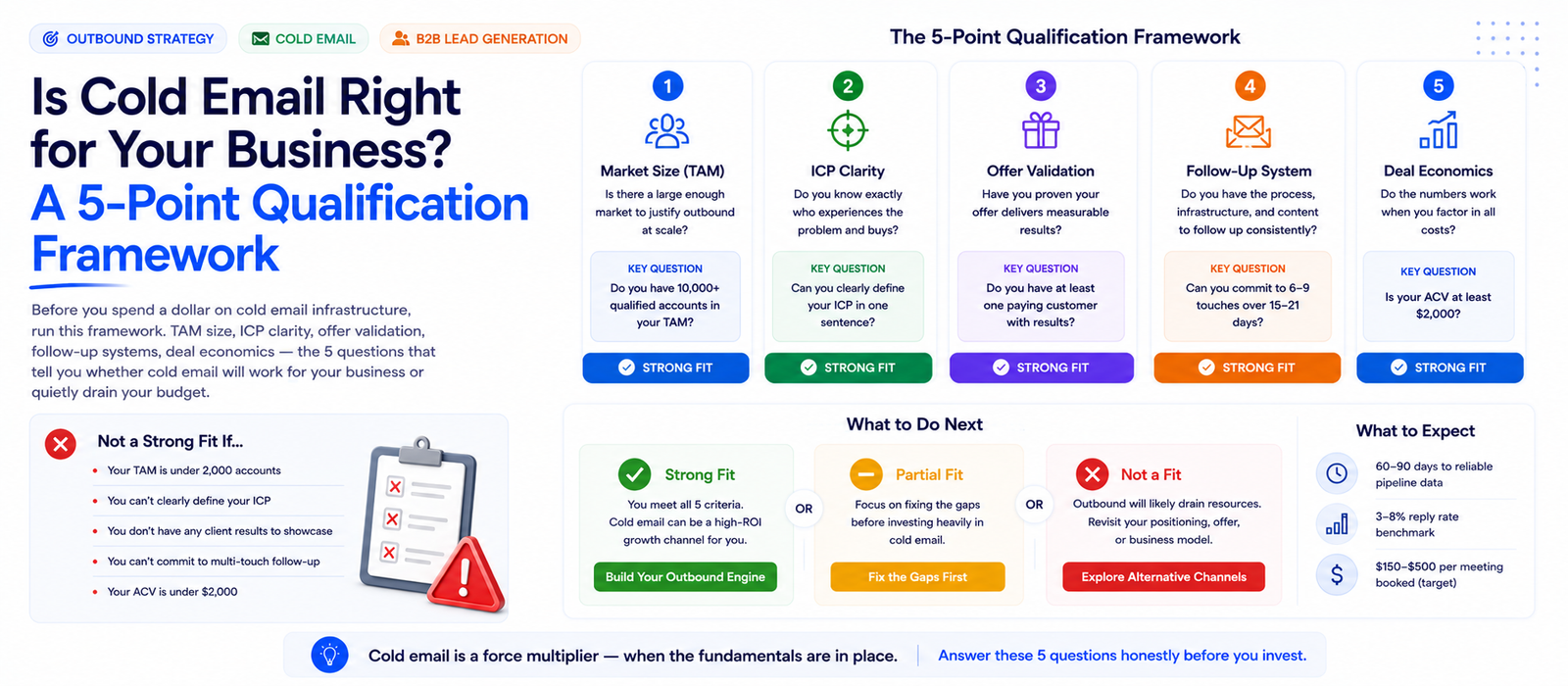
Is Cold Email Right for Your Business? A Qualification Framework
Konnektys Team · Jun, 2026