
Why Outbound Campaigns Fail: The 7 Root Causes (And How to Fix Each One)
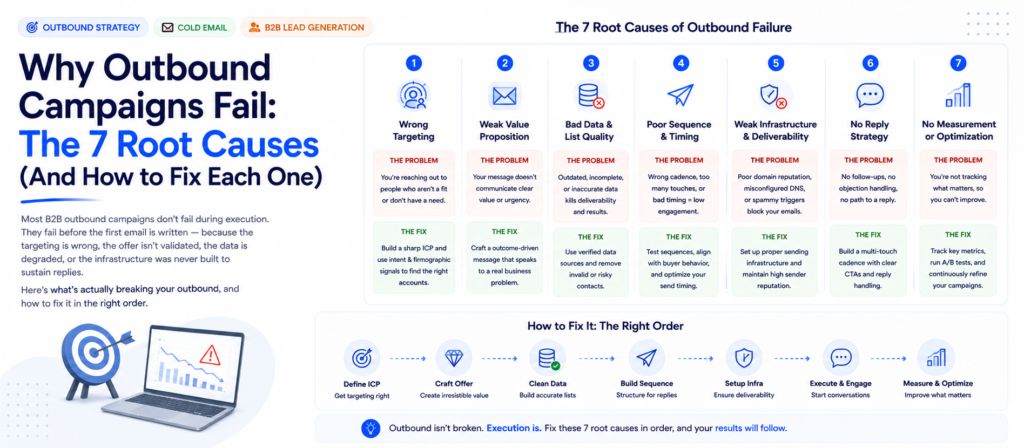
Most B2B outbound campaigns don’t fail during execution. They fail before the first email is written — because the targeting is wrong, the offer isn’t validated, the data is degraded, or the infrastructure was never built to sustain replies. Here’s what’s actually breaking your outbound, and how to fix it in the right order.
 Konnektys TeamMay 16, 2026 · 14 min read · Outbound Strategy
Why Teams Blame the Wrong Things
The conversation about why outbound fails usually starts in the wrong place.
A campaign underperforms. Reply rates are low. The post-mortem focuses on subject lines, email length, send times, personalisation levels. The team runs A/B tests. They try shorter emails, longer emails, different openers, different CTAs.
The reply rates stay low.
That’s because the problem was never the copy. Copy is the last mile. It fails visibly when everything behind it fails invisibly — wrong people targeted, unvalidated offer, bounced addresses, flagged sending domains, no follow-up system.
Optimising copy on top of broken fundamentals is like tuning a car engine with no fuel in the tank. The engine runs better. The car still won’t move.
Copy is visible. Infrastructure isn’t. When a campaign underperforms, the emails are right there — readable, criticisable, improvable. The deliverability rate, the domain health score, the ICP precision, the contact list verification rate — none of these appear in the dashboard most reps look at every morning.
The feedback loop is broken. Cold email response data is noisy. A 1% reply rate could mean the offer is wrong, the targeting is wrong, the copy is wrong, or the emails are landing in spam. Most teams don’t have monitoring in place to separate these variables.
The wrong things get resourced. Sequencing tools, copywriting contractors, personalisation software — these look like outbound investment. Domain procurement and rotation, contact verification infrastructure, ICP research — these look like operational overhead.
Sunk cost momentum. Once infrastructure is purchased and sequences are built, teams have a strong incentive to explain underperformance as a messaging problem rather than a structural one.
How to Diagnose Which Root Cause Is Your Problem
Before changing anything, run this diagnostic:
Check inbox placement first. Run your sending domains through an inbox placement tool (GlockApps, MXToolbox, or Mailmeteor’s seed testing). If primary inbox placement is below 65%, deliverability is broken. Fix that before changing anything else.
Check your bounce rate. If hard bounces are above 3% per campaign, your list has a data quality problem. Pause sends, clean the list, and verify before continuing.
Check your open rate relative to send volume. An open rate below 20% on a warmed domain sending to a verified list is a signal problem. Above 20% with low replies points to a messaging or offer problem.
Check your reply rate by segment. If certain job titles, industries, or company sizes are generating meaningfully higher reply rates, your ICP is probably too broad.
Check the offer. Ask: could a prospect who read your last three outbound emails explain to a colleague what you do and why it matters to them specifically? If no, the offer is the problem.
Root Cause 1: ICP That’s Too Broad to Be Useful
?? Symptom: Low reply rates across all segments, no clear pattern in what’s working, emails that feel relevant to write but generic to receive.
The real problem: “B2B SaaS companies” is not an ICP. “Fintech companies in the US” is not an ICP. These are categories — and categories have too much internal variation to allow for messaging that resonates consistently.
A real ICP is specific enough that you can build a list of 500 companies against it in under two hours without making judgment calls.
What a working ICP actually specifies:
Company attributes: Industry and sub-vertical, headcount range, revenue stage, geography, tech stack requirements, and explicit deal-breakers.
Contact attributes: Job title, seniority level, department, and the specific pain points that are live for this person right now — not pain they theoretically have, but pain actively costing them something today.
Buying triggers: Recent funding, hiring surges in relevant roles, leadership changes, product launches, tech stack shifts — conditions indicating an account is likely in buying mode.
Market research and TAM analysis establishes the actual universe of accounts that meet your criteria. AI-powered lead research layers signal detection on top of that universe.
The fix: Write your ICP as a single sentence: “We help [specific role] at [specific company type] who [specific live problem] achieve [specific measurable outcome].” If it takes more than 20 words, it needs to be tighter. If your existing closed deals closed fastest and referred others — that’s your actual ICP.
Root Cause 2: A Lead List That Was Never Qualified
?? Symptom: Hard bounce rate above 3%, spam trap hits, domain reputation declining faster than expected.
The real problem: Most lead lists used for cold outreach contain more problems than the team is aware of. Role changes go untracked. Company email addresses get recycled or deactivated. Data providers sell lists that were accurate 18 months ago. Roughly 25–30% of any B2B contact database becomes inaccurate within a year.
Every hard bounce registers against your sending domain’s reputation. A list with 10% invalid contacts will degrade a fresh domain in weeks rather than months. The damage is cumulative and largely irreversible.
What a qualified lead list actually requires:
Real-time verification. Not verified six months ago — verified before this campaign goes live. Email finding and verification run as a pre-campaign step.
Role accuracy. Reverse email and phone appending keeps contact-level data current.
Company-level enrichment. CRM data enrichment ensures company-level data is accurate and current.
Intent and signal layering. Hiring intent data, buyer intent data, and technographic data surface accounts at inflection points.
The fix: Never launch on a list not verified within the last 30 days. Monitor hard bounce rate from day one. If bounces exceed 2% in the first week, pause, clean, and re-verify. The cost of verification is always lower than the cost of domain rehabilitation.
Root Cause 3: An Offer Nobody Cares About Yet
?? Symptom: Reasonable open rates but very low reply rates, prospects opening multiple times without responding, replies that say “not right now”.
The real problem: The offer doesn’t answer the prospect’s implicit question: “Why does this matter to me, right now, specifically?”
Generic offers — “we help companies grow,” “we improve your sales process” — fail not because they’re badly written but because they’re about the seller, not the prospect.
A strong offer has four components working simultaneously:
Specificity. It names a clear segment, not a broad category. “We help VP of Sales at B2B SaaS companies with 20–100 reps” is specific.
Outcome focus. It leads with the result the prospect gets, not the process the seller runs. “Cut your SDR ramp time by six weeks” is an outcome.
Relevance to right now. Connect to something live for the prospect today. AI-powered lead research surfaces the signals that make this contextual relevance possible at scale.
Credibility. One specific result from one real client in a similar situation is worth more than a page of feature descriptions.
The fix: Before rewriting copy, validate the offer through warm channels. Pitch it to five people who match the ICP. If fewer than three say “I’d want to know more,” the offer needs work — not more outbound volume. Cold email amplifies existing demand — it doesn’t create it.
Root Cause 4: Deliverability That’s Already Broken
?? Symptom: Campaigns that used to perform have suddenly gone quiet. Open rates dropped. Reply rates negligible. Volume is the same, copy hasn’t changed.
The real problem: Most deliverability problems are silent for weeks before they become visible. By the time reply rates have noticeably collapsed, the sending domain has been fingerprinted, inbox placement has fallen below 40%, and the majority of outreach has been silently routed to spam for a month or more.
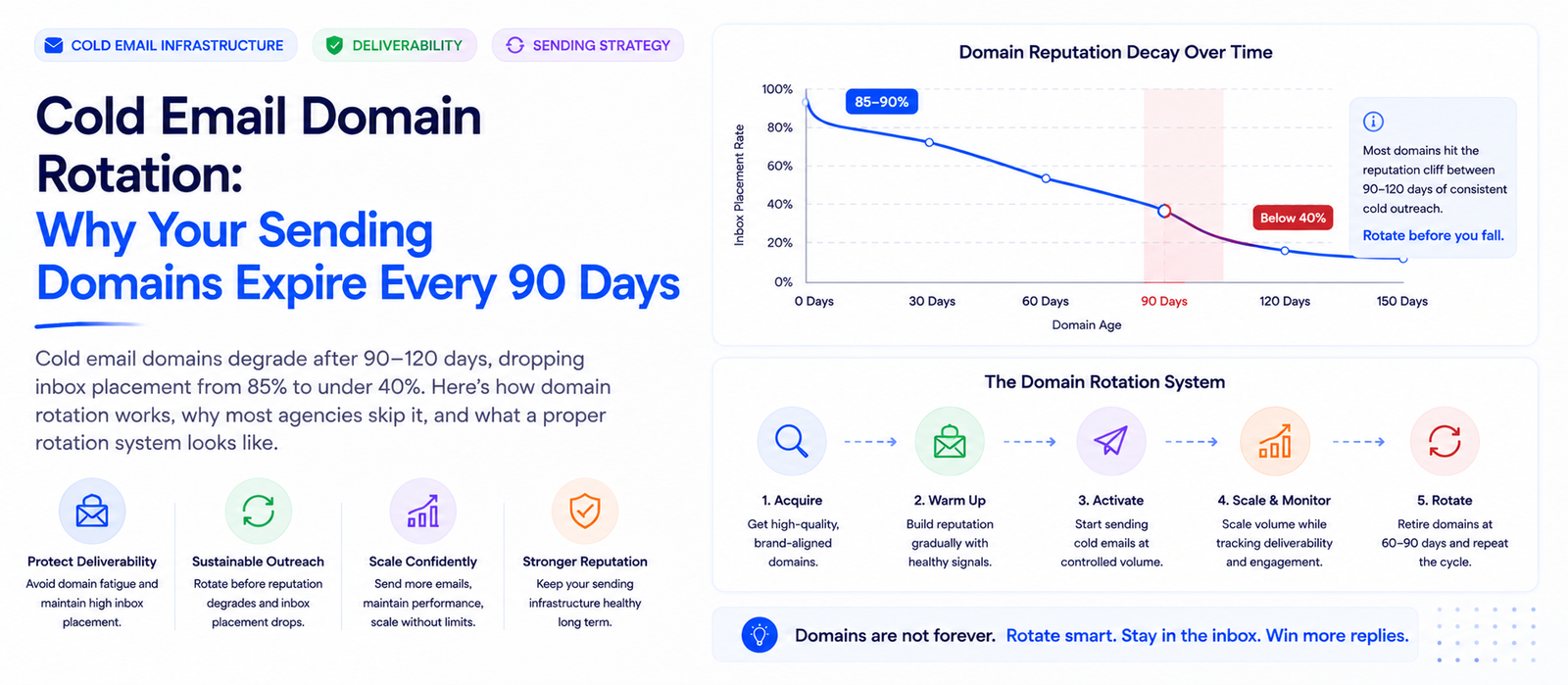
Cold email domains degrade. After 90–120 days of cold outreach volume, inbox providers have accumulated enough domain-level signals — engagement rates, complaint rates, bounce patterns — to permanently classify the domain as a commercial sales sender.
The technical requirements for healthy deliverability:
Authentication records. SPF, DKIM, and DMARC correctly configured on every sending domain. Non-negotiable baseline.
Structured warmup. New domains need 3–4 weeks of low-volume, high-engagement warmup before any cold sends begin.
Volume distribution. No single domain should carry the full campaign send load. Distribute sends across 3–5 domains per 1,000 daily emails.
Proactive domain rotation. On a fixed 90-day calendar — not triggered by performance drops. Our email infrastructure setup service manages this rotation proactively.
Inbox placement monitoring. Open rate tracking is not deliverability monitoring. You need inbox placement rate data at the domain level. See our cold email domain rotation guide.
The fix: Run an inbox placement test on every active sending domain today. If placement is below 65%, retire the domain and rotate to fresh infrastructure immediately. Anything over 90 days of active cold sending is past its reliable shelf life.
Root Cause 5: No Real Follow-Up System
?? Symptom: Reply rates low relative to open rates. A “one and done” send pattern. Sequences that stop at one or two emails.
The real problem: Most positive replies in a cold email campaign don’t come from the first email. Research consistently shows 60–80% of outbound replies come from follow-up touches — typically the second, third, or fourth. A campaign that stops at one email is structurally abandoning the majority of its potential pipeline.
What a working follow-up system requires:
Multi-touch structure. 4–6 touchpoints over 15–21 days. Day 1 opens with a relevant trigger. Day 4 leads with a case study. Day 7 asks a diagnostic question. Day 10 reframes the offer. Day 14 is a breakup email.
Engagement-based triggers. Prospects who opened three times without replying are meaningfully different from those who haven’t opened at all.
Multi-channel integration. Cold email and LinkedIn outreach running in parallel consistently outperform single-channel sequences for high-priority accounts.
The fix: Audit your last three campaigns. What percentage of replies came from email one versus later touches? If almost all came from email one, your follow-up isn’t adding value. Build the sequence first, automate it fully, then launch.
Root Cause 6: Copy Optimised Before the Foundations Are Fixed
?? Symptom: Constant A/B testing with no meaningful improvement. Subject line changes that move open rates by 1–2% but don’t affect reply rates.
The real problem: Copy optimisation is a multiplier, not a foundation. It amplifies a working system but cannot rescue a broken one.
The right order:
- ICP defined with specificity
- Offer validated through warm channels before cold deployment
- Infrastructure set up — authentication, warmup, rotation schedule
- List built and verified — bounce rate confirmed below 2%
- Follow-up sequence structured — 4–6 touches with varied angles
- Campaign launched with deliverability monitoring at the domain level
- Copy optimised — subject lines, first lines, CTAs — once baseline metrics are established
Copy optimisation at step 7 produces meaningful improvements. Copy optimisation at step 1 produces noise.
The specific copy elements worth optimising once fundamentals are working:
Subject line tension or curiosity. As we covered in our Day 1 cold email guide, the subject line has one job: earn the open. Create a small information gap, not describe the email.
First line about them, not you. Web and LinkedIn data scraping surfaces the signals that make genuine first-line personalisation possible at scale.
One clear CTA. Not three options. One ask, low friction.
Root Cause 7: No Pipeline Tracking or CRM Layer
?? Symptom: Replies that don’t convert to meetings. Meetings that don’t convert to opportunities. No visibility into what happened to leads after the sequence ended.
The real problem: Cold outreach without a downstream tracking system is a bucket with a hole in it. Prospects who reply but don’t immediately book get followed up on inconsistently. There’s no data on which segments actually convert to closed deals — which means the ICP can never be refined from real outcomes.
What a working pipeline layer requires:
CRM integration from day one. Every account that enters a sequence should be in the CRM, with status tracked from prospect to reply to meeting to opportunity to close.
Current, accurate CRM data. CRM data enrichment keeps company and contact records accurate. CRM cleaning removes records causing noise.
Closed-loop reporting. Which ICP segments from cold outreach convert to closed deals? What’s the average sales cycle from first reply to close? This data exists in the CRM if you’ve built the tracking.
Phone and direct outreach for high-priority accounts. Phone number finding enables a direct dial layer that often breaks through where email alone doesn’t.
The fix: Before launching any outbound campaign, confirm the CRM is set up to receive and track every contact who enters the sequence. If the CRM data is stale, enrich and clean it before the campaign starts.
The Correct Priority Order for Outbound Success
The seven root causes above have a natural hierarchy. Fixing them out of order wastes time and produces misleading results.
| Priority | What to Fix | Why It Comes First |
|---|---|---|
| 1 | ICP definition | Everything downstream — targeting, offer, signals, copy — inherits ICP quality |
| 2 | Offer validation | Cold email amplifies demand; it doesn’t create it |
| 3 | Infrastructure setup | Authentication, warmup, rotation — deliverability before any sends |
| 4 | List building and verification | Clean, verified, signal-enriched contacts |
| 5 | Follow-up sequence structure | 4–6 touches with varied angles, automated and triggered |
| 6 | Campaign launch with monitoring | Domain-level deliverability tracking from day one |
| 7 | Copy optimisation | Subject lines, first lines, CTAs — once baseline performance is established |
This order is not arbitrary. Each layer builds on the previous one. ICP precision makes offer specificity possible. Offer validation makes copy optimisation meaningful. Infrastructure setup makes list building effective. List quality makes follow-up worth running.
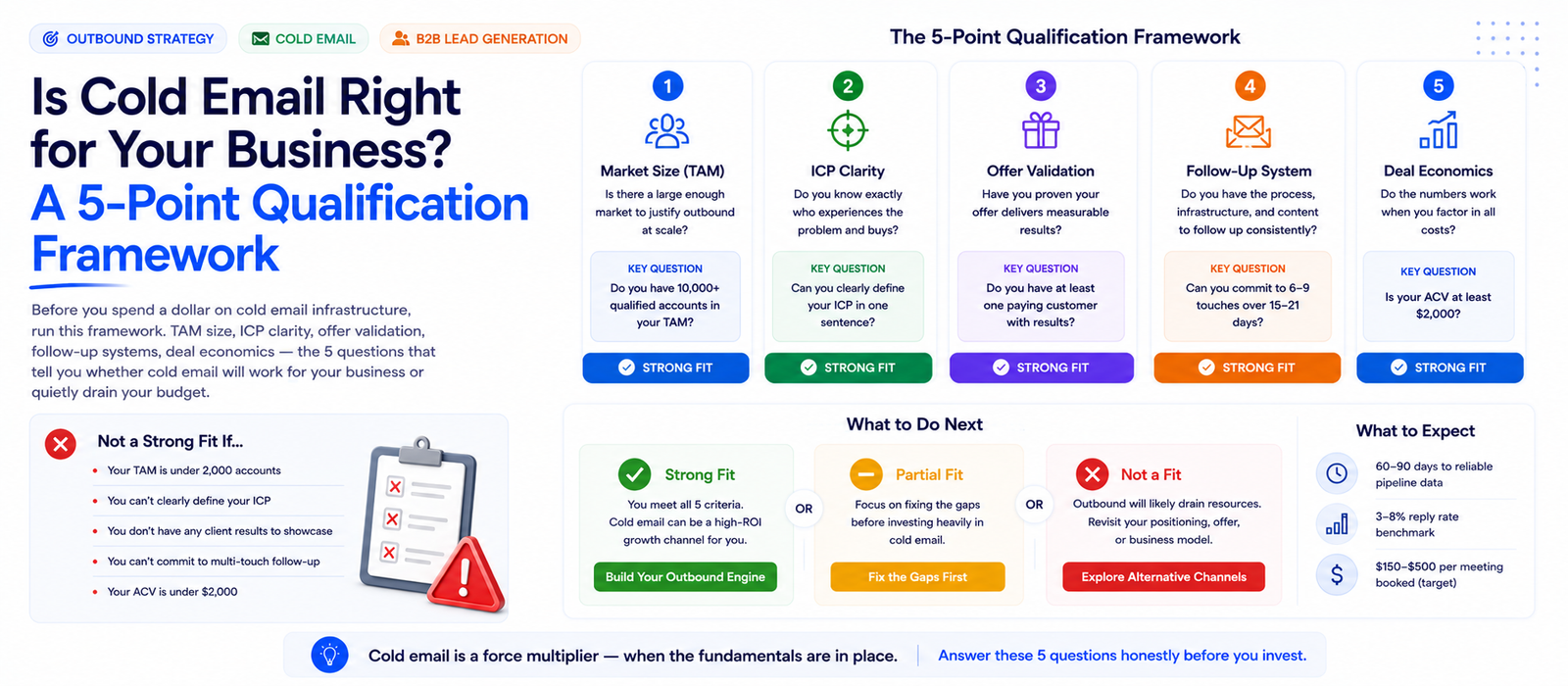
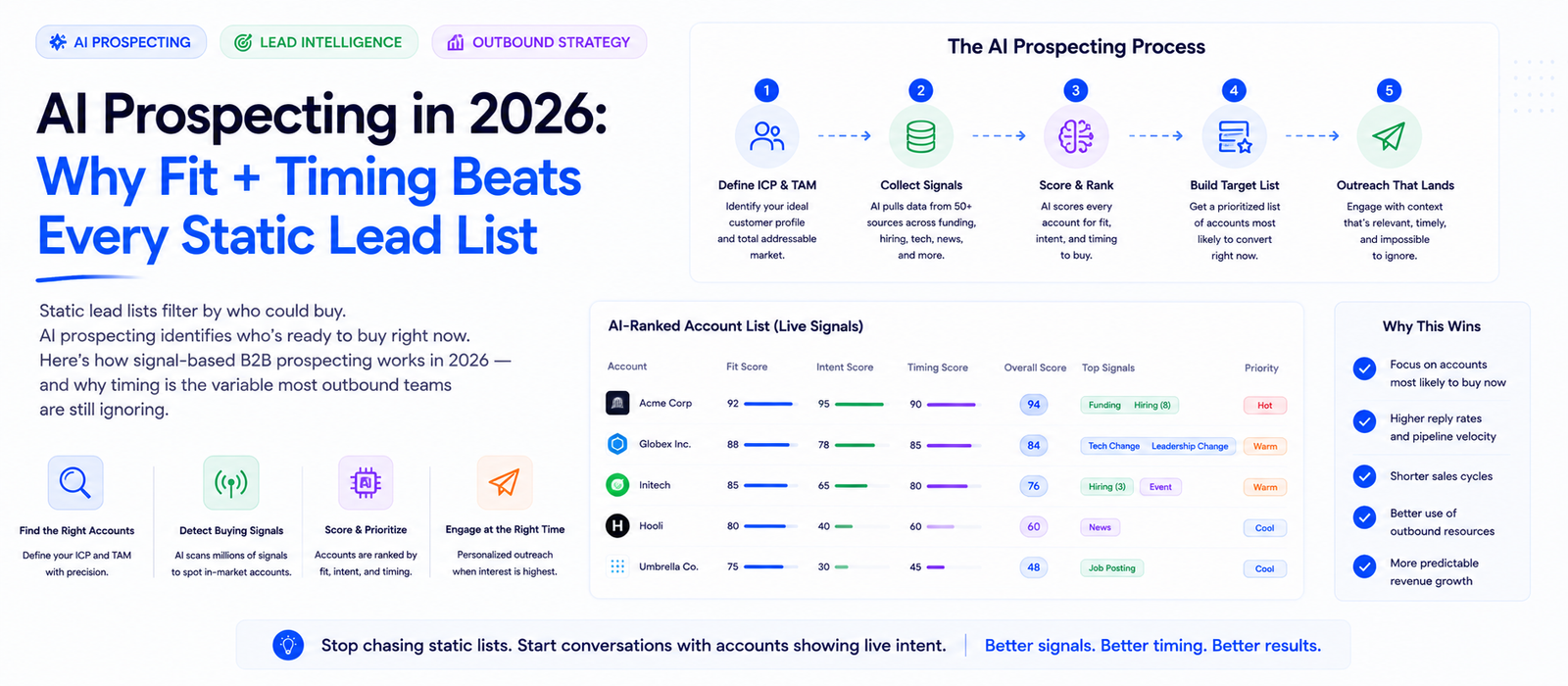
Start with our 5-point cold email qualification guide if you’re questioning whether cold email is even the right channel. And for a deep dive into how signal-based prospecting reshapes step 1 and 4, our AI prospecting guide covers the timing layer that most ICP definitions still ignore.
FAQ: Why Outbound Campaigns Fail — Answered
Why do most B2B outbound campaigns fail? +
What is the most common reason cold email campaigns get low reply rates?
+
How do I know if my cold email deliverability is broken?
+
What bounce rate is acceptable for a cold email campaign?
+
How many follow-up emails should a cold email sequence have?
+
Should I personalise every cold email at the individual level?
+
What’s the correct order for optimising a cold email campaign?
+
How long should it take for cold email to start producing results?
+
Can bad contact list data permanently damage my outbound programme?
+
What’s the difference between a cold email programme and a cold email experiment?
+
Ready to Fix What’s Actually Breaking Your Outbound?
If your outbound isn’t generating pipeline, the problem is almost certainly in steps 1–6 — not step 7. The copy is the last thing to fix, not the first.
Build Your Outbound from the Foundation Up
Konnektys builds and operates outbound revenue engines: ICP and TAM definition, AI-powered lead research, email infrastructure setup, and fully managed cold email and LinkedIn outreach.
Let’s find out what’s breaking your programme →- Why Teams Blame the Wrong Things
- How to Diagnose Your Root Cause
- Root Cause 1: ICP Too Broad
- Root Cause 2: Unqualified Lead List
- Root Cause 3: Offer Nobody Cares About
- Root Cause 4: Deliverability Broken
- Root Cause 5: No Follow-Up System
- Root Cause 6: Copy Before Foundations
- Root Cause 7: No Pipeline Tracking
- The Correct Priority Order
- FAQ
Need a consistent pipeline of qualified outbound leads? We’ll build and manage the entire system for you.
Talk to Konnektys →Share this article:
Related articles
Your Cold Email Domain Has a 90-Day Shelf Life — Here’s What That Means for Your Pipeline
Konnektys Team · 23 May, 2026
Is Cold Email Right for Your Business? A 5-Point Qualification Guide
Konnektys Team · 16 May, 2026
AI Prospecting in 2026: How Signal-Based Targeting Is Replacing List Buying
Konnektys Team · 30 May, 2026