
Why Every Cold Email Sounds the Same Now (And How to Sound Like a Human Again)
AI made every cold email sound identical and reply rates collapsed. The fix isn’t going fully manual — it’s using AI so well that the output sounds unmistakably like a specific human, not like everyone else selling into the same accounts.
 Konnektys TeamJune 25, 2026 · 11 min read · Cold Email Strategy
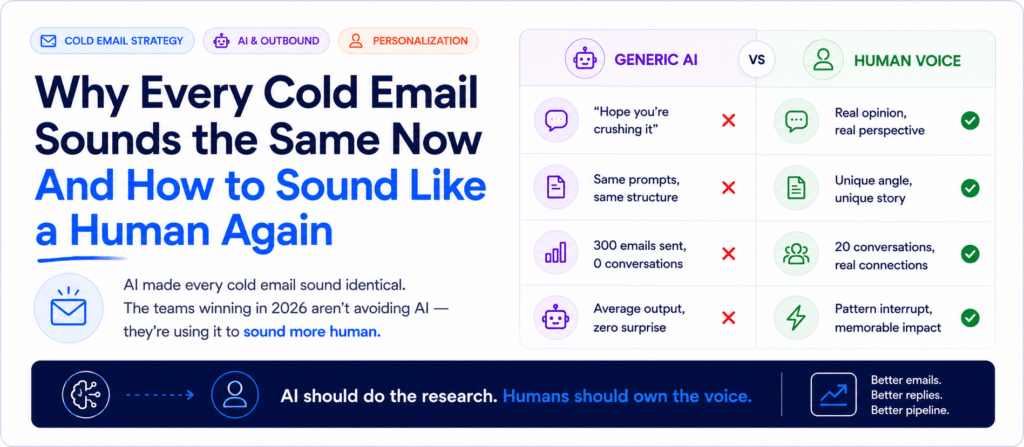
Open your inbox and read the last ten cold emails you received. I’ll bet money they read like one person wrote all of them.
“Hi [Name], hope you’re crushing it. I was looking at your company and noticed you’re scaling your go-to-market motion, and I had a quick thought…” You’ve seen that email a hundred times. You know exactly how it ends before you finish the first line. And here’s the part the sender doesn’t realize: you can tell, instantly, that nobody actually looked at your company. They ran your domain through an enrichment tool, fed the output to a language model, and fired the same template at four thousand other people that morning. The “I was looking at your company” line is a lie, and everyone on the receiving end knows it.
This is the state of B2B outreach right now, and it’s why reply rates have fallen off a cliff. Teams that used to see 8% replies are staring at 0.4% and blaming the market, the economy, the buyers, anything except the actual cause. The actual cause is that everyone bought the same tools, learned the same prompts, and outsourced their voice to the same robot, so every message now sounds like every other message. Sameness, at scale, is the problem.
This article is about how outreach got this way, why “more AI personalization” makes it worse rather than better, and what the people who’ll win the next couple of years are doing differently. Spoiler: they’re not abandoning AI. They’re using it far more carefully than the people drowning your inbox in robotic sludge.
The Short Answer
For anyone who wants the takeaway before the argument:
- •Cold email reply rates collapsed because outreach converged. Everyone uses the same handful of AI tools, trained on the same internet, prompted by the same playbooks, so every email, DM, and follow-up now sounds identical.
- •It’s not a tooling problem. It’s a voice problem. Teams stopped saying anything distinctive and let AI generate safe, generic, opinion-free copy that blends into the noise.
- •The fix isn’t going fully manual. AI is genuinely good at the heavy lifting of outbound. The fix is using it so well that the output sounds unmistakably like a specific human, not like everyone else selling into the same accounts.
- •A real opinion is the strongest pattern interrupt in B2B today, because no generic AI prompt will ever produce it.
Now the longer version, because the nuance is where the useful part lives.
How Outreach All Started Sounding the Same
Rewind a couple of years. AI writing tools arrived, and for a brief window they were a genuine edge. The early adopters who used them to research faster and draft quicker pulled ahead. Then everyone else caught up, and the edge didn’t just shrink. It inverted.
Here’s the mechanism, because it’s worth understanding precisely. Most sales teams in a given market now use the same small set of AI tools. Those tools are trained on broadly the same internet text, so they gravitate toward the same phrasings, the same sentence structures, the same safe, agreeable tone. On top of that, the prompts people feed them come from the same place: a handful of popular “AI outbound” courses and creators all teaching the same frameworks. Same tools, same training data, same prompts. The output was never going to be diverse. It converged, hard.
So now a buyer in any reasonably crowded market receives a stream of emails that are functionally interchangeable. The openers rhyme. The “personalized” first lines all reference the same surface details the same way. The follow-ups all open with “just bumping this” or “quick question.” The buyer’s brain learns the pattern fast, and once it recognizes the pattern, it stops reading. Every message that fits the template gets filed under “automated sales spam” before the actual content even registers.
This is the cruel irony of mass AI personalization: the more “personalized” everyone’s AI makes their emails, the less any individual email stands out, because everyone’s personalization looks the same. You’re not differentiating. You’re conforming, with extra steps. And the technology that was supposed to make outreach more efficient has instead made it more uniform, which in a competitive inbox is the opposite of what you want.
You can watch this happen in real time if you pay attention to the openers. A few years ago, “I noticed you’re hiring for [role]” felt sharp and observant. Now it’s in every third email, because every tool surfaces the same hiring signal and every playbook teaches the same line. “Congrats on the funding” went the same way. So did “I was checking out your website and…” Each of these phrases was once a small edge, and each became a liability the moment it went mainstream, because now it actively signals “automated template” to the reader. The phrases that mark you as a bot are simply last year’s clever personalization tricks, adopted by everyone. The treadmill never stops: whatever tactic the gurus are selling this quarter is the tell that gets you ignored next quarter.
The Takeaway
Outreach didn’t get worse because the tools got worse. It got worse because everyone adopted the same tools the same way, and sameness is invisible.
The “300 Personalized Emails” Trap
Let me describe something that happens in sales teams every single day, because it captures the whole problem in one scene.
A rep spends half a day getting an AI tool to write 300 “personalized” cold emails. Each one has the prospect’s name, their company, a reference to something pulled from their profile. On paper, 300 personalized touches sounds like a productive day. In reality, all 300 sound like the same machine wrote them, because the same machine did. The personalization is cosmetic. Underneath the swapped-in names, every email carries the identical rhythm, the identical hollow charm, the identical structure. A buyer who receives two of them can tell they came from the same source.
Now compare that to a different rep who sends 20 emails. But these 20 are written by a human who actually read each prospect’s last few posts, noticed something specific and true about their situation, and wrote a short message that sounds like a real person reacting to a real thing. Those 20 emails will book more meetings than the 300. Not slightly more. A lot more.
300 AI Emails
Generated 300 impressions in 300 inboxes. All pattern-matched to spam and ignored. Cosmetic personalization didn’t save them.
20 Human Emails
Generated 20 moments of genuine recognition. A handful converted. Quality of attention beat quantity of sends, decisively.
The lesson isn’t “send fewer emails.” It’s that fake personalization at scale is worth less than real relevance at smaller scale, and most teams have the ratio exactly backwards. They optimize for how many they can send when they should be optimizing for how many will actually land. The right targeting work, like building a tight list through AI-powered lead research instead of a giant generic one, is what lets you put human effort where it’ll actually convert rather than spraying it thin across thousands of contacts who’ll never reply.
The Takeaway
20 genuinely human emails beat 300 cosmetically personalized ones, because relevance and voice earn replies and swapped-in names don’t.
The Same Disease Has Infected LinkedIn
It’s not just email. Scroll LinkedIn for five minutes and you’ll see the exact same convergence playing out in “thought leadership.”
Every founder post follows the same template now. “I used to think X. Then I learned Y.” “Here’s the thing nobody tells you about Z.” “Unpopular opinion:” followed by an opinion that turns out to be extremely popular. Same hooks, same three-line-paragraph cadence, same tidy takeaway at the end, same carefully inoffensive insight. Thousands of people are all “building a personal brand,” and the brand they’re building sounds exactly like the other twelve thousand founders who also “learned this the hard way.”
The cause is identical to the email problem. The same creators teaching the same “viral hook formulas,” the same AI tools generating the same safe posts, the same engagement-bait structures everyone copies because they supposedly work. The result is a feed of beige nothing. Technically competent, completely forgettable content that exists to look like insight without risking an actual position.
And that’s the real tell. This content has no opinion. It’s been sanded down to the point where it can’t offend anyone, which also means it can’t interest anyone. A take that everyone already agrees with isn’t a take. It’s wallpaper. The posts that actually make people stop scrolling are the ones where a real person says something they genuinely believe, including things that some readers will disagree with, because disagreement means you said something with an edge instead of something pre-approved by an algorithm.
The Takeaway
Generic AI content has flattened LinkedIn the same way it flattened the inbox. A personal brand that sounds like everyone else’s isn’t a brand; it’s camouflage.
The Actual Problem: You Stopped Having an Opinion
Strip away the tooling talk and here’s what’s really going on. The reason all this content sounds the same isn’t that the AI is bad. It’s that people are using AI as a substitute for having something to say, rather than as a tool to say it better.
AI, left to its own devices, produces the statistically most average output. That’s literally how it works: it predicts the most likely next words, which by definition pulls toward the middle, toward the safe, toward what everyone else would also say. So if you hand it the whole job, ask it to “write a personalized cold email” or “write an engaging LinkedIn post” with no real point of view of your own, it gives you the average. The average is exactly what’s already flooding every inbox and every feed. You’ve automated your way into the crowd.
A real opinion is the one thing AI can’t manufacture for you.
It’s also the most powerful differentiator in B2B right now.
When a prospect reads something that has an actual point of view, something a robot would never write because it’s too specific or too pointed or too willing to be disagreed with, it interrupts the pattern. Their brain snaps out of spam-filtering mode because this doesn’t match the template. That interruption is the entire game. It’s what earns the read, the reply, the laugh on a cold call, the comment on a post.
The people who’ll win outbound and brand-building over the next couple of years are the ones who still sound like themselves. The reps who’ll say something on a cold call that makes a prospect actually laugh, because no AI would have scripted it. The founders who’ll post something that genuinely annoys part of their audience, because they actually believe it and weren’t optimizing for universal approval. Having an unfiltered, specific, defensible opinion is the ultimate pattern interrupt, precisely because the entire rest of the channel has been automated into agreeableness.
Picture the difference on a cold call. The average opener is some version of “Hi, did I catch you at a bad time?” delivered in the slightly apologetic tone every script teaches, and the prospect’s hand is already moving to hang up because they’ve heard it forty times this week. Now picture a rep who opens with something honest and specific, even a little disarming, that admits it’s a cold call but gives a real, human reason for it in a voice that sounds like an actual person rather than a recited line. The second rep gets a few more seconds of attention, and a few more seconds is sometimes all it takes, because the prospect’s pattern-recognition didn’t immediately file the call under “ignore.” The script-following rep never gets those seconds, no matter how polished the script is, because polish isn’t the thing that earns attention. Surprise is. Humanity is. A real voice is.
The Takeaway
The sameness problem is a voice problem wearing a tooling costume. AI defaults to average; only you can supply the opinion that makes a message worth reading.
So Should SDRs Go Fully Manual? No, the Opposite
Here’s where a lot of people take this argument in the wrong direction. They hear “AI made everything generic” and conclude the answer is to ban AI and go back to writing everything by hand. That’s wrong, and it throws away the genuine value the technology offers.
SDR and BDR work is full of exactly the kind of labor AI should be doing. Researching accounts, scanning for signals, summarizing what a company does, pulling together context on a prospect, drafting first versions, handling the repetitive grind of list-building and enrichment. This is real, time-consuming work, and AI is genuinely excellent at it. Forcing humans to do all of it manually in the name of “authenticity” is a waste of expensive human hours on tasks that don’t require human judgment.
The problem was never that AI is involved. The problem is how it’s involved. Using AI to do your thinking and your voice is what produces the generic sludge. Using AI to do your research and your heavy lifting, while you supply the judgment, the opinion, and the voice, is what produces outreach that’s both efficient and distinctive. Same technology, completely different outcome, depending on which jobs you hand it.
Let AI Do This
Find accounts worth pursuing. Scan for buying signals. Handle enrichment and verification. Draft, summarize, and accelerate. Data grunt work at scale.
Humans Own This
The actual message the prospect reads. The judgment, the opinion, the voice. The part that makes the email sound like a specific person, not a system.
The research is where AI adds the most leverage, and the data layer behind it — things like email finding and verification and contact list building — is exactly the kind of work that should be automated so your people can spend their time on the part that needs a human: the voice.
The Takeaway
The answer to generic AI isn’t no AI. It’s AI doing the research and the grind while humans own the judgment and the voice.
How to Use AI So It Sounds Like You, Not Everyone
If the goal is outreach that’s AI-assisted but unmistakably human, here’s how to actually get there. The aim is simple to state and hard to do: use AI so well that even people who know you personally can’t tell whether you wrote the message yourself or the AI helped. When someone who’s met you reads your email and thinks “yeah, that sounds like them,” you’ve won.
Feed it your actual voice, not generic instructions.
The reason most AI output sounds average is that people prompt it with average instructions. If instead you give it samples of how you genuinely write and talk, your real phrases, your real opinions, your actual way of making a point, it has something specific to imitate rather than defaulting to the internet average. Generic in, generic out.
Cut everything a robot would write.
After AI drafts something, your editing job is to delete the tells: sentences that lead nowhere, fake charm, hollow pleasantries, “I hope this finds you well,” soulless questions like “would you be open to a quick chat?”, and any phrase you’ve seen in a thousand other emails. If a line could have been written about any prospect by any rep, it’s filler. Cut it.
Keep the opinion in.
The draft will tend to sand down anything pointed, because that’s what AI does. Your job is to put the edge back. Say the thing you actually believe about their situation, even if it’s a little provocative. That’s the part that interrupts the pattern.
Make it sound like spoken language.
Read it out loud. If it sounds like a person talking, keep it. If it sounds like a press release or a script, rewrite it until it sounds like you’d actually say it standing in front of someone. The bar is: would this survive being read aloud without sounding like a robot?
Stay short and specific.
Long, vague messages read as automated. Short messages that reference something real and true about the prospect read as human. Specificity is hard for generic AI to fake, which is exactly why it works.
Done this way, AI becomes a force multiplier on your voice rather than a replacement for it. You get the efficiency of automation and the distinctiveness of a real human, which is the combination almost nobody is actually achieving right now, which is precisely why it works so well. For teams that want this built into their whole outbound motion rather than left to each rep’s discretion, a managed end-to-end B2B lead generation program can bake the human-voice standard into the process, so AI handles the scale and humans guard the quality.
The Takeaway
The test for AI-assisted outreach is whether someone who knows you can tell the difference. If they can’t, you’ve used it right. If every prospect can smell the robot, you’ve used it wrong.
What This Means for Your Reply Rates
Bring it back to the number that actually matters, because all of this has a direct effect on pipeline.
If your sequences sound like your top three competitors’ sequences, that’s a large part of why you’re missing quota. It’s tempting to blame external forces, the market’s tough, budgets are frozen, buyers are cautious, and sometimes those things are real. But before reaching for the economy as an explanation, look at your actual messages and ask an honest question: does this sound like a specific human with a point of view, or does it sound like the average of every sales email ever written? If it’s the average, you’re competing on sameness against everyone else who’s also generating the average, and sameness loses in a crowded inbox every time.
The reps and teams clawing their reply rates back up aren’t doing it with a new tool. They’re doing it by sounding like people again. They use AI for the research and the grunt work, then they put a real human voice on the message, and that voice cuts through precisely because everything around it is automated mush. The differentiation that used to come from having a tool nobody else had now comes from having a voice nobody else has, because the tools are commoditized and the voice can’t be.
That’s also why the structural side of outbound matters so much in parallel. A distinctive voice reaching the wrong accounts still fails, and a great message that lands in spam never gets read at all. The voice is what earns the reply once the message is seen; getting it seen depends on the unglamorous fundamentals like clean targeting, healthy email infrastructure setup, and accurate data. The teams that win pair a genuinely human voice with a genuinely sound system underneath it. Either one alone underperforms.
The Takeaway
Your reply rate problem is more likely a sameness problem than a market problem. Sound like yourself, reach the right people, and make sure the message lands, and the number recovers.
Frequently Asked Questions
Why do all cold emails sound the same now?
+
Did AI cause cold email reply rates to drop?
+
Should SDRs stop using AI for outreach?
+
How do I make AI-written emails sound human?
+
Is sending fewer, personal emails better than mass AI emails?
+
What is a pattern interrupt in B2B outreach?
+
Why does having an opinion matter in sales and marketing content?
+
Can AI and a distinctive human voice work together in outbound?
+
Closing Thought
The tools were supposed to save everyone time. Instead, half of us now spend twice as long deleting the robotic garbage they flood our inboxes with. If a pitch reads like something a toaster could have written, it’s already lost the reader, and no amount of swapped-in first names changes that.
The way out isn’t to swear off AI. It’s to use it so well that nobody can tell. Let it eat the research and the grunt work it’s genuinely good at, and then put your actual self on the message: your opinion, your phrasing, the thing you’d say out loud that no algorithm would ever generate. In a channel where everyone has automated away their voice, sounding like a real human with a real point of view isn’t a nice-to-have. It’s the entire advantage.
Outbound That Scales With AI but Still Sounds Like It Came From Actual People
See how end-to-end B2B lead generation keeps the human voice in the loop while AI handles the scale, or start with AI-powered lead research so your team’s human effort goes only to the prospects most worth a real message.
- The Short Answer
- How Outreach All Started Sounding the Same
- The “300 Personalized Emails” Trap
- The Same Disease Has Infected LinkedIn
- The Actual Problem: You Stopped Having an Opinion
- So Should SDRs Go Fully Manual? No, the Opposite
- How to Use AI So It Sounds Like You, Not Everyone
- What This Means for Your Reply Rates
- Frequently Asked Questions
- Closing Thought
Want outreach that uses AI for scale and humans for the voice? We build the system and guard the quality so neither one gets sacrificed.
Talk to Konnektys →Related articles
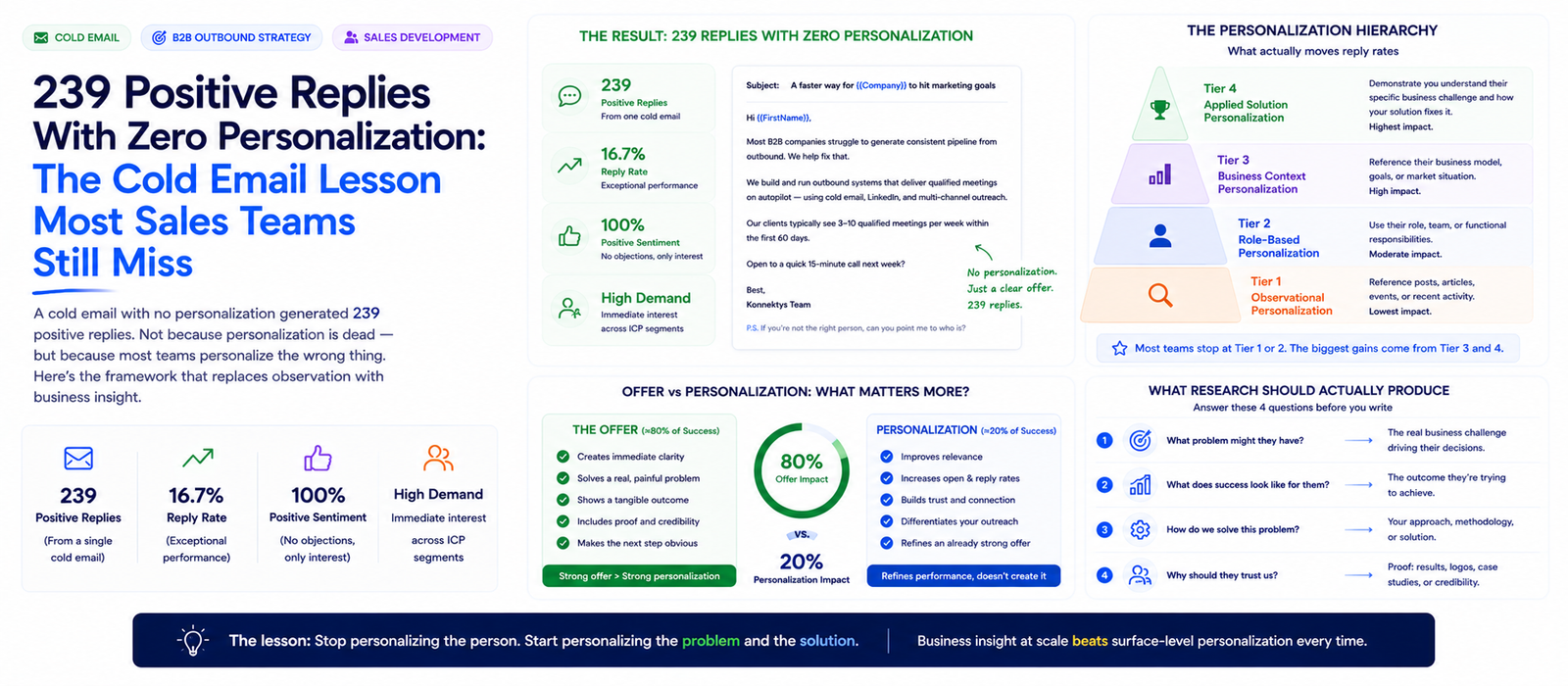
239 Positive Replies With Zero Personalization: The Cold Email Lesson Most Sales Teams Still Miss
Konnektys Team · 8 Jun, 2026
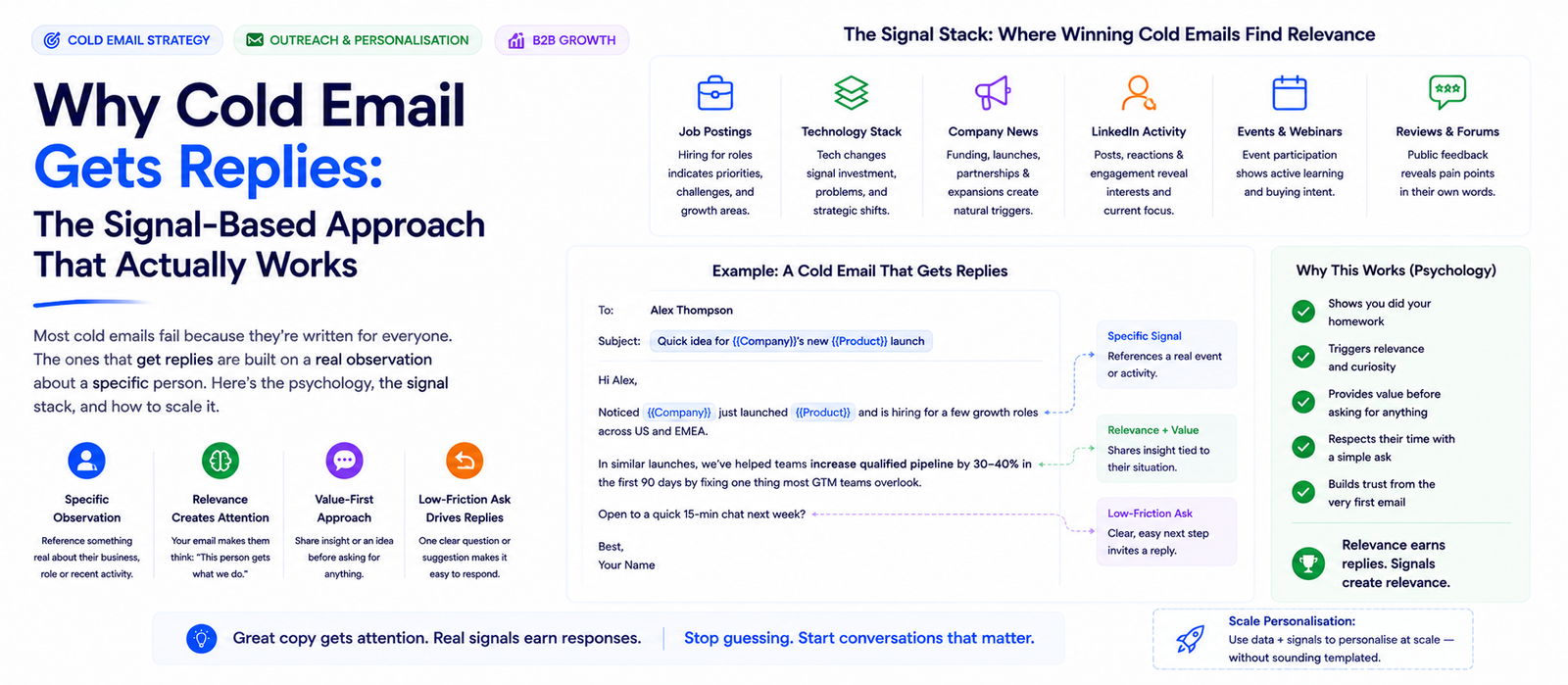
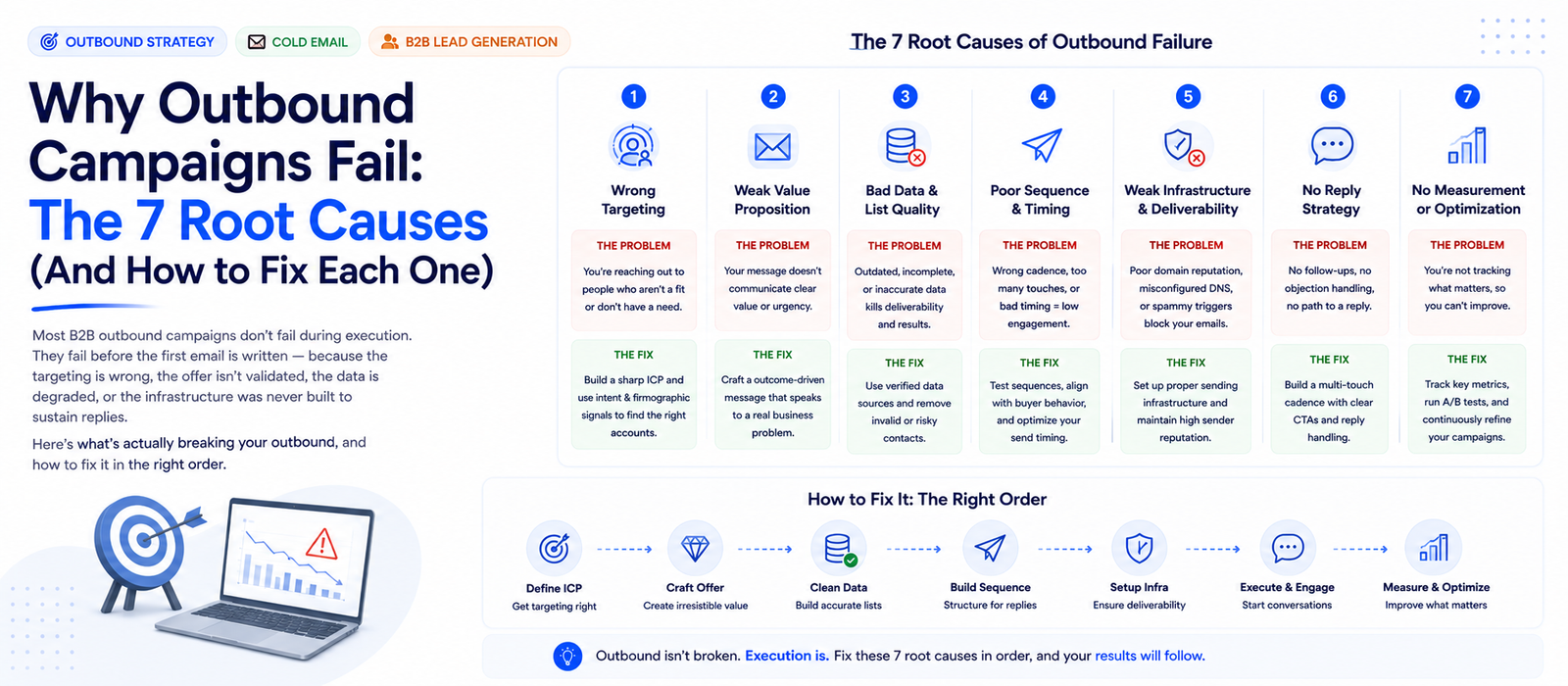
Why Outbound Campaigns Fail: The 7 Root Causes (And How to Fix Each One)
Konnektys Team · 7 Jun, 2026