
Who Makes B2B Buying Decisions? It Depends on the Market You’re Selling Into
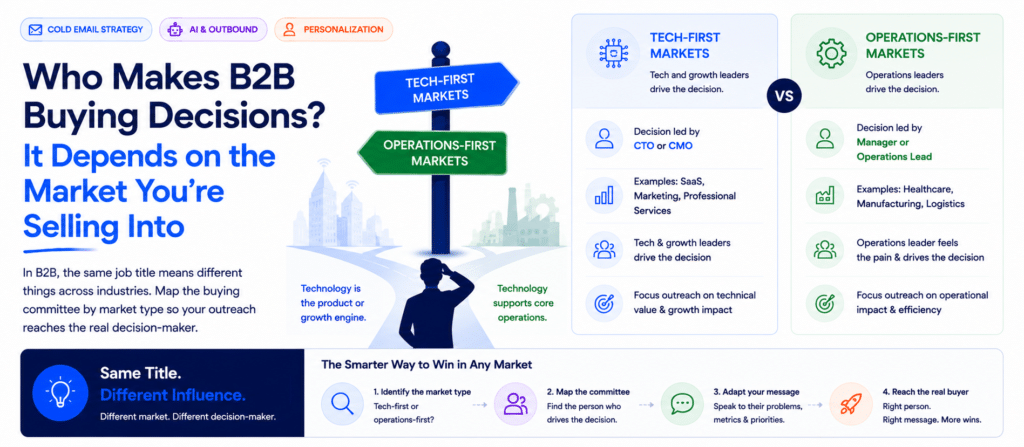
The target list looks the same in every industry. The buyer rarely is. B2B markets split into two broad types — tech-first and operations-first — and the decision-maker in one can be a supporting player in the other. Figure out which type a vertical belongs to before you build anything.
 Konnektys TeamJune 24, 2026 · 14 min read · B2B Sales Strategy
When a sales team moves into a new vertical, the instinct is to copy the playbook that already works. Same titles, same messaging, same sequence, swapped onto a fresh list of companies. It feels efficient. It usually isn’t. The list might be built on the right titles, but those titles carry different weight depending on the kind of market you’re walking into, and outreach that lands beautifully in one industry can go quiet in the next for reasons that have nothing to do with the copy.
Here’s the short version, the answer most people are actually looking for: B2B markets split into two broad types. In some, technology leads the decision. In others, operations does. Figure out which one a vertical belongs to before you build anything, because that tells you who sits at the top of your list, what they care about, and where deals tend to stall. Get the market type right and your sequence has a chance. Get it backwards and you’ve sent the right message to the wrong person.
This isn’t a small distinction. The modern B2B purchase is decided by a group, not a person. Gartner puts the typical buying committee for a complex solution at six to ten people, each arriving with their own independently gathered research. Forrester’s 2024 buying study puts the average even higher, around 13 stakeholders, with nearly 89% of decisions crossing more than one department. So when you pick “the decision-maker” to target, you’re not really choosing one person. You’re choosing where to enter a committee. And the right entry point shifts depending on the market.
The Quiet Way Win Rates Fall in a New Vertical
Most expansion stories follow the same shape. A team has a motion that works. Pipeline is healthy in their core market. Leadership wants growth, so they pick an adjacent industry that looks similar on paper, point the existing engine at it, and wait.
For a few weeks nothing seems wrong. Then the numbers come in soft. Reply rates dip. Meetings that do get booked feel like they’re with the wrong people, or they stall after the first call. The pipeline looks busy but doesn’t convert. The team’s first reaction is almost always to blame execution: the copy needs work, the list needs cleaning, the cadence needs more touches.
Sometimes that’s true. Often it isn’t. The deeper problem is that the new vertical runs a different decision process, and the playbook was built for the old one. You’re targeting the title that used to be your champion, except in this market that title is an advisor, not a driver. Or you’re leading with the message that used to close, except in this market the person who cares about that message has no budget authority and the person who does has never heard your pitch in language that matters to them.
The reason this is so easy to miss is that nothing obvious failed. You didn’t send a broken email. You reached real people with real titles at real companies. The motion just quietly lost its grip because the ground underneath it changed.
Why the Same Title Is a Trap
Job titles feel like a reliable filter. They’re searchable, they map cleanly to seniority, and every prospecting tool lets you sort by them. So we treat a title as if it tells us what a person does in a deal. It doesn’t, or at least not consistently.
A title tells you where someone sits on an org chart. It says very little about their influence over a specific purchase. A CTO at a software company spends their days thinking about architecture, scale, and the technical decisions that make or break the product. Technology is the business, so the CTO is close to most buying decisions that touch it. A CTO at a hospital network or a manufacturer holds the same title, but technology there supports the real work rather than being the work. That CTO weighs in, but the person who actually feels the pain and pushes for a solution is usually running the operation on the floor.
CTO at a SaaS company
Technology is the product. The CTO is close to most buying decisions that touch it. Primary buyer.
CTO at a hospital or factory
Technology supports the real work. The CTO weighs in, but the operations floor drives the search. Supporting player.
Same title. Different gravity. If you build your list purely on “CTO” and assume the role behaves identically everywhere, you’ll over-target a strong buyer in one market and a peripheral one in another, with the same email.
This is also why accurate targeting depends so heavily on the data underneath your list. Knowing a company’s industry, size, and tech stack isn’t trivia. It’s what lets you predict how a title is likely to behave inside that company’s buying process. Firmographic and technographic context is the difference between a list of names and a list of people you can actually reach with the right message. This is a big part of what we focus on in our AI-powered lead research and technographic and intent data work at Konnektys: building lists that reflect how a buyer actually decides, not just what their badge says.
The Two Kinds of B2B Markets
Tech-First Markets
In a tech-first market, technology is central to how the company creates value, so technical and growth leaders sit at the front of buying decisions. Think SaaS, marketing, and professional services. The CTO or CMO usually drives the evaluation. They scope the problem, shortlist options, and form a point of view before finance is even in the room. The CEO approves the budget, and finance follows the lead the technical buyer has already set.
A few things tend to be true here:
Primary target
The CTO or CMO. They’re running the evaluation, so they’re who you want shaping their view of you early.
The champion
The technical buyer. When they’re convinced, they carry the deal internally.
The pitch
Architecture, scale, integration, and productivity. These buyers care how something fits their stack and how much faster it makes their team.
The biggest blocker
Budget. The technical buyer wants it; the CFO has to agree it’s worth the spend. Deals die at the money conversation more than the merit one.
The sales cycle
Comparatively fast, because fewer people need to sign off and the lead evaluator already has authority.
If you sell into tech-first verticals, your job is to win the technical buyer’s confidence and then arm them to win the budget conversation they’ll have without you in the room.
Operations-First Markets
In an operations-first market, the work happens on the floor, in the clinic, on the line. Technology serves that work. Healthcare and manufacturing are the clearest examples. Here the manager or operations lead drives the evaluation. They’re the ones who feel the daily friction and go looking for something to fix it. The CTO supports the decision rather than leading it, and finance controls whether it actually gets approved.
The pattern looks different:
Primary target
The manager or operations lead. They start the search and shape the requirements.
The champion
The person who will actually use the tool. If it doesn’t fit their day, it dies, no matter how good it looks in a demo.
The pitch
Workflow, compliance, operational fit, and how implementation will really go. Elegance matters less than whether it works with the way they already operate.
The biggest blocker
Fit. The fastest way to lose is for the user to conclude it doesn’t work with how they actually work.
The sales cycle
Longer, because the C-suite has to sign off and operational changes carry more risk and more people.
If you sell into operations-first verticals, you win by proving the solution slots into existing workflows and by earning the trust of the people who’ll live with it daily, then helping them build the internal case for the executives who control approval.
Worth saying plainly: these are tendencies, not laws. A given company can break type, especially smaller ones where one person wears several hats. But as a starting frame for a vertical, the split holds up remarkably well, and it gives you a far better first guess than treating every market as if it decides the same way.
A CTO in SaaS Is Not a CTO in Healthcare
The cleanest way to see this is to hold the title constant and watch the influence move.
CTO in SaaS
Sits at the center of most technology purchases. Technology is the product, so their say carries enormous weight. Primary buyer.
CTO in Healthcare
Consulted on security, integration, and compliance, but the manager who runs the affected unit often has comparable or greater sway. Supporting player.
CTO in Manufacturing
The CTO matters, but the plant or operations manager who owns the process being changed often has comparable or greater sway over adoption. Supporting player.
The takeaway isn’t a precise percentage. It’s directional and it’s reliable: a CTO in a tech-first market is a primary buyer, and a CTO in an operations-first market is a supporting one. If your sequence treats both as the lead, you’ll write to one of them in a language that doesn’t match their actual role in the deal.
This also lines up with what the broader research says about how committees behave. Gartner has found that buyers spend only about 17% of their total purchase time meeting with potential vendors, and when they’re weighing more than one supplier, any single rep gets just five or six percent of that time. Most of the decision happens in conversations you’re not part of. Which means the person you reach has to be both the right person and equipped to represent you to the rest of the committee when you’re not there. Reaching the supporting player and asking them to carry a deal they don’t own is a slow way to lose.
What Goes Wrong When You Get the Market Type Backwards
A tech-first pitch in an operations-first market
This is the more common and more damaging mistake, usually made by teams whose home turf is SaaS. They lead with the CTO, open with architecture and scale, and talk about productivity gains in the abstract. In an operations-first vertical, that means they’ve aimed at the supporting buyer with a message the actual decision-driver doesn’t care about.
The operations manager who should have been the entry point never hears a relevant word. The compliance and workflow concerns that would have earned trust never get addressed because the pitch was built for a buyer who weighs different things. The result is wrong person, wrong message, and a sequence that generates polite non-responses. The team concludes the vertical is “hard” or “not a fit,” when really they sent a SaaS pitch into a market that doesn’t buy like SaaS.
An operations-first pitch in a tech-first market
The reverse is subtler but real. A team whose home turf is operations-heavy moves into SaaS and leads with workflow fit, implementation detail, and operational caution. None of that is wrong, exactly. It’s just underwhelming to a CTO who wants to hear about architecture, scale, and how this multiplies their team’s output.
By playing it safe and practical, the team under-sells its actual edge. The technical buyer, who could have been an enthusiastic champion, comes away thinking the product is fine but unremarkable, because the pitch never spoke to the ambition that drives them. The deal doesn’t blow up. It just never catches fire.
Both failures trace back to the same root cause. Most teams run one pitch into every vertical. That single playbook is exactly why win rates drop the moment they expand, and it’s why the dip feels mysterious. The motion didn’t break. It was applied to a market with a different decision structure than the one it was designed for.
How to Map Accounts by Market, Not by Title
The fix is a shift in how you organize targeting. Stop building your list around a title and start building it around the market type, then let the market type tell you which title to lead with.
Classify the vertical.
Before any list-building, decide whether the vertical is tech-first or operations-first. Ask: is technology the thing this business sells, or the thing that supports what it sells? If technology is the product or growth engine, you’re in tech-first territory. If technology supports work that happens elsewhere, you’re operations-first. For anything ambiguous, look at where the budget pain shows up and who in the company complains loudest about the problem you solve.
Pick the entry point that matches.
In tech-first verticals, lead with the CTO or CMO and build the conversation around architecture, scale, and output. In operations-first verticals, lead with the manager or operations lead and build the conversation around workflow, fit, and implementation. Then sequence the supporting cast rather than ignoring them.
Write to the role, not the title.
A CTO in a tech-first market wants to hear how you change what their team can build and how cleanly you fit their stack. An operations manager wants to hear that you understand their day and won’t blow up their process. Same product, two genuinely different stories, told to the person who can move each market.
Run two playbooks if you sell across both.
If your TAM spans tech-first and operations-first verticals, you need two playbooks, not one stretched to cover both. Two entry titles, two message frameworks, two proof sets, and two cadences calibrated to two different deal speeds. The infrastructure underneath (sending setup, list-building, enrichment) can be shared. It’s the targeting logic and the message that fork.
Instrument it so you can tell which is working.
Track reply and conversion rates by market type, not just in aggregate. Aggregate numbers hide exactly the problem this whole approach is meant to surface. If your tech-first segment converts well and your operations-first segment lags, that’s a targeting signal, not a copy problem, and you’ll only see it if you’re cutting the data by market.
Where This Fits Into the Modern Buying Committee
It’s worth zooming out, because the two-market frame sits inside a bigger shift that every B2B team is living through.
Buying is now a group sport. Gartner’s research describes a committee of six to ten people for complex purchases, and a 2025 Gartner survey found that buying groups can range anywhere from five to sixteen people across as many as four functions. Those people don’t move in a straight line. They loop back, revisit decisions, and bring in new stakeholders late. Gartner found that 74% of buying teams experience unhealthy conflict during the process, and that groups who do reach consensus are 2.5 times more likely to call the resulting decision a high-quality one.
Two things follow from that, and they reinforce everything above.
First, you’re never really selling to one person, so the question isn’t only “who do I email” but “who do I enter through.” The market type answers that. It tells you which committee member is most likely to open the door and carry your case to the rest.
Second, the content and message you give that person has to help them align the rest of the group, not just convince them individually. Gartner found something counterintuitive here: tailoring a message for the buying group as a whole improved consensus by around 20%, while content aimed at a single individual’s priorities actually hurt group consensus by 59%, because it reinforced one person’s view at the expense of the group’s. In practice that means your champion needs material they can forward, a business case finance will accept, proof the user-level team will believe, and language that helps these people agree with each other. Picking the right entry point gets you in. Equipping that person to drive consensus is what gets you the deal.
This is the real reason the same title behaves differently across markets. The committee is shaped differently, the entry point is different, and the kind of internal selling your champion has to do is different. Tech-first champions mostly need to win a budget argument. Operations-first champions mostly need to win a “this fits how we work” argument and then survive a longer executive approval. Same job, different fight.
Turning the Framework Into Outbound That Books Meetings
Knowing the framework is the easy part. Operationalizing it across hundreds or thousands of accounts is where most teams run out of road, because it demands three things at once: clean targeting data, role-aware segmentation, and the bandwidth to run more than one playbook at a time.
It starts with the list. A market-aware approach is only as good as the data behind it, so the foundation is research that captures not just titles but the firmographic and technographic context that tells you how a title behaves in a given company.
Research and list-building
Our AI-powered lead research and contact list building services exist to produce lists segmented by market type, with the right entry-point role identified for each account rather than a flat dump of every CTO in a database.
Intent and signal data
Knowing a vertical’s decision structure tells you who to target. Intent and technographic data tells you which accounts are likely in motion right now, so your two playbooks point at companies actually evaluating rather than at a cold universe.
Outreach infrastructure
Running two calibrated playbooks takes real infrastructure: reliable cold email setup that lands in the inbox, multichannel sequencing across email and LinkedIn outreach, and the operational discipline to keep both motions running cleanly.
Ongoing data quality
The whole approach lives or dies on data quality, so ongoing CRM enrichment and cleaning keeps your segmentation accurate as accounts change.
The thread running through all of it is that this is done-for-you work with a human judgment layer, not a tool you’re handed and left to figure out. The framework in this article is genuinely useful, but the gap between understanding it and executing it at scale across multiple verticals is exactly the gap a done-for-you lead generation partner is built to close.
If you’re about to expand into a new vertical, the highest-leverage thing you can do is spend an hour deciding what kind of market it is and who really decides in it, before you build a single sequence. That one decision shapes everything downstream.
Frequently Asked Questions
Who actually makes the buying decision in a B2B company?
+
What is the difference between a tech-first and an operations-first market?
+
Why does the same job title behave differently across industries?
+
Why do win rates drop when a sales team expands into a new vertical?
+
How do I figure out which market type a vertical belongs to?
+
Should I run two separate playbooks if I sell into both market types?
+
How does good data help with market-based targeting?
+
Does targeting the right entry point guarantee the deal?
+
The One Decision to Make Before Your Next Sequence
Most teams obsess over copy, cadence, and list size when their outreach underperforms in a new market. Those things matter, but they’re downstream of a bigger choice that usually gets skipped: deciding what kind of market you’re actually selling into and who really makes the call in it.
A tech-first market and an operations-first market can hold identical titles and behave nothing alike. A CTO in SaaS and a CTO in healthcare are not the same person to sell to, and a sequence that treats them as interchangeable will quietly leave deals on the table in one market or the other. Map your accounts by market first, let that decide your entry point and your message, and run separate playbooks where your market demands it.
Expand Into New Verticals Without Watching Win Rates Slide
Konnektys handles the research, segmentation, data, and multichannel outreach that turn this framework into booked meetings. End-to-end B2B lead generation — market-typed from day one.
- The Quiet Way Win Rates Fall in a New Vertical
- Why the Same Title Is a Trap
- The Two Kinds of B2B Markets
- Tech-First Markets
- Operations-First Markets
- A CTO in SaaS Is Not a CTO in Healthcare
- What Goes Wrong When You Get the Market Type Backwards
- How to Map Accounts by Market, Not by Title
- Where This Fits Into the Modern Buying Committee
- Turning the Framework Into Outbound That Books Meetings
- Frequently Asked Questions
- The One Decision to Make Before Your Next Sequence
Expanding into a new vertical? We’ll map the market type, build the right-person list, and run two playbooks where needed — so you don’t lose a quarter finding out your motion doesn’t fit.
Talk to Konnektys →Related articles
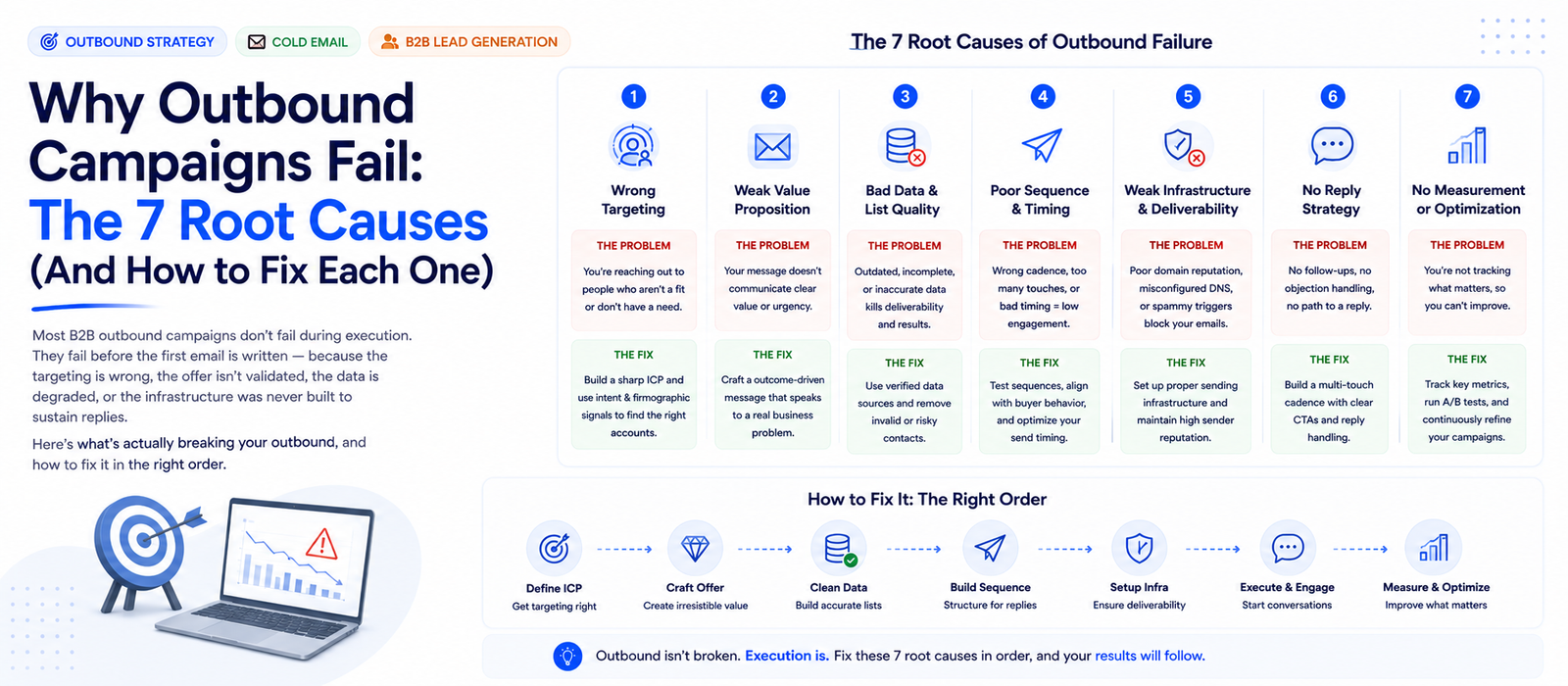
Why Outbound Campaigns Fail: The 7 Root Causes (And How to Fix Each One)
Konnektys Team · 7 Jun, 2026
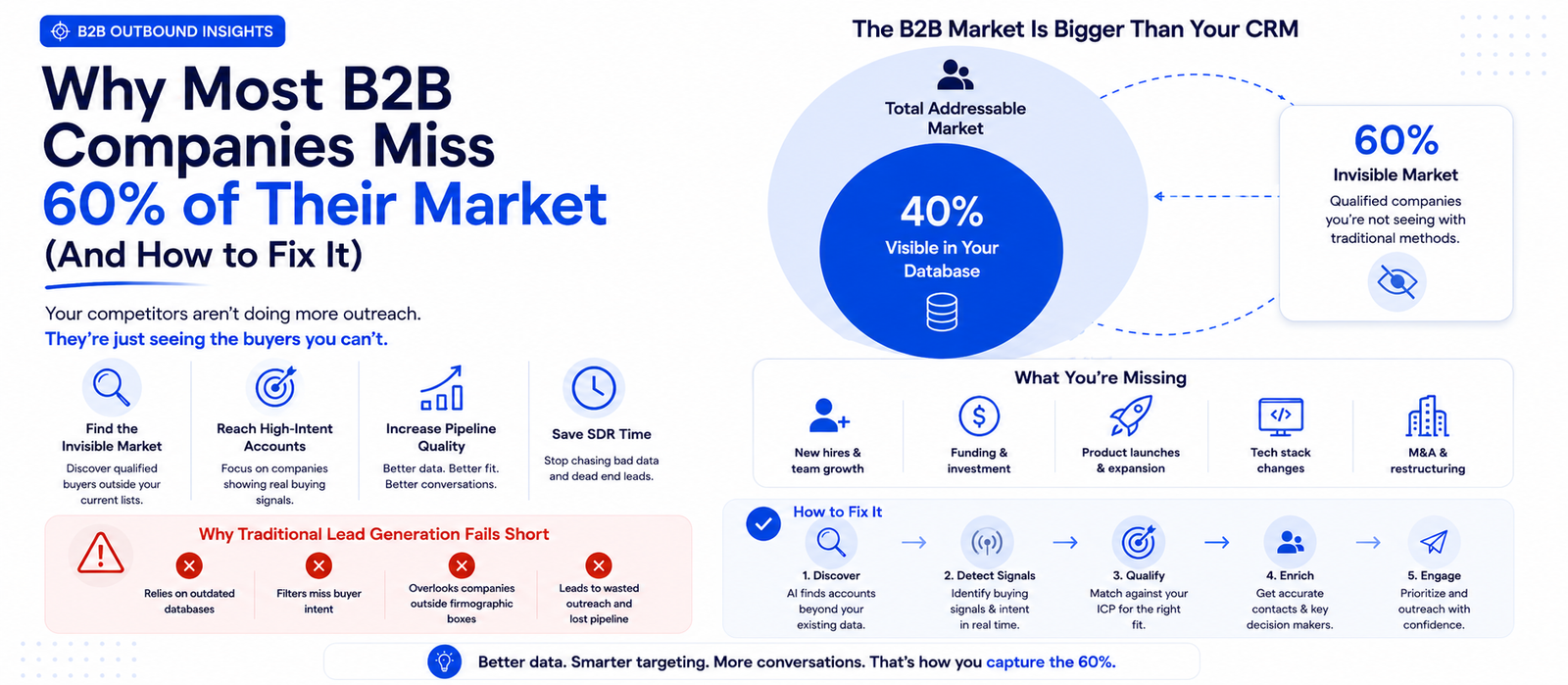
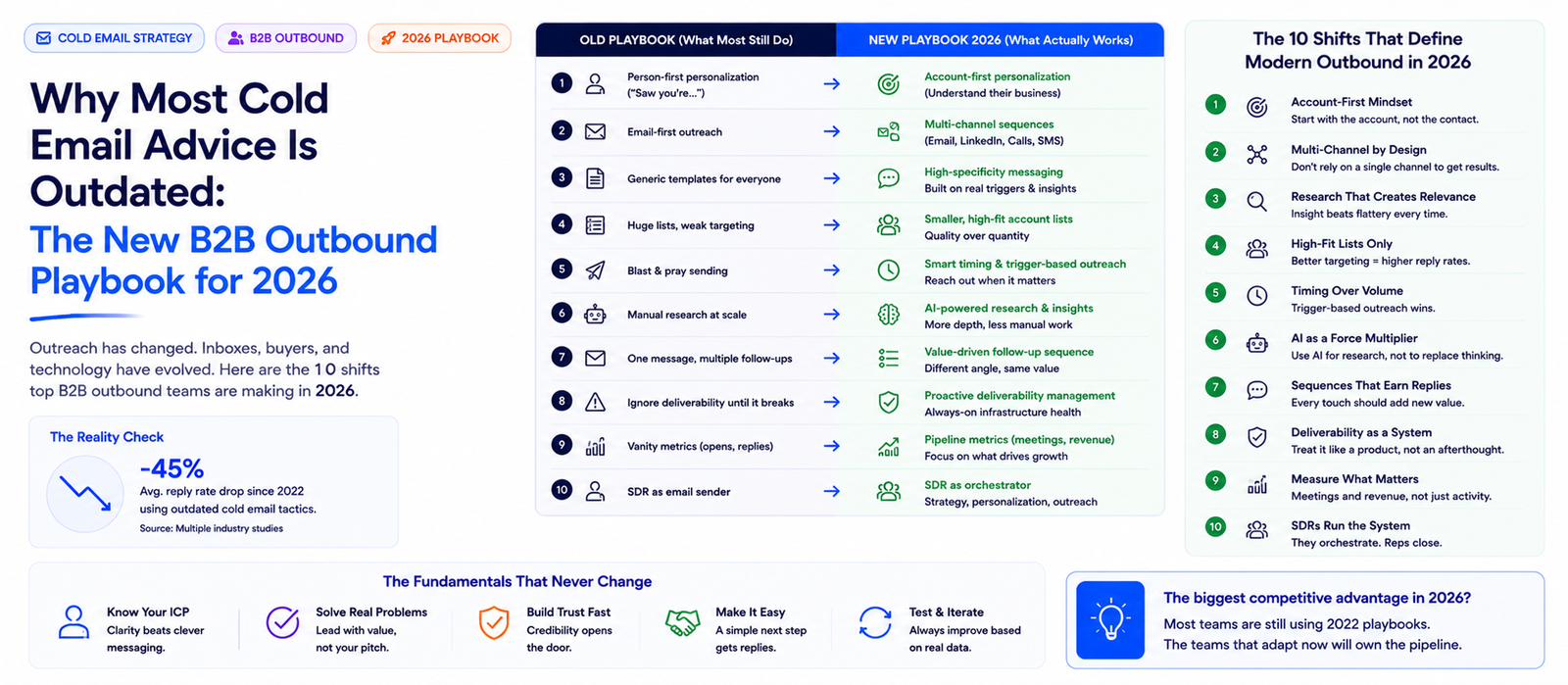
Why Most Cold Email Advice Is Outdated: The New B2B Outbound Playbook for 2026
Konnektys Team · 14 Jun, 2026