
Why Cold Email Programs Fail Between Steps, Not Inside Them
Most cold email programs fail between tools, not inside them. Research, framework, copy, and QA sit in separate tabs, and information gets lost at every handoff — so the final email barely resembles the insight that was supposed to drive it. Here’s what a connected process actually looks like.
 Konnektys TeamJuly 24, 2026 · 11 min read · Cold Email Strategy
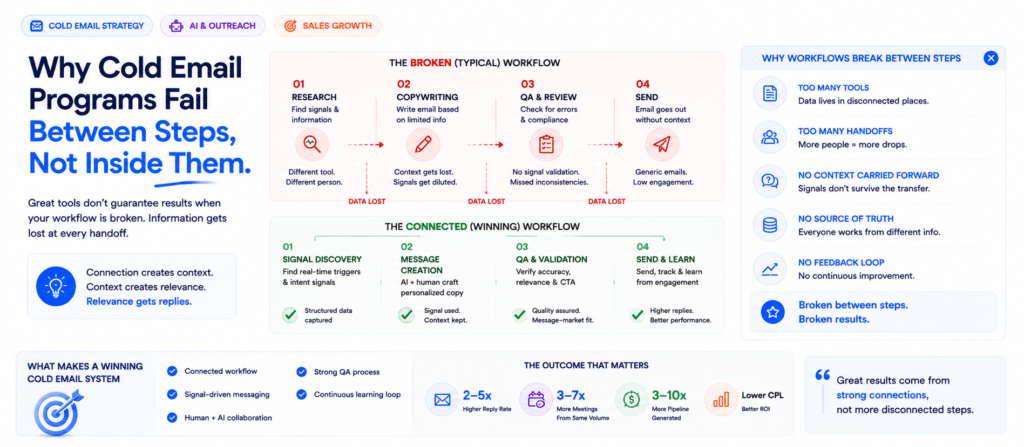
Open the average cold email operation’s browser and count the tabs. There’s usually a spreadsheet with the ideal customer profile written out somewhere three months ago and never updated. A separate doc where someone pasted “signals” — funding announcements, job changes, tech stack detections — copied from a sales intelligence tool. A Google Doc or a Notion page with copy drafts. Maybe a scoring rubric in a spreadsheet nobody fills in consistently. And the actual sending tool, sitting apart from all of it, waiting for someone to paste the final version in.
None of these tools are bad on their own. The trouble starts in the gaps between them — in the moment someone has to take a signal from one tab, remember it while switching to another, and manually decide whether it belongs in the opening line of an email. That’s the point where most personalization efforts quietly die. Not because the research was missing. Because the connection between the research and the message got lost somewhere in the copy-paste.
This is worth taking seriously, because it’s not a minor operational annoyance — it’s the single biggest reason cold email campaigns that start out promising end up sending generic messages anyway. The team did the research. The research just never made it into the send.
The Real Cost of a Disconnected Stack
Signal decay.
A trigger event — a company raising a funding round, a prospect changing roles, a competitor being mentioned in a news article — has a shelf life. The value of referencing it drops fast, sometimes within days. When that signal sits in a research doc waiting for someone to manually route it into a message, the window closes before the email ever sends.
Context loss between handoffs.
Every time information moves from one tool or one person to another, something gets lost in translation. A researcher notes that a prospect’s company just switched CRM platforms; by the time a copywriter picks that up secondhand, the nuance of why that matters to the pitch has often evaporated, leaving a surface-level mention rather than a genuinely relevant hook.
Inconsistent qualification.
Without a shared, enforced standard for what counts as a good signal or a strong fit, different people on a team — or different days for the same person — apply different bars. That inconsistency shows up downstream as wildly uneven message quality across the same campaign.
No feedback loop.
When research, copywriting, and quality review live in separate places with no structured connection, there’s rarely a mechanism that says “this framework worked for this type of signal, use it again” or “this angle keeps underperforming, stop using it.” Every campaign starts from scratch instead of building on what the last one taught.
Manual QA that doesn’t scale.
A human reading every email before it sends is genuinely valuable — but only if it’s consistent. Reviewers get tired, skim faster on a Friday afternoon, and let things through that a sharper morning read would have caught. Without a defined, repeatable standard, quality control becomes a matter of whoever happens to be reviewing that day.
Put these problems together and you get the outcome nearly every B2B seller has lived through: months of effort invested in research and strategy, and a send that still reads like it could have gone to anyone on the list.
What a Connected Cold Email Process Actually Looks Like
The Signal Drives the Framework, Not the Other Way Around
A common mistake in outbound is picking a messaging framework first and then trying to force every signal into that mold. A connected process runs it backward: the signal itself should determine which approach fits.
Problem-First
Works when there’s clear evidence the prospect is actively wrestling with a specific, nameable problem — a job posting for a role that suggests a gap, a public complaint, a pattern visible in their tech stack.
Trigger-Based
Fits recent events: a funding round, an executive hire, a product launch, an expansion into a new market. The message references the event directly and ties it to a plausible next need.
Mutual-Connection
Leans on a shared network, a mutual contact, or overlapping professional communities — useful when the relationship angle is stronger than the pain-point angle.
Value-First
Leads with a specific, concrete insight or resource before making any ask — useful for colder segments where trust needs to be built before a pitch lands.
Direct-Ask
Skips the build-up entirely and states the offer plainly — most effective with warmer segments, referral-adjacent contacts, or highly time-sensitive situations.
Key Point
The signal should decide the framework, every time, on a message-by-message basis — not a house style applied uniformly across the list.
The Framework Drives the Copy, Not a Generic Template
Once the right framework is chosen, the actual writing should follow from it rather than getting bolted onto a fixed template with a first-name merge field. This is where a lot of “personalized” cold email quietly reveals itself as not personalized at all — the structure and tone are identical across every recipient, and the only thing that changes is a name and a company.
The Copy Drives a Real QA Gate
Quality control works best when it’s a defined checkpoint, not a vibe check. That means specific, testable criteria: does the opening line reference something true and specific about this exact prospect? Does the framework match the signal it’s built on? Is the call-to-action proportionate to how warm or cold this contact actually is? Is there anything in the message that could apply to literally any recipient on the list?
A workflow that treats QA as a hard gate — nothing proceeds until it clears a defined bar — behaves very differently from one that treats QA as an optional final glance. The former catches generic messaging before it reaches a prospect’s inbox. The latter catches it, if at all, after the reply rate has already told you something was wrong.
The Sequence Timing Reflects Buyer Psychology, Not a Fixed Cadence
Even a strong first message loses most of its value if the follow-up sequence around it is generic. A well-designed cadence treats each touch differently depending on where the prospect is in their attention span and decision process:
- •Early touch (day 5): can afford to stay close to the original angle, reinforcing the same signal with a slightly different frame.
- •Mid-sequence touch (around day 14): often benefits from a different angle entirely — new evidence, a different pain point, social proof — because repeating the same pitch for the third time reads as tone-deaf.
- •Late touch (day 26+): usually works best as a lower-pressure, easy-exit message — a final useful resource, a light “should I close this out” note, something that doesn’t ask for much and therefore costs the prospect very little to respond to.
Getting this sequencing right by hand, across dozens or hundreds of prospects with different signals, different frameworks, and different timing needs, is exactly the kind of coordination problem that breaks down in a fragmented tool stack.
Why This Matters More Now Than It Did Two Years Ago
Cold outbound has gotten harder to do well, for reasons that have nothing to do with any individual seller’s skill. Inboxes are more crowded. Spam filters and deliverability requirements have tightened meaningfully — authentication standards from major mailbox providers now actively penalize senders with poor engagement, which means a batch of low-quality, generic emails doesn’t just underperform, it can actively damage a domain’s ability to land in any inbox at all, including future, better-targeted campaigns.
At the same time, buyers have gotten faster and more ruthless at spotting a template. Years of exposure to obviously mail-merged outreach have trained recipients to recognize the pattern within the first sentence, and once they do, the message gets deleted regardless of how relevant the underlying offer actually was.
That combination — higher deliverability stakes and a more skeptical audience — means the cost of a disconnected, generic-by-default workflow has gone up too. A few years ago, a mediocre personalization effort might still have produced an acceptable reply rate simply because the bar was lower across the board. The gap between “researched but disconnected” and “researched and connected all the way through to the send” shows up directly in reply rates, spam complaints, and — eventually — whether a domain can reliably reach an inbox at all.
What to Look for in a Real Solution
Does the signal research actually reach the copywriting step, or does it just get stored?
A lot of sales intelligence tools are excellent at surfacing signals and genuinely weak at making sure those signals get used. Ask specifically how a piece of signal research travels from discovery to the final sentence of an email — not whether the research exists, but whether it’s structurally connected to what gets written.
Is there a defined, enforced qualification bar, or is quality control informal?
Ask what the actual criteria are for a message to be considered “good enough to send,” and who or what enforces that bar consistently. If the answer boils down to “someone reads it before it goes out,” ask what specifically they’re checking for, and whether that standard is written down anywhere or lives entirely in one person’s judgment.
Does the sequence adapt based on what’s already known about the prospect, or is it the same five-email cadence for everyone?
A cadence that doesn’t vary by signal type, prospect warmth, or previous engagement is a strong sign the workflow isn’t actually connected end-to-end — it’s a research step bolted onto a generic sending schedule.
Is there a feedback loop between what closes and what gets sent next?
The most valuable data a cold email program generates isn’t the initial research — it’s what happens after: which frameworks produced replies that turned into real conversations, and which produced replies that went nowhere. A connected workflow captures that and feeds it back into future targeting and framework selection.
What This Looks Like in Practice
Take a mid-market software company selling to operations leaders. A rep spots that a target account just posted three job openings for a role tied to a process the product automates — a strong signal.
Fragmented Process
Job posting gets noted in a spreadsheet. A week later, the specific detail has faded into: “noticed you’re growing your ops team.” Technically true. Also true of half the companies on the list. No reply.
Connected Process
Signal captured with context: which role, what it implies about process gaps, how recently. Framework: trigger-based. QA checks opening line couldn’t apply to any other company. Follow-up at day 5 adds a related data point. Day 14 shifts angle. Day 26 low-pressure close.
Same underlying signal. Same company, same rep, similar amount of total effort. Very different outcome, because the connection between what was discovered and what was sent held all the way through instead of breaking somewhere around tab three.
This is also where the compounding advantage of a connected process shows up over time. In the fragmented version, every campaign is essentially a fresh start. In the connected version, every reply, every meeting, every closed deal feeds back into a growing sense of what actually works — which signal types produce replies, which frameworks convert those replies into real conversations, which follow-up angles keep prospects engaged. Volume without qualification is one half of the problem; disconnection between research and message is the other half.
The Team Question: Fragmentation Is Organizational Too
There’s a version of this problem that’s less about tools and more about people. Even a technically connected workflow can fall apart if the humans running it aren’t set up to use it that way. A common pattern: a company hires a researcher, a copywriter, and someone to manage sending, and treats them as three sequential roles handing off a finished product to the next person. That structure recreates the same fragmentation problem organizationally that a five-tab tool stack creates technically.
The alternative isn’t necessarily fewer people — it’s making sure whoever owns each stage has visibility into the stages next to it, and a shared, explicit standard for what “ready to move forward” means at every handoff. A researcher who understands what makes a signal usable for a copywriter produces different notes than one who’s just filling in a spreadsheet field. A copywriter who knows exactly what the QA gate checks for writes differently from the first draft, rather than relying on a reviewer to catch problems after the fact.
Key Point
Treat the connections between roles as seriously as the roles themselves. Fragmentation is an organizational problem as much as a tooling one.
Audit Your Own Process in 20 Minutes
If you want to know how fragmented your current cold email process actually is, pick five emails that went out in the last campaign and try to trace each one backward:
What specific signal, if any, prompted this message?
Can you find where that signal was originally recorded?
Does the framework used in the message match what that signal would suggest?
If this email underperformed, is there a record of why, and did that record change what got sent next?
How many separate tools or documents did this single email pass through, from research to send?
If the answer to that last question is more than two or three, and if the answers to the first four are hard to reconstruct, that’s a strong sign the fragmentation described above is quietly eating into the effectiveness of the entire program — even if every individual step, taken on its own, looks fine.
Key Takeaways
- •Most cold email quality problems happen between steps, not inside any single step. Information gets lost at every handoff.
- •Signals lose value fast. A trigger event that isn’t connected to the message within a short window often ends up dropped or awkwardly bolted on late.
- •The signal should determine the messaging framework, not the other way around — forcing every prospect into a house-style template is a common, quiet cause of generic-feeling outreach.
- •QA works best as a hard, defined gate, not an informal final read. Specific, testable criteria catch generic messaging before it ships.
- •Sequence timing should reflect where a prospect is in their attention span, not a fixed one-size-fits-all cadence.
- •The stakes for getting this right have gone up. Tighter deliverability standards and more pattern-savvy buyers mean disconnected outreach costs more than it used to.
- •Auditing your own process is straightforward: trace a handful of recent emails back to their originating signal and see how many tools and handoffs sit between research and send.
Frequently Asked Questions
Why does cold email personalization often fail even when the research is done well?
+
What’s the difference between a trigger-based and a value-first cold email framework?
+
How should follow-up email timing change across a sequence?
+
What does a real QA process for cold email actually check for?
+
Why does deliverability suffer more from generic email now than it used to?
+
Do I need new software to fix a fragmented cold email process, or can I fix it with the tools I already have?
+
How do I know if my cold email workflow is too fragmented?
+
Closing Thought
The tools you use for cold email matter less than whether they’re actually talking to each other. A brilliant signal that never makes it into the message it should have shaped is functionally the same as no research at all — and a five-tab workflow with manual handoffs at every step is where that disconnection happens, quietly, campaign after campaign.
If you’re not sure whether your own outbound process has this problem, the audit above takes about twenty minutes and tends to be more revealing than most people expect.
Research Nobody’s Actually Using Is Just Overhead
Konnektys builds outbound programs that connect research, framework, copy, and sequencing into a single accountable process rather than five disconnected ones. See how end-to-end B2B lead generation closes the gap between signal and send.
- The Real Cost of a Disconnected Stack
- What a Connected Cold Email Process Actually Looks Like
- Why This Matters More Now Than It Did Two Years Ago
- What to Look for in a Real Solution
- What This Looks Like in Practice
- The Team Question: Fragmentation Is Organizational Too
- Audit Your Own Process in 20 Minutes
- Key Takeaways
- Frequently Asked Questions
- Closing Thought
Research that never reaches the send is just overhead. We build the connection from signal to send into the program by default.
Talk to Konnektys →Related articles
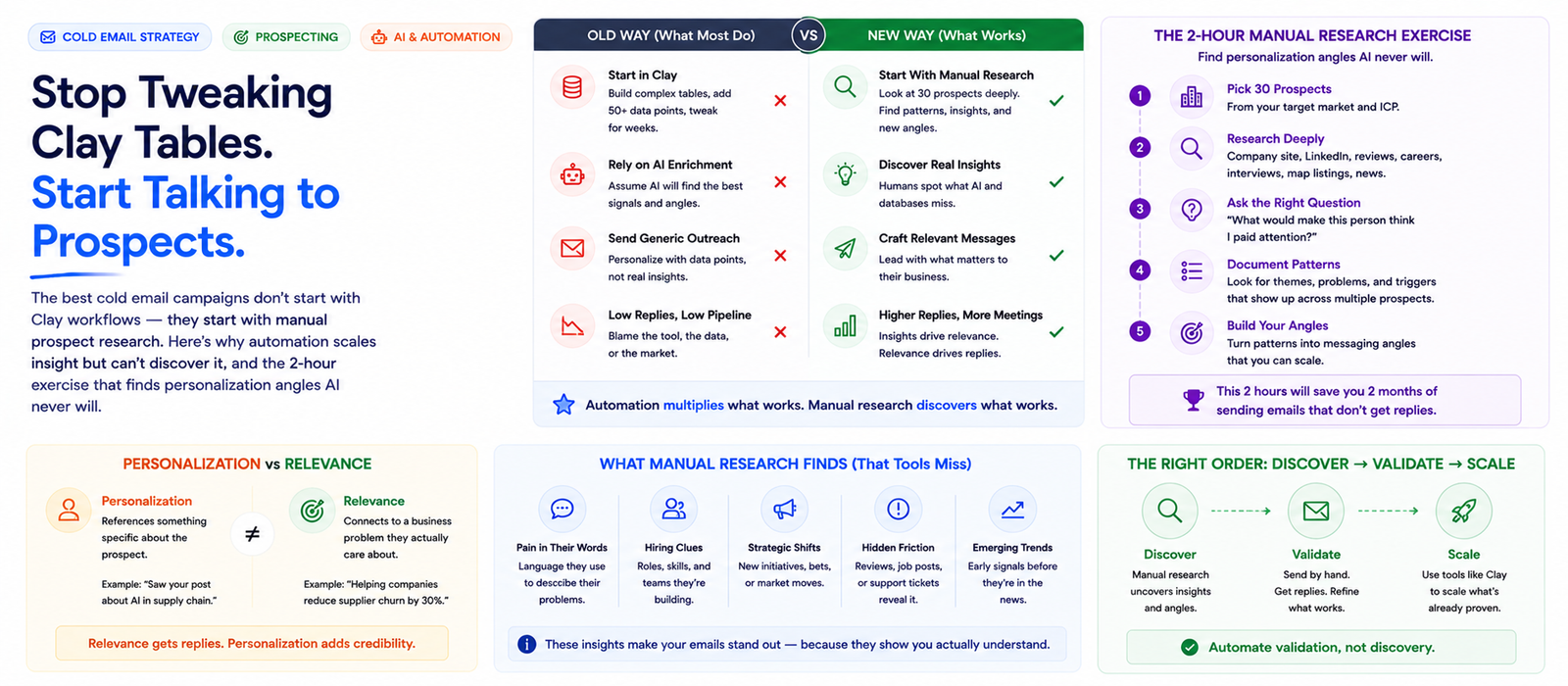
Stop Tweaking Clay Tables. Start Talking to Prospects.
Konnektys Team · 9 Jun, 2026
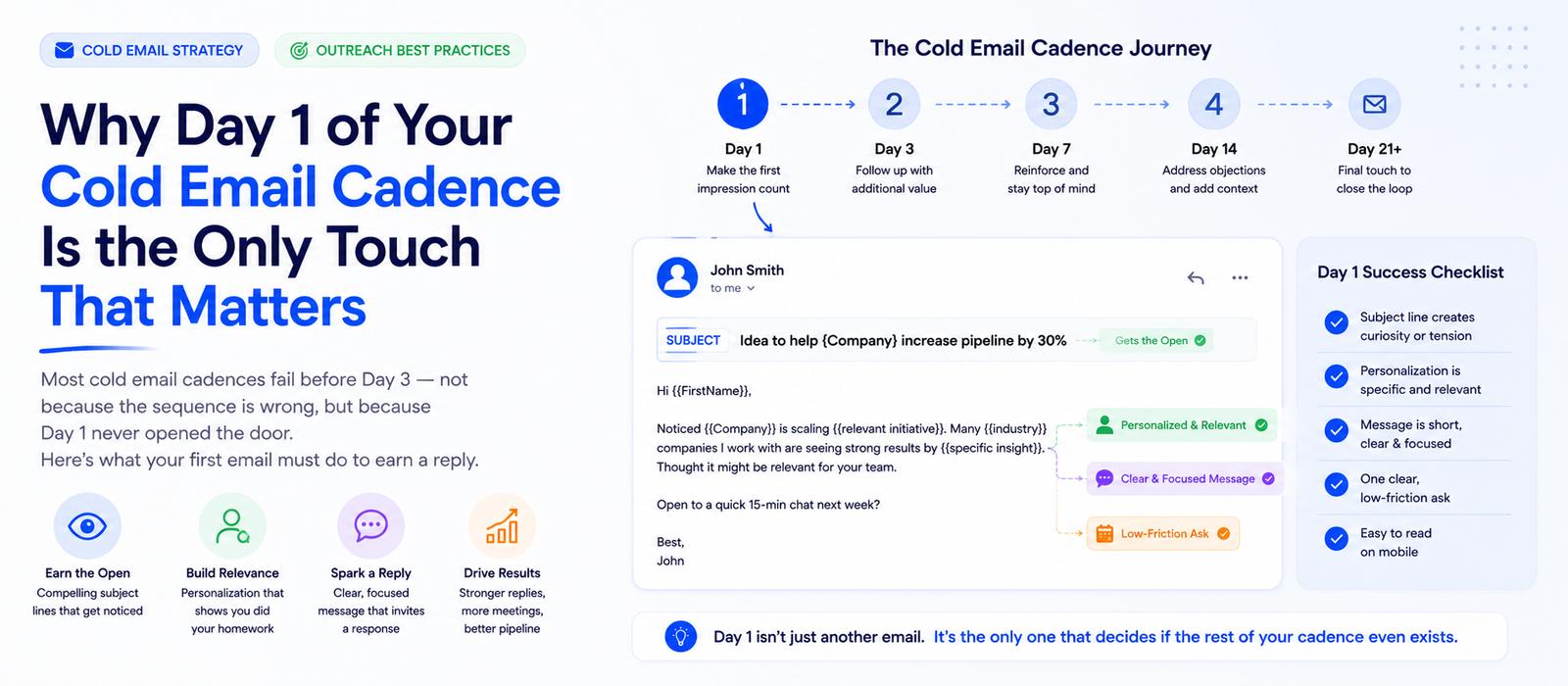
Why Day 1 Makes or Breaks Your Cold Email Cadence (Everything Else Is Just Follow-Through)
Konnektys Team · 6 Jun, 2026
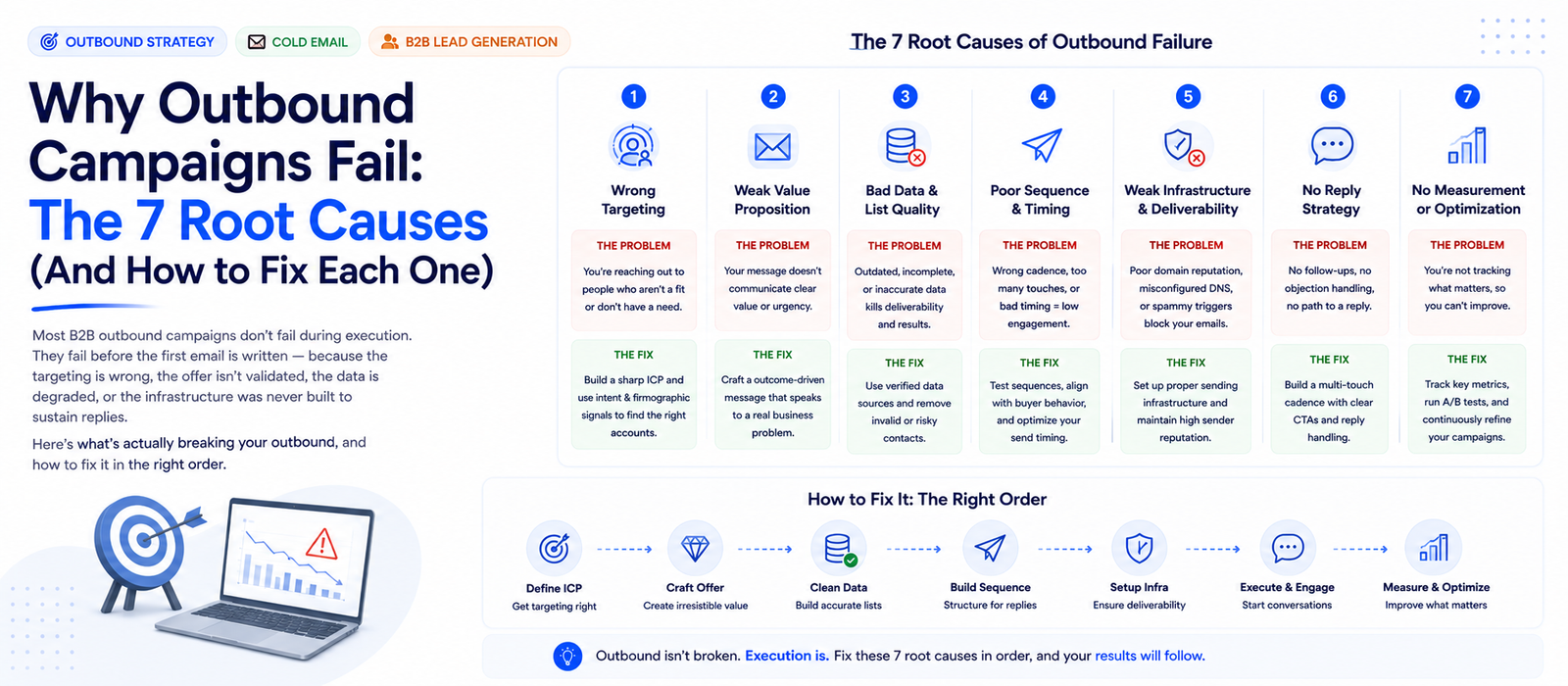
Why Outbound Campaigns Fail: The 7 Root Causes (And How to Fix Each One)
Konnektys Team · 7 Jun, 2026