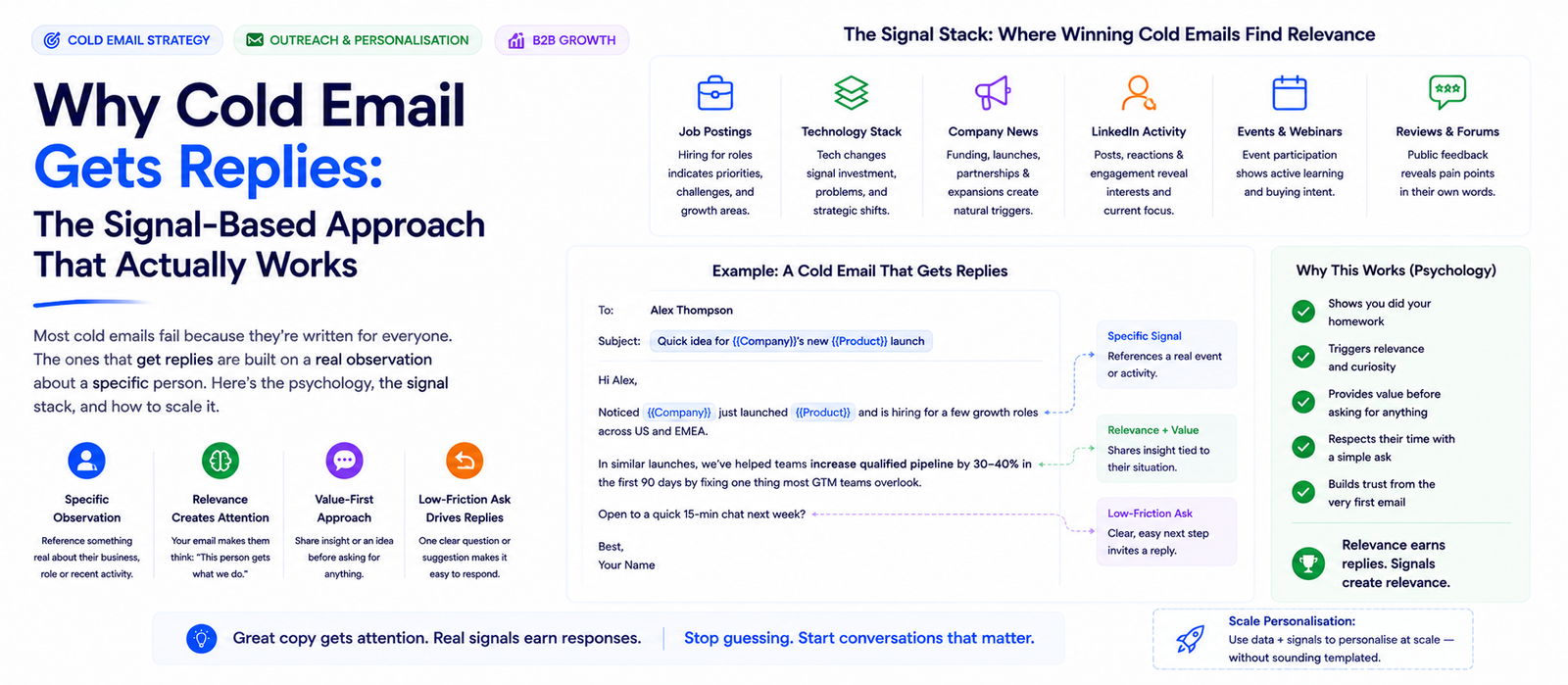
Stop Optimizing the Email. Start Optimizing the Offer.
Personalization is overvalued in cold outreach. The offer sets the ceiling on how well a campaign can perform — personalization only determines how close to that ceiling you get. Most stalled campaigns are offer problems misdiagnosed as copy problems.
 Konnektys TeamJuly 2, 2026 · 11 min read · Cold Email Strategy
There’s a habit in B2B outbound that looks like progress but usually isn’t: rewriting the first line of a cold email for the fortieth time. New opener, sharper hook, a fresher way to reference the prospect’s company. Send it out. Still nothing. Rewrite again.
Meanwhile the actual reason nobody’s replying has nothing to do with the first line. It’s the ask. If you’re offering a demo of a product a prospect has already decided they don’t need, no first line saves you. You can hand that email to the best copywriter alive and the reply rate barely moves, because the person on the other end isn’t rejecting your sentence structure. They’re rejecting what you’re asking them to do.
This is the trap a lot of outbound teams fall into: they treat every rejection as a messaging problem, when a huge share of rejections are actually offer problems wearing a messaging costume. Personalization has become the default fix for everything that goes wrong in cold outreach, to the point where teams have started overvaluing it. It matters, but it’s not the lever most people think it is, and mistaking one for the other is why so many “optimized” campaigns still fall flat.
This article makes the case for flipping the usual priority. Instead of asking “how do I write a better email,” start asking “what am I actually asking this person to say yes to, and have I made that yes as easy as possible?” Get that right and personalization becomes a multiplier on something that already works. Get it wrong and personalization just makes a bad ask slightly more polite.
The Short Answer
The offer sets the ceiling on how well a cold outreach campaign can perform; personalization only determines how close to that ceiling a given campaign gets. A weak offer will underperform regardless of how personalized the message is, because rejection in cold outreach is primarily a response to the ask itself, not to the writing quality.
Key facts on offer-led cold outreach:
- •People don’t reject you. They reject the offer. A cold email is really an ask, and if the ask isn’t compelling, no amount of personalization changes the outcome.
- •Personalization is a multiplier, not a fix. It improves reply rates for offers people already want. It does almost nothing for offers people don’t.
- •The strongest outbound wins come from reducing risk, not from writing cleverer copy. A free pilot, a free audit, or an offer to solve one problem before asking for a contract all lower the cost of saying yes.
- •A strong offer with average personalization beats a weak offer with perfect personalization almost every time. If you’re stuck optimizing the wrong layer, that mismatch is usually why.
- •The real structure behind high-converting outbound is a front-end offer that removes risk, followed by a backend built to capture the value once trust exists.
| Factor | Offer | Personalization |
|---|---|---|
| What it controls | Whether the prospect wants what’s being asked | Whether the message feels relevant and gets read |
| Effect on a weak proposal | Determines whether it converts at all | Minimal; can’t create demand that isn’t there |
| Effect on a strong proposal | Sets the ceiling on results | Pushes results closer to that ceiling |
| Common mistake | Rarely revisited once a campaign launches | Endlessly A/B tested even when it isn’t the bottleneck |
| Where most teams over-invest | Under-invested | Over-invested |
Why “No Reply” Usually Means “Wrong Offer,” Not “Bad Copy”
A cold email that goes unanswered has failed at one of two separate jobs: getting read, or earning a yes. Personalization affects the first. The offer determines the second. When a campaign underperforms, most teams assume the failure is in the first job and rewrite the message, when the failure is actually in the second job and no rewrite touches it.
When a cold email gets ignored, the instinctive read is that the message failed. Wrong subject line, weak opener, not enough personalization, bad timing. All of those are real variables, and they matter at the margins. But margins are exactly what they are: they can push a decent offer from a 3% reply rate to a 5% reply rate. They can’t turn an offer nobody wants into one people are lining up for.
Job 1: Getting Read
What affects it: subject line, opener, formatting, deliverability, personalization.
This is what most teams optimize.
Job 2: Earning a Yes
What affects it: the actual thing you’re proposing, and whether it’s worth the prospect’s time to say yes.
This is what actually fails most campaigns.
If your offer gets rejected by thousands of prospects who genuinely fit your ideal customer profile, rewriting the first line isn’t going to change that outcome. You can make the email more likely to be opened and read. You cannot make people want something they don’t want just by phrasing the ask more nicely. That’s an offer problem, not a copy problem, and treating it as a copy problem means you’ll spend months polishing something that was never going to convert, while the actual fix — changing what you’re asking for — sits untouched.
There’s a useful diagnostic question buried in all this: would you personally say yes to this ask, cold, from a stranger, with nothing at stake but your time? Most people, asked to sit with that question honestly about their own campaign, realize the answer is no. They wouldn’t book a 30-minute call with an unknown vendor either. That gut check is a faster and more reliable signal than any A/B test, because it forces you to evaluate the ask on its own terms, separate from how nicely it’s phrased. If the answer is no, no clever subject line rescues it, because the problem was never in the subject line to begin with.
The Takeaway
Before you rewrite another opener, ask whether the real problem is that people don’t want what you’re asking them to want. If the answer is yes, better copy won’t fix it.
What Does Personalization Actually Do — And What Can’t It Do?
To be clear, this isn’t an argument against personalization. A well-personalized opener genuinely does improve reply rates, and pretending otherwise would be its own kind of mistake. The nuance is understanding exactly what it’s improving and under what condition.
Personalization works because it signals relevance and effort. When an opener references something true and specific about the prospect’s situation, it tells them this message was written with them in mind, which earns a slightly longer read and a slightly higher chance of a response. That’s a real, measurable effect, and it’s worth doing well.
But that effect only shows up on top of an offer the person is at least somewhat receptive to. If someone has zero interest in what you’re proposing, personalization doesn’t create interest out of nothing. It just makes the rejection feel slightly more considered. You’ve written a more relevant-sounding email about something they still don’t want. The conversion rate barely moves, because the underlying willingness to say yes was never there to begin with.
Picture two versions of the same campaign:
Version 1 Wins
Average opener + genuinely strong offer. Something low-risk and clearly valuable to the recipient. Outperforms version 2 consistently.
Version 2 Loses
Exceptional, deeply personalized opener + weak, high-commitment ask. Despite the effort, the offer ceiling caps the results well below version 1.
The offer sets the ceiling on how well a campaign can perform. Personalization decides how close to that ceiling you get. If the ceiling is low, no amount of personalization gets you anywhere close to a good result.
Get people interested in the value first. Then use personalization to make the message feel relevant to them specifically. In that order, both levers do real work. Reversed, personalization is fighting a battle it can’t win alone.
The Takeaway
Personalization is a multiplier on an offer’s existing appeal. It can’t manufacture appeal that isn’t there, so fix the offer first and let personalization amplify it.
What Makes One Cold Outreach Offer Stronger Than Another? Reducing Risk.
If the offer is what actually decides outcomes, the next question is what makes one offer stronger than another. The consistent answer, across the outbound campaigns that actually perform, is risk reduction.
Think about what you’re really asking a cold prospect to do. You’re a stranger. They have no track record with you, no proof you’ll deliver, and no relationship to fall back on if it goes badly. Every ask you make carries an implicit cost: time spent evaluating you, risk of it not working out, and the awkwardness of having said yes to a vendor pitch from someone they’ve never met. The bigger that implicit cost, the higher the bar your offer has to clear before someone says yes.
High-Risk Ask
“Book a 30-minute demo” — calendar time, attention, a willingness to sit through a sales conversation with an unknown vendor, all before any proof of value.
Low-Risk Ask
“Let us audit your cold email deliverability and send you a report within a week” — no call, no pitch, something useful regardless of what happens next. Dramatically higher yes rate.
The consistently strong offer types share a pattern: they let the prospect experience value before committing to anything substantial. A few structures that work well:
Offer a pilot
A small, bounded, low-commitment version of the real engagement, scoped so the prospect can evaluate results before signing anything larger.
Offer a free audit
Deliver real, specific insight into their situation at no cost. This proves competence and surfaces a genuine problem worth solving, which sets up the next conversation naturally.
Offer to solve one problem before asking for a contract
Pick a narrow, well-defined piece of their situation, fix it, and let the result speak before you ask for anything ongoing.
Each of these inverts the usual order of operations. Instead of asking for trust up front and delivering value after, you deliver value up front and let trust build naturally from there. That’s a fundamentally easier yes to get, and it’s why offers built this way consistently outperform offers that ask for commitment before any value has been demonstrated.
The Takeaway
The fastest way to raise your conversion rate isn’t a better sentence. It’s making the first ask small enough, and valuable enough, that saying yes barely feels like a decision.
What Is the Front-End Bait, Backend Profit Model?
There’s a simple mental model that captures why this approach works, and it’s worth understanding as a structure rather than a single tactic.
Split your offer into two layers. The front-end is the bait: a low-risk, high-value entry point designed to get a yes, not to make money. Its entire job is to remove the friction of that first decision and get the prospect engaged. The backend is where the actual profit lives: upsells, retainers, long-term contracts, premium services, the ongoing relationship that the front-end offer was designed to open the door to.
Pilot / audit / one problem fixed
Earns the yes, builds trust
Upsells / long-term contracts
Revenue captured after trust exists
This is the opposite of how most cold outreach is structured today. Most campaigns lead with the backend ask directly. “Book a call to discuss our full retainer engagement” is a backend ask delivered as a first message, and it’s asking a stranger to commit to the expensive, high-trust version of the relationship before they’ve seen any evidence it’s worth it. That’s a hard sell dressed up as a first touch, and it explains a lot of the flat reply rates teams struggle with.
The people who came in weren’t chasing a vendor relationship. They came for the free audit, the pilot, the one problem solved. They stayed because the value was real. That’s a completely different psychological entry point than “please get on a call with our sales team,” and it’s why offer-led campaigns tend to produce not just more replies but more durable, higher-trust customer relationships on the other side, because the relationship started with proof instead of a promise.
There’s a natural objection worth addressing here: doesn’t giving away free work just attract people who want free things and never pay? In practice this concern is usually overstated, because the front-end doesn’t just generate leads. It filters them, cheaply, before you’ve spent real sales cycles on people who were never going to buy. The prospects who engage genuinely reveal themselves through the process: the ones who show up, ask real questions, and act on the findings are exactly the ones worth pursuing for the backend.
This is the exact thinking behind end-to-end B2B lead generation done well: the campaign strategy has to account for offer design, not just messaging and targeting, or the funnel breaks at the exact point this article is describing.
The Takeaway
Structure your outbound as bait-and-value up front, profit on the backend. It’s a completely different funnel shape than “pitch the full engagement in message one,” and it converts at a completely different rate.
Can Excellent Personalization Save a Weak Offer? Rarely.
It’s worth spending a moment on the specific failure mode this article opened with, because it’s common enough to deserve its own section: the campaign with beautiful, highly personalized copy that still underperforms.
This happens because personalization effort and offer strength get confused as the same investment. A team spends real budget on research tools, AI personalization, and copywriting talent, sees the email quality visibly improve, and assumes results will follow proportionally. Often they don’t, because none of that spend touched the actual ask. The email got smarter. The offer stayed exactly as weak as it was before.
A strong offer with decent personalization will outperform
a weak offer with perfect personalization almost every time.
The offer sets a ceiling copywriting cannot raise.
The practical implication is about where to invest first. If your reply and conversion rates have plateaued despite genuine effort on messaging, the highest-leverage next move usually isn’t another round of copy testing. It’s an honest look at the offer itself. Is the first ask something a stranger could reasonably say yes to without much risk? Does it deliver real value before requiring commitment? Would you say yes to it, if you received it cold from a vendor you’d never heard of? If the honest answer is no, that’s the fix, and it’s a bigger one than another subject line test, but it’s the one that actually moves the number.
This is a common diagnosis behind stalled campaigns generally. A closer look at the real reason outbound campaigns fail covers several of the structural issues that produce this exact symptom, offer mismatch chief among them, alongside targeting and infrastructure problems that can compound it.
The Takeaway
If your metrics have plateaued after real copywriting effort, the offer is the more likely culprit than the copy. Test that assumption before you test another subject line.
How to Build a Cold Outreach Offer People Actually Want to Say Yes To
If you’re convinced the offer deserves more attention than the email, here’s a practical way to approach building one.
Start from the prospect’s risk, not your product’s features.
Instead of asking “what can we sell,” ask “what’s the smallest, lowest-risk thing we could offer that would still be genuinely valuable to this specific audience?” That reframing consistently produces stronger offers than starting from your product catalog and working backward.
Make the value tangible before you ask for anything.
A pilot, an audit, or a fix to one specific problem all deliver something real the prospect can evaluate on its own merits, independent of whether they ever become a paying customer. That’s what makes the yes feel low-risk: there’s a genuine, standalone outcome even in the worst case.
Keep the scope narrow and specific.
Vague offers (“let’s explore how we can help”) are hard to say yes to because the prospect can’t picture what they’re agreeing to. Narrow offers (“we’ll audit your current cold email deliverability and hand you a report within a week”) are easy to say yes to because the commitment and the outcome are both crystal clear.
Design the backend before you launch the front-end.
The front-end only works as bait if there’s a real backend worth capturing. Know in advance what the pilot, audit, or fix is meant to lead into, so the transition from front-end to backend feels like a natural next step rather than an unexpected upsell.
Test the offer independent of the copy.
Run the same offer through a few different message variants, and separately, run different offers through similar messaging. This isolates which variable is actually driving your results, rather than conflating a good week with good copy when it was really a good offer.
Feed the offer into properly targeted outreach.
Even a great offer underperforms if it’s reaching the wrong accounts. Pairing offer design with tight targeting through AI-powered lead research ensures the low-risk, high-value ask is landing with people who are actually positioned to want it, which is where offer strategy and list quality reinforce each other.
The Takeaway
Build the offer around removing the prospect’s risk first, keep it specific and tangible, and only then invest in making the message that delivers it feel personal.
Key Takeaways
A quick summary before the FAQ:
- •Cold outreach rejection is primarily a response to the offer, not the writing quality of the email.
- •Personalization improves reply rates only for offers a prospect is already somewhat receptive to; it cannot create demand where none exists.
- •Risk reduction, not clever copy, is the strongest lever for improving cold outreach conversion.
- •Effective offers (pilots, audits, fixing one problem for free) deliver tangible value before asking for commitment.
- •The front-end bait, backend profit model separates a low-risk entry offer from the higher-value engagement it’s designed to lead into.
- •A strong offer with average personalization beats a weak offer with excellent personalization in most real campaigns.
- •Diagnose stalled campaigns by asking: would a stranger reasonably say yes to this exact ask, cold, with nothing else changed?
Frequently Asked Questions
Why do people reject cold emails even when the personalization is good?
+
Is personalization overrated in cold outreach?
+
What makes a cold outreach offer low-risk?
+
What is the “front-end bait, backend profit” model in outbound?
+
How do I know if my outbound problem is the offer or the messaging?
+
Should I lead with a demo or a lower-commitment offer in cold outreach?
+
Can a weak offer with excellent copywriting still convert well?
+
The Bottom Line
The next time a campaign underperforms, resist the reflex to rewrite the email one more time. Ask the harder question first: is this actually a good offer? Would a stranger, cold, with no relationship to you, reasonably say yes to what you’re asking? If the honest answer is no, that’s the fix, and it’s a bigger one than a subject line change, but it’s the one that actually moves the number.
People don’t reject you. They reject the offer. Build one that removes the risk of saying yes, prove your value before you ask for commitment, and let personalization do what it’s actually good at: making a genuinely good offer feel like it was written for the person reading it.
Suspect the Offer Is Your Ceiling, Not the Copy?
See how end-to-end B2B lead generation builds offer strategy into the campaign from day one, or start with AI-powered lead research to make sure a stronger offer reaches the people most likely to say yes to it.
- The Short Answer
- Why “No Reply” Usually Means “Wrong Offer,” Not “Bad Copy”
- What Does Personalization Actually Do — And What Can’t It Do?
- What Makes One Cold Outreach Offer Stronger Than Another? Reducing Risk.
- What Is the Front-End Bait, Backend Profit Model?
- Can Excellent Personalization Save a Weak Offer? Rarely.
- How to Build a Cold Outreach Offer People Actually Want to Say Yes To
- Key Takeaways
- Frequently Asked Questions
- The Bottom Line
If your metrics have plateaued and you suspect the offer is the ceiling, that’s the kind of strategic gap Konnektys works through with clients.
Talk to Konnektys →Related articles
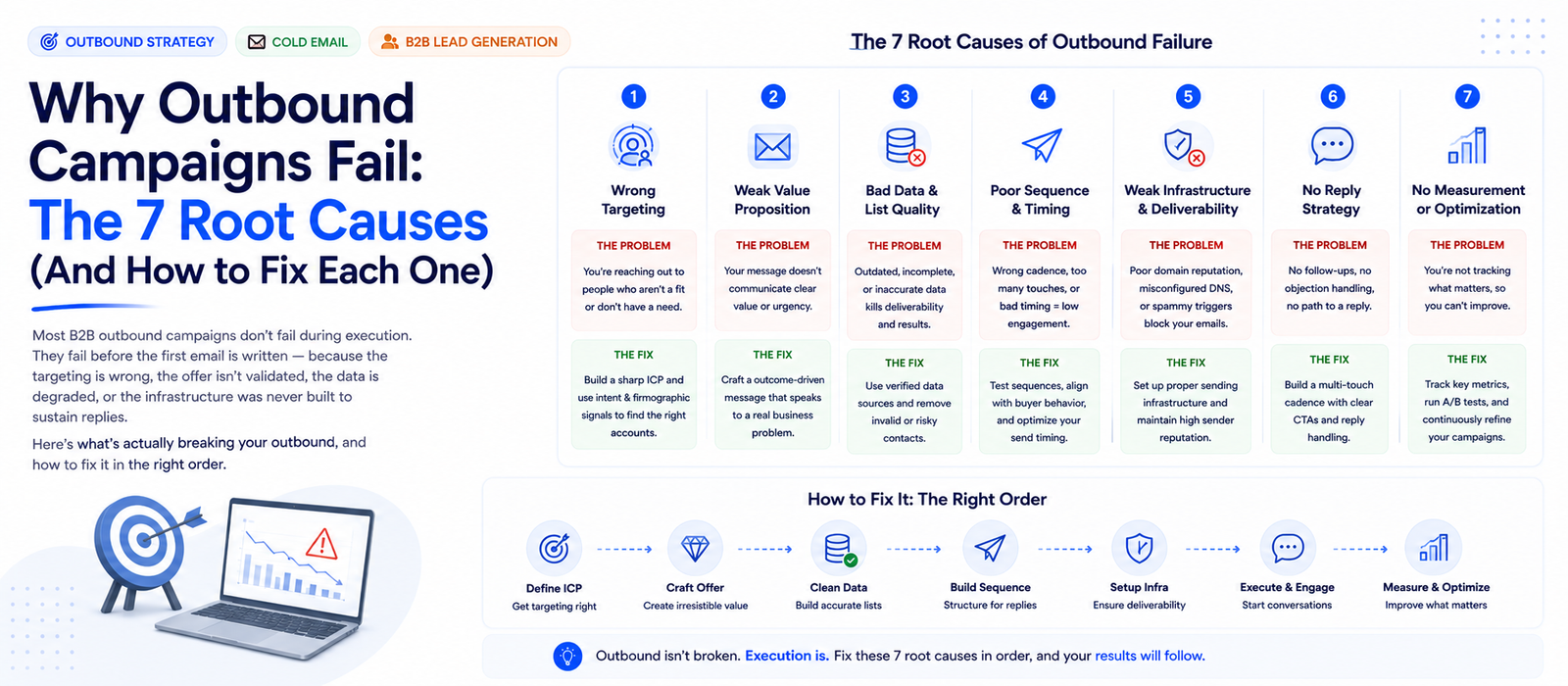
Why Outbound Campaigns Fail: The 7 Root Causes (And How to Fix Each One)
Konnektys Team · 7 Jun, 2026