
The 5 Layers of LinkedIn Outbound: Why “Send More DMs” Stopped Working in 2026
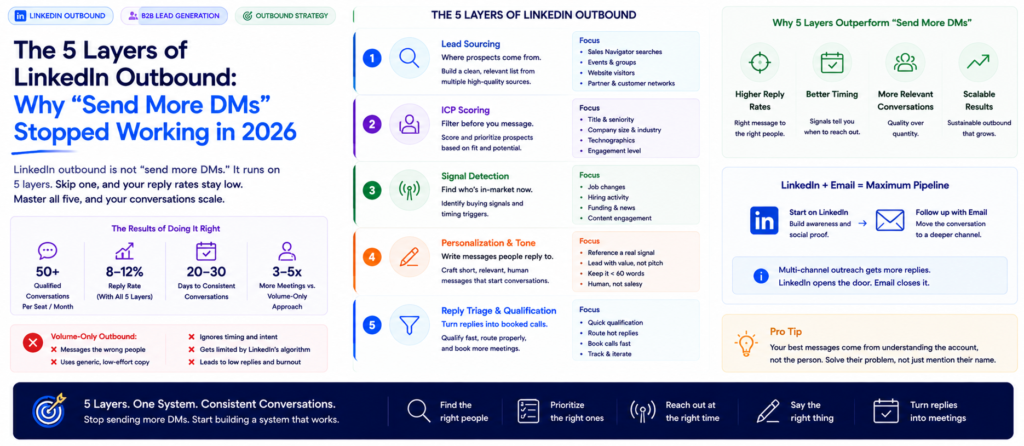
LinkedIn outbound is not “send more DMs.” It runs on five distinct layers — sourcing, ICP scoring, signal detection, personalization, and reply triage — and the teams winning in 2026 work all five, not just the two that feel productive.
 Konnektys TeamJune 19, 2026 · 13 min read · LinkedIn Outbound
Ask most sales teams what LinkedIn outbound means and you’ll get some version of the same answer: send connection requests, then send messages, then send more messages. Faster, if possible. More of them, definitely.
That answer was fine in 2021. In 2026 it’s the reason half of these teams have a reply rate hovering somewhere around 2% and a pipeline they can’t predict from one month to the next.
Sending DMs is one part of LinkedIn outbound. It is not the whole thing, and it isn’t even the part that decides whether the channel works. Running outbound on message volume alone today is a bit like running a sales team with no idea who you’re supposed to be selling to. You can stay busy forever and never get anywhere.
After three years of running LinkedIn outbound for B2B founders, agencies, and in-house sales teams (and booking north of 1,900 sales calls in the process), the pattern is hard to miss. The teams that win treat outbound as a system with five distinct layers, and they actually work on all five. The teams that struggle pour all their energy into one or two layers and wonder why the numbers won’t move.
This article walks through all five layers, what each one actually does, where teams go wrong, and how to tell which layer is currently holding you back. If you only fix the layer that’s broken, you’ll usually get more out of it than from doubling your sending volume.
The Short Version
For anyone who wants the answer before the explanation, here are the five layers of modern LinkedIn outbound:
Lead sourcing
Where your prospects come from, and whether they’re worth contacting at all.
ICP scoring
Filtering the raw list down before anyone gets a message.
Signal detection
Figuring out who is actually in a buying window right now.
Personalization and tone
Writing messages a real person would reply to.
Reply triage and qualification
Turning replies into booked, qualified calls.
Most teams put real effort into layer one and layer four. The competitive advantage in 2026 sits in layers two, three, and five, because almost nobody runs them well. Teams that operate all five are seeing 50 or more qualified conversations per seat per month, which is a different universe from the one or two meetings a week that volume-only outbound tends to produce.
Now the detail.
Layer 1: Lead Sourcing
Lead sourcing is the foundation. Everything downstream depends on the quality of what you feed in at the top. If the people entering your sequence aren’t a fit, no amount of clever copywriting saves the campaign. You’ll just write very polished messages to the wrong people.
The problem with most sourcing is that it’s lazy in a specific way. A team runs one Sales Navigator search, exports a few thousand contacts that match a job title and a company-size band, and calls it a list. The titles match. Nothing else does. Half of those people changed roles months ago, a chunk of them work at companies that would never buy, and there’s no reason to believe any of them are thinking about the problem you solve.
Good sourcing pulls from more than one place, and each source tells you something different:
- •Sales Navigator searches give you breadth and let you filter on firmographics. This is the baseline, not the finish line.
- •Post engagers are people who liked or commented on relevant content, including your own and your competitors’. They’ve already shown a flicker of interest in the topic.
- •Profile viewers looked at your profile for a reason. That’s a warm signal most teams completely ignore.
- •Live intent signals point you at accounts doing something right now that suggests they’re in-market, like hiring for a relevant role or announcing a funding round.
The difference between a list and a good list is whether the contacts share something beyond a job title. The best sourcing layers blend the breadth of search with the warmth of engagement and intent, so the people entering your funnel already have a reason to be there.
This is also where a lot of teams underestimate how big their market actually is. Most B2B companies are working from a far narrower view of their addressable market than they realize, which means their sourcing keeps drawing from the same shallow pool. Proper market research and TAM analysis usually surfaces whole segments a team didn’t know to target, and pairing that with structured web and LinkedIn data scraping turns those segments into a real, sourceable list instead of a vague idea.
A quick example of how much sourcing quality changes outcomes. Say you sell a tool that helps sales teams manage outbound. A title-only search gives you every “Head of Sales” in your size band, most of whom aren’t actively changing anything. Now layer in the people who engaged with a competitor’s post about outbound last week, plus the companies that just posted a job for an SDR, plus the accounts that recently raised a round. You’ve narrowed from a few thousand lukewarm names to a few hundred people with a live reason to care. Same effort on the messaging side, completely different return, because the input changed. That’s the whole game with sourcing: the list you start with sets the ceiling on everything that follows.
The Takeaway
Before you touch your messaging, look at where your leads are coming from. If the answer is “one Sales Nav search from six weeks ago,” that’s your first fix.
Layer 2: ICP Scoring
Here’s the layer that quietly decides whether your reply rate sits at 2% or 25%, and it’s the one most teams skip entirely.
ICP scoring is the filtering step between sourcing and messaging. You’ve pulled a few thousand contacts. Now you decide which ones are worth a message and which ones get cut before they ever reach a sequence. Skipping this step is how teams end up messaging everyone and converting almost no one.
The instinct to skip it is understandable. You spent effort building the list. Cutting 60% of it feels like throwing work away. But a smaller list of genuinely good fits will out-convert a bloated list every single time, and it’ll protect your account health while it does. LinkedIn watches your acceptance and response rates. Blasting messages at people who’ll never reply trains the algorithm to treat you like a spammer, which hurts the deliverability of every message you send afterward.
Useful scoring looks at several things together:
- •Title fit — not just whether the title contains a keyword, but whether this person actually owns or influences the decision you care about. “VP of Marketing” and “VP of Marketing Operations” are different buyers.
- •Company stage — a 12-person seed startup and a 4,000-person enterprise have different problems, different budgets, and different buying processes. A message that lands with one will fall flat with the other.
- •Industry — relevance is industry-specific. The pain you solve shows up differently in fintech than it does in logistics.
- •Geography — time zones, language, and regional context affect both response rates and whether you can realistically serve the account.
- •Signal-of-life recency — when did this person last post, comment, or change roles? A profile that’s been dormant for two years is a worse bet than one that was active last week.
Score each contact across these and you can rank your list instead of treating it as a flat blob. The top tier gets your best effort and your most researched messages. The middle tier gets a lighter touch. The bottom tier gets cut. That ranking is what lets a small team punch well above its weight, because the limited hours go to the prospects most likely to turn into pipeline.
Getting this right depends heavily on data quality. You can’t score a contact accurately if the underlying data is wrong or stale, which is why ongoing CRM data enrichment and CRM cleaning matter more than they look. A scoring model is only as good as the fields it reads from. For teams that want the filtering and the data work handled together, AI-powered lead research builds the scored, qualified list rather than handing over a raw export.
The Takeaway
If you’re messaging your whole list, you don’t have an ICP scoring layer. Add one, and watch your reply rate climb without sending a single extra message.
Layer 3: Signal Detection
Sourcing and scoring tell you who fits. Signal detection tells you who’s ready. Those are not the same question, and the gap between them is where most timing mistakes happen.
A prospect can be a perfect fit and still be the wrong person to message this week, simply because nothing is happening in their world that makes your offer relevant right now. Signal detection is the layer that turns “this account matches our ICP” into “this account is showing signs of being in-market,” which is a completely different level of intent to act on.
The signals worth watching:
- •Job changes — someone stepping into a new role has budget to prove, a mandate to make changes, and a short window where they’re actively reshaping their stack and their team. New executives buy.
- •Funding rounds — fresh capital usually means hiring, scaling, and new tooling. A company that just raised is far more likely to be solving the kind of growth problems outbound vendors address.
- •Hiring posts — when a company posts a job, it’s telling you exactly where it has a gap. A company hiring three SDRs is openly admitting it’s trying to scale outbound, which is a gift if that’s what you help with.
- •Content engagement — someone who keeps engaging with posts about a problem is thinking about that problem. That’s a far better moment to reach out than a cold contact who’s shown no interest at all.
The reason signal detection is such an edge is that timing does most of the heavy lifting in outbound. The same message, sent to the same person, performs completely differently depending on whether it lands during a buying window or in a dead month. Reps who chase signals aren’t necessarily writing better copy. They’re showing up at the right moment, and the right moment forgives a lot.
Wrong Moment
A message about scaling outbound arrives in a month when the prospect is heads-down on something unrelated. Polite no, or more likely nothing.
Right Moment
The exact same message, arriving the week after they posted three SDR job openings, reads as someone who understood their situation and reached out at the perfect time.
Nothing about the copy changed. The timing did everything. This is why two reps with identical scripts can post wildly different numbers: one is sending into buying windows and the other is sending into the void.
Different signals deserve dedicated attention, which is why intent data tends to get split by type. Hiring intent data watches for the staffing moves that reveal where a company is investing, while events and buyer intent data catches the broader activity that suggests an account has entered a buying cycle. Layering technology signals on top through technographic data append sharpens it further, because knowing what tools an account already runs tells you whether your offer slots in or competes head-on.
The Takeaway
Stop asking only “does this person fit?” Start asking “is anything happening in their world that makes now the right time?” That second question is where the in-market prospects hide.
Layer 4: Personalization and Tone
This is the layer everyone obsesses over, and it does matter. It’s just not the only thing that matters, and most teams get it wrong in a predictable way.
The goal of personalization is to make a message feel like one person wrote it to one other person. The failure mode is a message that’s technically personalized (it has the prospect’s name and company in it) but obviously mass-produced. People can tell. We’ve all received the “I came across your profile and was impressed by your work at [Company]” opener enough times to recognize it as a template the moment it lands.
Real personalization in 2026 has a few rules that consistently separate replies from silence:
- •Tie the opener to a signal. This is where layer three pays off directly. An opener that references something real, like a role change or a hiring post, beats generic flattery every time because it proves you actually looked.
- •Keep a consistent, human tone. Write the way you’d talk. Stiff corporate phrasing reads as automated. A slightly casual, direct tone reads as a person.
- •Stay under 60 words. Long opening messages get skimmed and dismissed. Short, specific messages get read. If you can’t make your point in 60 words, your point isn’t clear enough yet.
- •No pitch in the first message. The first message exists to start a conversation, not to close a deal. The moment a DM turns into a sales pitch, the prospect mentally files it under “spam” and stops reading. Earn the reply first.
What makes personalization hard at scale is that it pulls against volume. Genuinely tailored messages take time, and time caps how many you can send. The way out isn’t to abandon personalization for templates. It’s to use the upstream layers so the personalization effort goes only to well-scored, in-market prospects. You’re not writing custom messages to everyone. You’re writing them to the people most likely to convert, which makes the time investment pay off.
It’s worth seeing the difference in practice:
Weak
“Hi Sarah, I came across your profile and was really impressed by your work at Acme. I’d love to connect and explore how we might be able to help your team.”
Strong — Signal-Tied
“Hi Sarah, saw Acme’s hiring two SDRs right now. Usually means outbound’s becoming a priority. Curious how you’re thinking about ramping them.”
The first has her name and company, so it’s technically personalized, and it says absolutely nothing. The second is shorter, references something real, and opens a conversation instead of asking for a meeting. It gets replies because it proves a human looked before typing.
This is also the right place to mention that LinkedIn shouldn’t operate in isolation. The strongest results come from running LinkedIn alongside email so the same prospect sees a coherent, multichannel approach rather than a single channel hammering away. Pairing the two through cold email and LinkedIn outreach lets a signal-tied LinkedIn message reinforce an email, and vice versa, which lifts response rates well beyond what either channel does alone.
The Takeaway
Personalization isn’t about mentioning the company name. It’s about proving you understand the moment the prospect is in, in a message short enough to actually get read.
Layer 5: Reply Triage and Qualification
You did the work. The messages went out, they were relevant and well-timed, and replies are coming in. This is the layer where a surprising number of teams quietly lose most of their pipeline, because a reply is not a meeting, and a meeting is not a qualified meeting.
Reply triage is the process of sorting incoming replies and moving the right ones toward a booked, qualified call without letting warm interest go cold. It sounds simple. In practice, it’s where speed and judgment matter enormously, and where a disorganized team leaks opportunities daily.
A few things separate teams that convert replies from teams that waste them:
- •Sort reply states. Not all replies mean the same thing. “Interested, tell me more” is different from “not right now” which is different from “we already use a competitor.” Each needs a different next move, and treating them all the same wastes the good ones.
- •Get the timing right on the calendar link. Drop a booking link too early and you look pushy and presumptuous. Drop it too late and the warm moment passes. There’s a window after a positive reply where the link feels natural, and hitting that window is a skill.
- •Qualify before you book. A calendar full of unqualified calls is worse than an empty one, because it burns your time and your reps’ morale. Light qualification before the call, confirming budget, fit, and genuine interest, means the meetings that do get booked are worth showing up to.
The reason this layer is so often neglected is that it’s unglamorous. It’s not strategy, it’s not clever copywriting, it’s follow-through. But follow-through is exactly where deals are won or lost. You can run the first four layers beautifully and still come up empty if warm replies sit unanswered for two days and the prospect moves on.
For teams running outbound at any real volume, triage is also the layer most likely to break under load. When the replies are flowing, keeping up with them while also sourcing, scoring, and writing becomes genuinely hard for a small team. That’s one of the clearest signs it’s time to bring in support through a managed end-to-end B2B lead generation setup, where the whole pipeline from sourcing to qualified handoff runs as one operation instead of five things one stretched rep is trying to juggle.
The Takeaway
Treat replies like the fragile, time-sensitive things they are. The gap between a warm reply and a booked qualified call is where most LinkedIn pipeline is actually won or lost.
Where the Real Advantage Lives
Step back and look at how effort usually gets distributed across these five layers, and a clear imbalance shows up.
Most teams work hard on layer one (sourcing) because it feels productive and the tools make it easy. They also work hard on layer four (personalization) because that’s the part everyone tells you matters. Then they more or less ignore layers two, three, and five.
That’s backwards, or at least incomplete. The scoring layer is what makes your reply rate jump. The signal layer is what gets you in front of people at the right moment. The triage layer is what converts the interest you generate into actual calls. These three are doing the quiet work that turns activity into pipeline, and because so few teams run them well, they’re where the competitive advantage sits right now.
Most teams optimize 2 layers out of 5.
The advantage sits in the other 3.
None of this means sourcing doesn’t matter. It absolutely does. It’s the input that determines everything downstream, and a great scoring model can’t rescue a list of badly chosen prospects. The point isn’t to neglect sourcing. It’s to stop treating sourcing and messaging as the whole job when they’re really two layers out of five.
The teams seeing 50-plus qualified conversations per seat per month aren’t doing one thing dramatically better than everyone else. They’re running all five layers competently, which compounds. A decent list, properly scored, timed to real signals, messaged like a human, and followed up with discipline produces results that no single-layer optimization can match.
How to Find Your Weakest Layer
If you want a practical place to start, audit your own outbound against the five layers and find the one that’s leaking. The symptoms are usually specific:
Low acceptance rates on connection requests
Often points to a sourcing or scoring problem. You’re reaching the wrong people.
Decent acceptance but low replies
Usually means a messaging problem (layer four) or a timing problem (layer three). Your message isn’t landing, or it’s landing at the wrong moment.
Good replies but few booked calls
Almost always a triage problem (layer five). The interest is there; the follow-through isn’t.
Booked calls that don’t qualify
Points at scoring (layer two). You’re getting meetings with people who were never going to buy.
Fix the leaking layer first. It’ll do more for your numbers than a general push to “do more outbound,” and it costs a lot less.
Frequently Asked Questions
What are the five layers of LinkedIn outbound?
+
Why doesn’t sending more LinkedIn DMs work anymore?
+
What is ICP scoring in LinkedIn outbound?
+
What signals show that a prospect is in-market?
+
How long should a LinkedIn outreach message be?
+
How many qualified conversations can a good LinkedIn outbound system produce?
+
Should LinkedIn outbound be combined with cold email?
+
Can LinkedIn outbound be automated?
+
Closing Thought
LinkedIn outbound didn’t get harder because the channel died. It got harder because everyone learned the easy version of it at the same time, and the easy version stopped being enough. Sending more messages is something anyone can do, which is exactly why it no longer separates you from anyone.
The separation now comes from the layers nobody bothers with. Score your list properly. Watch for the moments that signal real intent. Write like a person. Chase your replies like they expire, because they do. Do all five, not just the two that feel productive, and the channel starts working again.
Run All Five Layers Without Rebuilding From Scratch
If your LinkedIn outbound is stuck on volume, see how end-to-end B2B lead generation ties all five layers together, or start smaller with AI-powered lead research and see what a properly scored, signal-driven list does to your reply rate.
Stuck on volume-only LinkedIn outbound? We’ll build all five layers — sourcing, scoring, signals, messaging, and triage — as one system.
Talk to Konnektys →Related articles
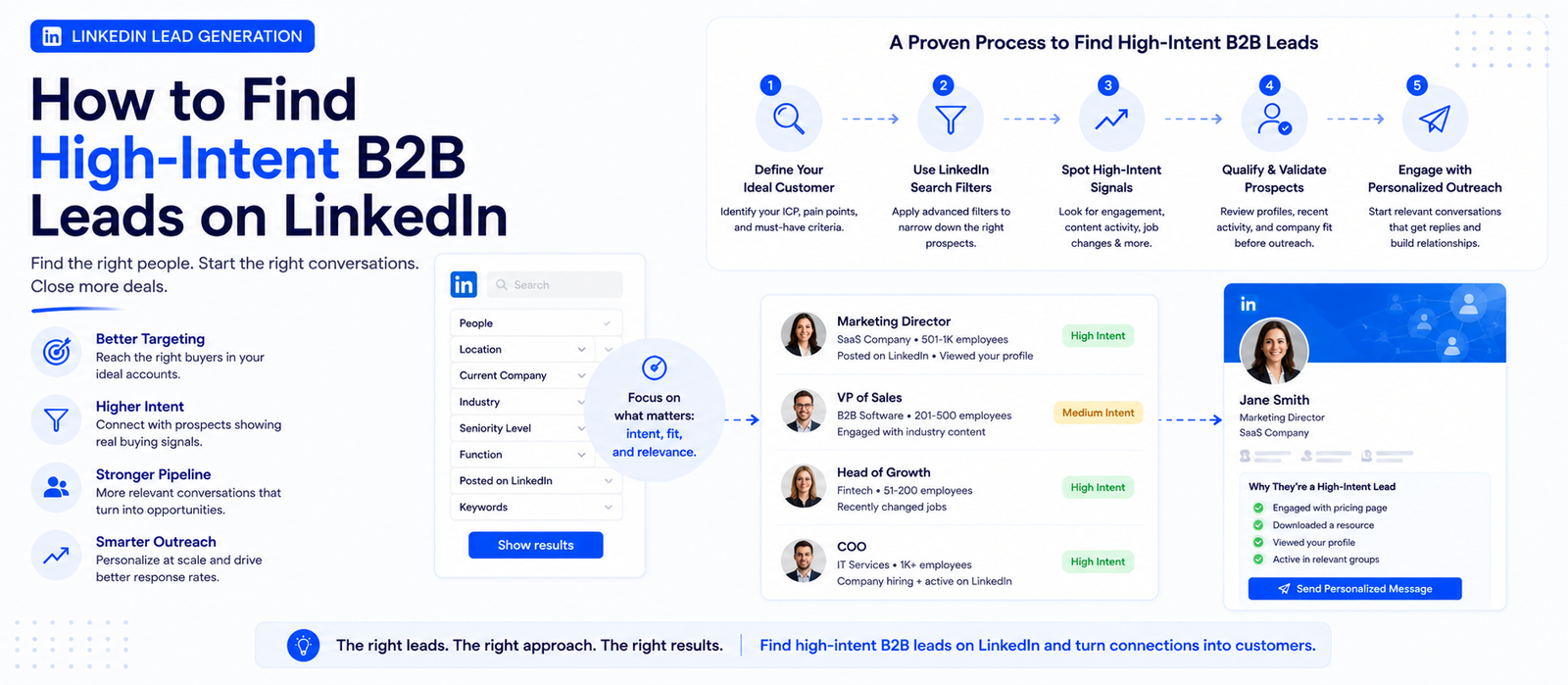
How to Find High-Intent B2B Leads on LinkedIn in 2 Minutes
Konnektys Team · Jun, 2026
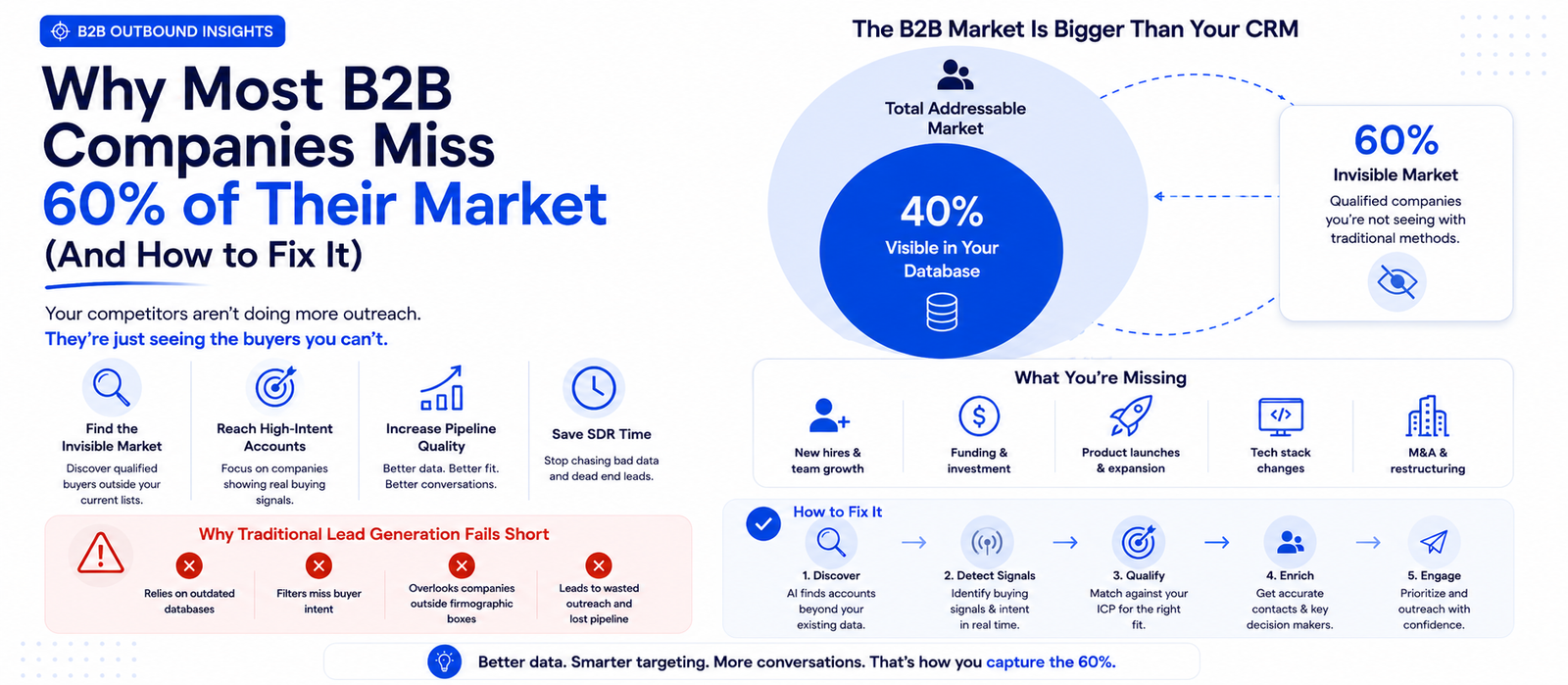
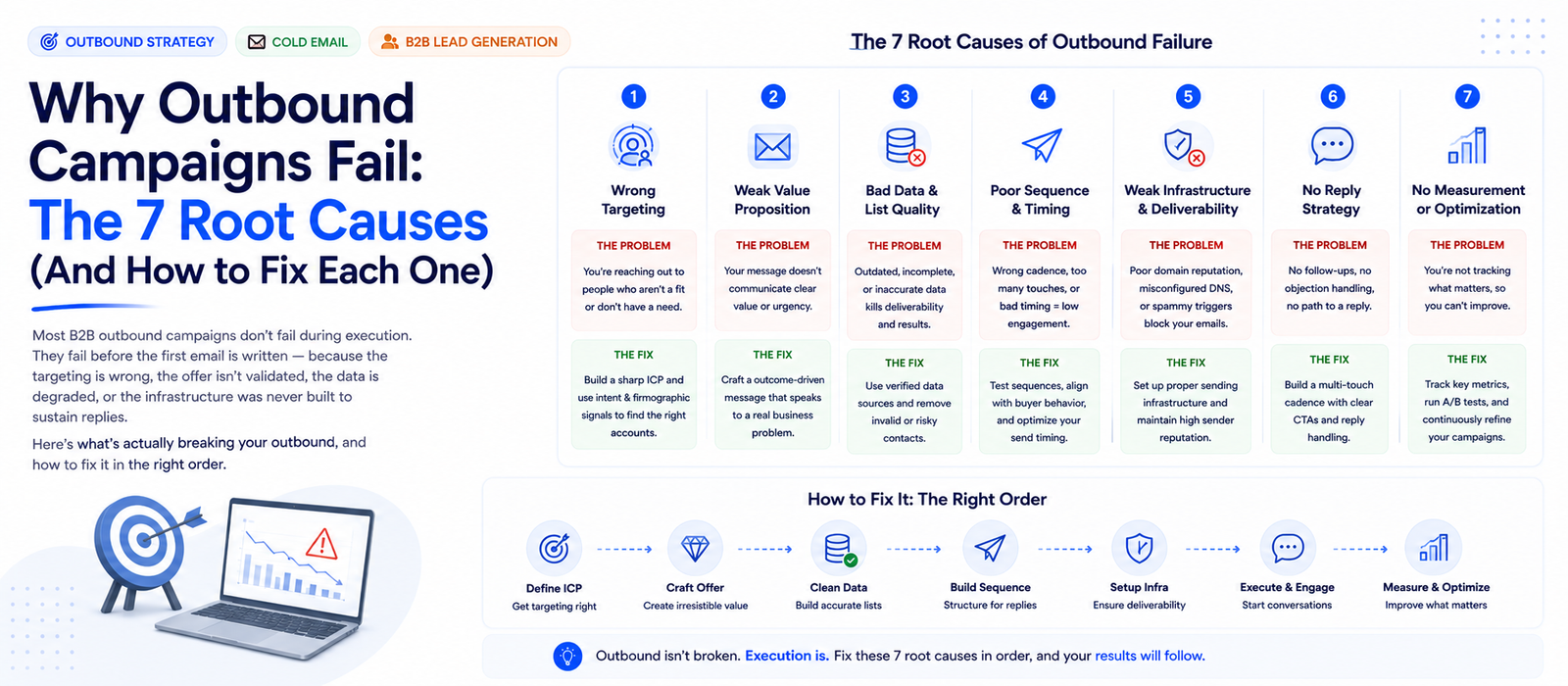
Why Outbound Campaigns Fail: The 7 Root Causes (And How to Fix Each One)
Konnektys Team · 7 Jun, 2026