AI Prospecting in 2026: Why Fit + Timing Beats Every Static Lead List
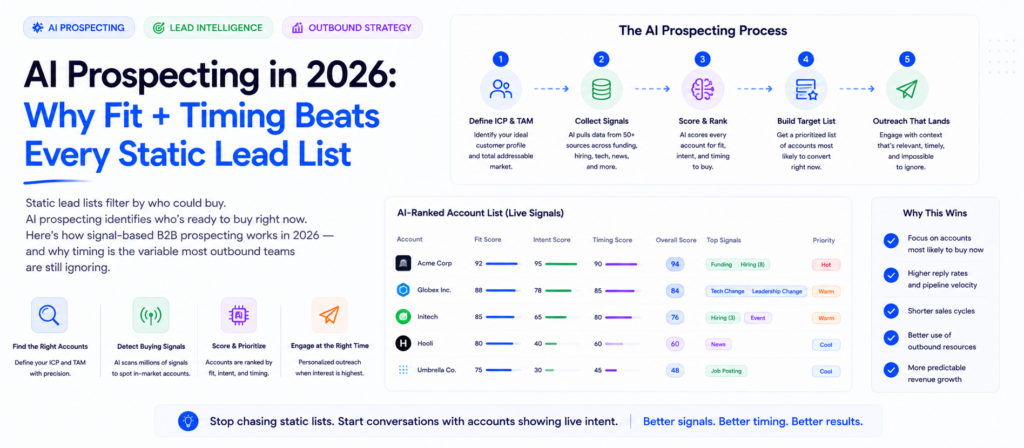
Static lead lists filter by who could buy. AI prospecting identifies who’s ready to buy right now. In 2026, the gap between those two things is where most outbound budgets are quietly disappearing.
 Konnektys TeamMay 17, 2026 · 10 min read · AI Prospecting · Lead Intelligence
Here’s a scenario that plays out in B2B sales teams every quarter.
Someone pulls a list of 3,000 accounts that match the ICP perfectly — right industry, right headcount, right job titles. The sequence goes out. The follow-ups fire on schedule. And at the end of the month: 11 replies, 3 demos, 1 closed deal.
The response is usually to pull a bigger list.
The problem was never the list size. It was that most companies matching your ICP aren’t actively in the market when you reach them. They fit the profile. They’re just not moving. And a company that isn’t moving has no reason to respond to outbound, regardless of how well your copy is written.
The Real Problem With Traditional Prospecting
Traditional B2B prospecting operates on a simple logic: define your ideal customer profile, filter a database by those attributes, and contact everyone who makes the cut. Company size, industry, revenue range, job title. Pull. Upload. Send.
It works — occasionally. But it works by volume, not precision. The conversion rates are low because the model assumes uniform intent across every company that matches the filter. In reality, intent varies enormously. Two companies with identical ICP profiles can be at completely different stages of readiness.
| Traditional List Building | AI Prospecting | |
|---|---|---|
| Core logic | Who could buy | Who is ready to buy now |
| Filters used | Size, industry, title, revenue | ICP fit + real-time buying signals |
| Timing awareness | None — treats all matches equally | Core — surfaces in-motion accounts |
| Output | Static list | Continuously ranked queue |
| Conversion model | Volume — catch the right account by luck | Precision — reach accounts in buying windows |
| Refresh cadence | Manual, periodic | Continuous / weekly re-ranking |
The other cost is invisible: every message sent to an account that wasn’t ready to buy is a touch wasted, a domain reputation point spent, and a sender impression left with someone who’ll remember the irrelevance next time you reach out.
What AI Prospecting Actually Means in 2026
The term “AI prospecting” gets applied to a wide range of things — from basic data enrichment tools to fully automated outreach sequences. It’s worth being specific about what it means in practice in 2026.
AI prospecting at its most useful is the combination of three things running simultaneously:
The Signals That Predict Buying Behaviour
Not all signals carry equal weight, and understanding the difference between weak and strong signals is what separates useful AI prospecting from expensive noise generation.
| Signal | What It Indicates | Window | Strength |
|---|---|---|---|
| Hiring intent (sales/ops roles) | Scaling outbound — tool evaluation imminent | 30–90 days | Strong |
| Recent funding round | Growth mode, budget available, stack evaluation | 60–120 days | Strong |
| Leadership change (VP Sales, CMO) | New mandate, new budget, open to new vendors | First 90 days | Strong |
| Tech stack shift | Replacing tools — adjacent buying opportunity | 30–60 days | Strong |
| Events / product launches | Externally visible, internally reorganised | 30–60 days | Medium |
| LinkedIn activity / news mentions | Visibility signal, not buying signal | — | Weak |
The signal stack in practice. The best AI prospecting workflows don’t rely on a single signal — they stack them. An account with a new VP of Sales, aggressive SDR hiring, and a just-closed Series B is a different target than an account with only one of those. Signal stacking is how you identify the top 5% of accounts that warrant immediate, high-investment outreach.
Web and LinkedIn data scraping is one of the primary mechanisms for building this signal intelligence at scale — gathering the raw data across sources that signal detection models then interpret.
Why Fit Alone Isn’t Enough
This is the point most outbound teams intellectually accept but operationally ignore.
A perfect-fit account with zero urgency often converts worse than a decent-fit account under pressure. The company with the ideal profile — right size, right industry, right tech stack, right title in the buying chair — but no active pain, no pending budget decision, and no reason to change anything is not going to respond to outbound. They might read your email. They might even find it interesting. But interesting doesn’t move pipeline.
Signal-based prospecting is the infrastructure that makes timing actionable. Instead of filtering the universe down to “companies that match” and hoping some are ready, you filter to “companies that match” and then layer signals to identify which ones are actively in motion.
How an AI Prospecting Workflow Actually Runs
In practice, a modern AI-assisted prospecting workflow looks like this:
Account Tiering: The Operational Unlock
One of the underrated practical benefits of AI prospecting is that it forces prioritisation — and removes the daily decision of where to start. Most SDR teams treat accounts as roughly equivalent because they don’t have a system for ranking them. The result is effort distributed evenly across a pool that isn’t evenly valuable.
Where AI Prospecting Fails (And Why)
AI prospecting is not self-executing. The most common failure modes:
The TAM Problem: You Need Boundaries Before You Need Signals
Signal-based prospecting requires a well-defined account universe to score signals within. If your total addressable market isn’t defined — or is defined too loosely — the scoring system has nothing meaningful to prioritise against.
This is the step most teams skip. They move directly from “we sell to mid-market SaaS” to “run the signals” without establishing the actual boundaries of the universe they’re working within.
Market research and TAM analysis does this foundational work: defining the total addressable market by segment, mapping the serviceable addressable market by geography and ICP fit, and identifying the realistic pool of accounts within reach. Once those boundaries are established, signal scoring has a defined universe to rank within.
What AI Prospecting Means for Your CRM
AI prospecting produces a stream of signal-enriched account data. That data needs somewhere to live — and for most B2B teams, that’s the CRM.
The problem is that most CRMs aren’t ready to receive this data usefully. Records are stale. Contacts have changed roles. Company data hasn’t been updated in 18 months. When fresh AI prospecting output gets pushed into a degraded CRM, the result is contradictory data, duplicate records, and rep confusion.
CRM data enrichment and CRM cleaning are the prerequisite infrastructure that makes AI prospecting output usable. Clean, current CRM data means that when a hot account surfaces in the prospecting queue, the rep can see the full relationship history, verified current contacts, and accurate company data — not a record that hasn’t been touched since 2023.
How to Evaluate Any AI Prospecting Partner
Whether you’re evaluating a tool, a data provider, or a managed service, the questions that surface quality providers:
Our AI-powered lead research service and end-to-end B2B lead generation are built around this full stack — ICP definition, signal enrichment, account scoring, verified contact discovery, and execution — managed as a continuous system rather than a one-time list pull.
FAQ: AI Prospecting Questions Answered
What is AI prospecting? +
How is AI prospecting different from traditional list building? +
What buying signals does AI prospecting use? +
Does AI prospecting replace SDRs? +
How many accounts should be in my “hot” tier at any given time? +
How often should account scores be refreshed? +
Can AI prospecting work for small outbound teams? +
What’s the most common reason AI prospecting underperforms? +
What data sources does AI prospecting pull from? +
Why is TAM analysis important before running AI prospecting? +
How do I know if an account is genuinely in-market vs. just active? +
Konnektys Team
Konnektys builds signal-based prospecting infrastructure for B2B outbound teams — from ICP definition and TAM analysis to AI-powered account research, verified contact discovery, and fully managed cold email and LinkedIn outreach. See all services →
The Bottom Line on AI Prospecting in 2026
Teams still running traditional list-building workflows aren’t failing because they’re unsophisticated. They’re failing because the model was always a blunt instrument — and they haven’t yet replaced it with one that accounts for timing.
Fit + timing is not a tagline. It’s the operating logic that separates outbound programmes that fill pipeline from ones that just generate sends. Signal-based prospecting is the infrastructure that makes timing actionable.
If you’re still pulling static lists and hoping some percentage happen to be ready to buy right now — the cost of that approach is visible in your reply rates. The fix isn’t better copy or more volume. It’s better intelligence about who to contact and when.
- The Real Problem With Traditional Prospecting
- What AI Prospecting Actually Means in 2026
- The Signals That Predict Buying Behaviour
- Why Fit Alone Isn’t Enough
- How an AI Prospecting Workflow Actually Runs
- Account Tiering: The Operational Unlock
- Where AI Prospecting Fails (And Why)
- The TAM Problem
- What AI Prospecting Means for Your CRM
- How to Evaluate Any AI Prospecting Partner
- FAQ
Want signal-based prospecting built and managed for your team? Let’s talk.
Talk to Konnektys →Share this article:
Related articles
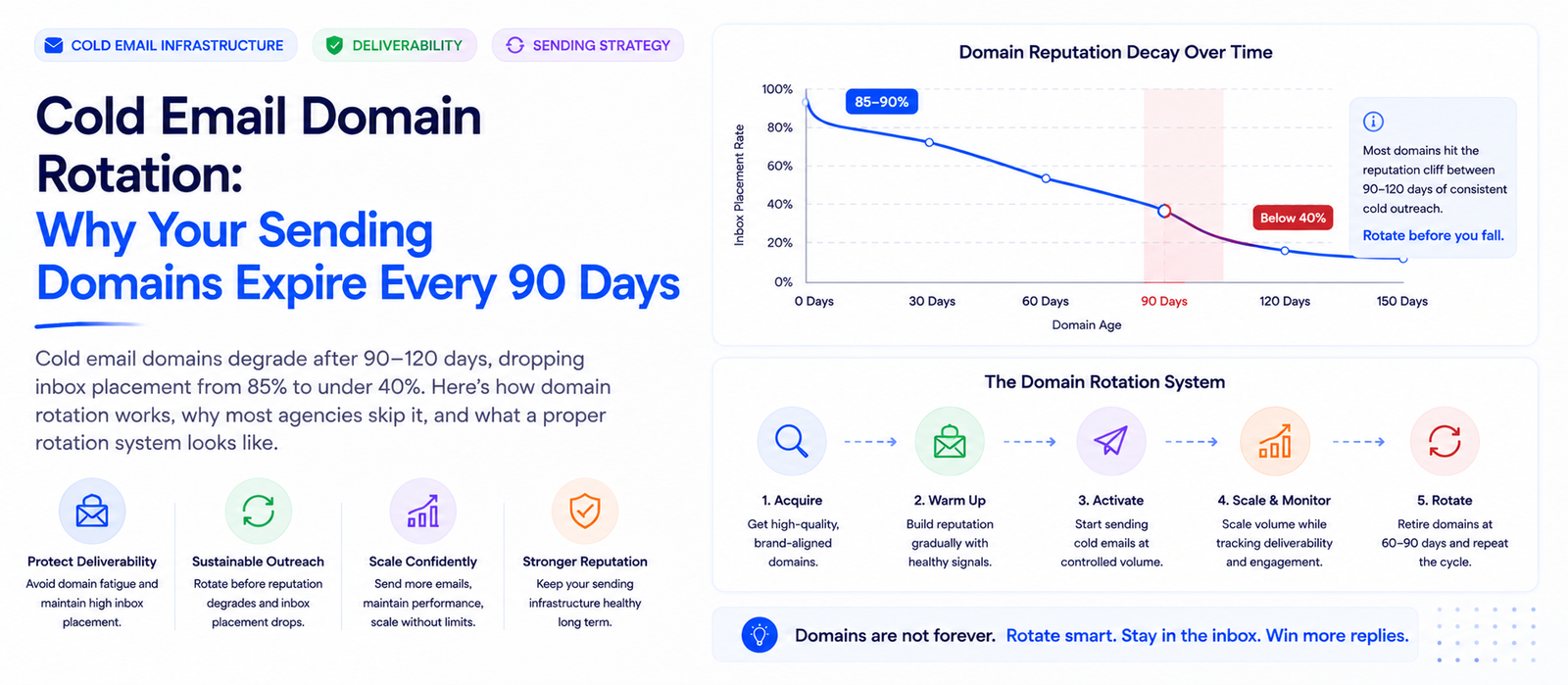
Your Cold Email Domain Has a 90-Day Shelf Life
Konnektys Team · 23 May, 2026