
Why Day 1 Makes or Breaks Your Cold Email Cadence (Everything Else Is Just Follow-Through)
A 15-touch outbound sequence built on a weak Day 1 is not a cadence. It’s automated noise. Here’s why the first email is the only one that actually does persuasion work — and exactly what it needs to contain.
 Konnektys TeamJune 6, 2026 · 8 min read · Cold Email Strategy
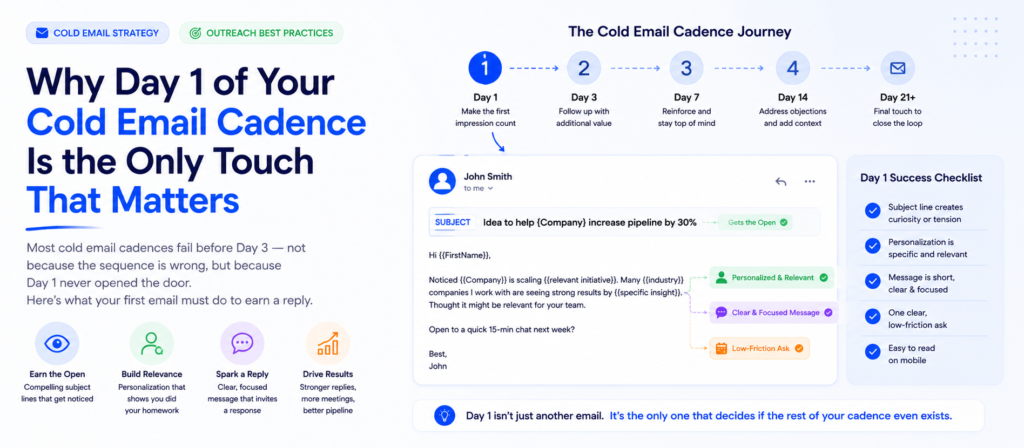
The Hard Truth About Cold Email Cadences
A cadence is not a sales strategy. It’s infrastructure. It only works when there’s something worth delivering inside it.
That something is your first email.
If the first touchpoint doesn’t land — doesn’t get opened, doesn’t earn a read, doesn’t create at least a flicker of curiosity — the prospect doesn’t open Day 4. They don’t see your Day 7 LinkedIn message. You are generating noise in an inbox that already contains 80 to 120 cold emails per week from people who also think their sequence is the problem.
The rest of the cadence assumes interest that Day 1 has to create. This is where most sales teams get it wrong. They optimize the structure — timing gaps, touchpoint count, channel mix — while leaving Day 1 as an afterthought.
It isn’t. It’s the whole game.
What “Strong Day 1” Actually Means
Three components. Not ten. Three. Nail all three and you have a door worth knocking on.
Not a subject line that describes the email. Not “Quick intro” or “Partnership opportunity” or the increasingly useless “Quick question.” Those are subject lines that tell the prospect exactly what to skip.
Tension: “Your SDR team is burning pipeline” creates discomfort. “Introduction from Konnektys” does not.
Curiosity: “How [Direct Competitor] cut CAC by 34% last quarter” is specific enough to feel credible. “A tool your sales team might find useful” is not specific enough to feel like anything.
The subject line has one job: earn the open. It just needs a click from someone who is busy, skeptical, and has seen every subject line pattern before.
“Hi [First Name], I’m [Name] from [Company] and we help B2B sales teams with [value prop]” is not a first line. It’s a reason to stop reading. Nobody cares who you are yet.
- A recent hire pattern on their LinkedIn that suggests they’re scaling outbound
- A job posting that reveals internal friction you can solve
- A product launch in the past 90 days that signals a specific need
- A comment they made publicly that’s directly relevant to your opening
One sentence. About them. No preamble, no throat-clearing, no “Hope this finds you well.” Our AI-powered lead research service surfaces buying signals and trigger events that make first lines feel written, not generated.
Most cold emails ask for too much. Pick one. Usually it’s a short call. Sometimes it’s a yes/no question designed to confirm a pain point. The more options you give, the less likely they are to choose any. Decision fatigue is real.
Make it effortless to say yes to one specific thing.
The Research Problem Nobody Talks About
Strong Day 1 emails require knowing something real about the prospect. That’s the constraint most teams hit and then work around badly.
They work around it with fake personalization: merge tags that insert a job title or company name and call it “highly relevant outreach.” It isn’t. Prospects recognize mail merge in two seconds.
Real first-line personalization means:
- Account-level signals — recent funding, hiring surges, product launches, expansions
- Contact-level signals — content they’ve published, positions they’ve taken, problems they’ve discussed publicly
- Technographic context — what tools they’re running that your offer fits, replaces, or integrates with (technographic data append)
- CRM history — whether they’ve engaged before, what conversations have already happened (CRM data enrichment)
This is one reason building a targeted contact list properly — before you write a single email — matters so much. Good email finding and verification is the other half of this. A perfect first line sent to a dead inbox is invisible.
Why the Rest of the Cadence Is “Just” Follow-Through
That word “just” is not meant to dismiss follow-through. Persistence is a real part of B2B outreach. A prospect who opened Day 1 and didn’t reply might reply on Day 5. But follow-through only works when Day 1 has already established relevance.
Day 3 follow-ups don’t create interest from nothing. They remind someone who was already curious. Even a well-executed LinkedIn outreach sequence running in parallel with email only works when the email thread gave the prospect a reason to recognize your name.
This also has infrastructure implications. A weak Day 1 at scale is an infrastructure risk, not just a conversion problem. Cold email infrastructure built for volume eventually degrades if the underlying message quality pulls down engagement signals.
The Most Common Day 1 Mistakes
Nobody cares yet. You have not earned the right to talk about yourself in sentence one. Open on them, then introduce context.
“Intro + partnership opportunity” tells them exactly what to ignore. Same goes for “Following up on my previous email” as a Day 1 subject — that’s not a thing.
“We work with companies like Salesforce, HubSpot, and Zendesk” reads as desperation when it’s the first thing out of your mouth. Save proof for after you’ve given them a reason to care.
If it takes more than 90 seconds to read, it won’t get read. 100–150 words is the sweet spot for Day 1. Save the case studies for follow-up.
“Let me know if you’d like to connect, or I can send over a case study, or if you just want to answer a quick question that works too.” Pick one. One.
“I noticed you’re in the SaaS space” is not personalization. “I noticed you posted about hiring three enterprise AEs in Q1 while your SDR headcount stayed flat” — that’s personalization.
Sending Day 1 to a list full of bounced, outdated, or wrong-role contacts tanks your sender reputation. Reverse email appending and verification should happen before any sequence goes live.
How to Audit Your Day 1 Before You Deploy
Before you launch a new cadence, run this check on the Day 1 email:
- ✓The stranger testShow the email to someone who doesn’t know your product. Ask: “What problem does this company solve, and why should the person reading this care?” If the answer takes more than two sentences, the email is doing too much explaining.
- ✓The subject line testRead the subject line out loud. Would you open it from a sender you don’t know? Be honest.
- ✓The first-line testCover everything after the first line and ask: “Is this about me or about them?” If it’s about you or your company, rewrite it.
- ✓The CTA testCount the asks. If there’s more than one, cut until there’s one.
- ✓The length testPaste the email into a word counter. If it’s over 175 words, find what to cut.
Konnektys Team
B2B Growth & Outbound Specialists
Konnektys builds and operates outbound revenue engines for B2B companies — from ICP definition and LinkedIn prospecting to AI-powered lead research, email infrastructure, and fully managed outbound campaigns.
FAQ: Cold Email Cadence Questions Answered
What is a cold email cadence? +
Why does Day 1 matter most in a cold email cadence? +
What should a cold email subject line include? +
How long should a cold email Day 1 email be? +
What is the best CTA for a cold outreach email? +
How many touches should a B2B cold email cadence have? +
What’s the difference between personalization and merge tags? +
What causes cold email cadences to fail? +
What This Means for Your Outbound Right Now
If reply rates are low and you’re blaming the sequence, check Day 1 first.
Pull your last 20 sent emails. Read the subject lines. Read the first lines. Ask honestly: would you open this from a stranger? Would you keep reading?
Most of the time the answer is no — and that’s where the problem lives, not in the follow-up timing.
Fix Day 1. The door opens. Everything else follows.
Need a consistent pipeline of high-intent leads from LinkedIn? We’ll build and manage the entire system for you.
Talk to Konnektys →Share this article:
Related articles
Why Most B2B Companies Miss 60% of Their Market — And How to Fix It
Konnektys Team · 19 May, 2026

Your Cold Email Domain Has a 90-Day Shelf Life — Here’s What That Means for Your Pipeline
Konnektys Team · 23 May, 2026
How to Find High-Intent B2B Leads on LinkedIn in 2 Minutes
Konnektys Team · 22 May, 2026