
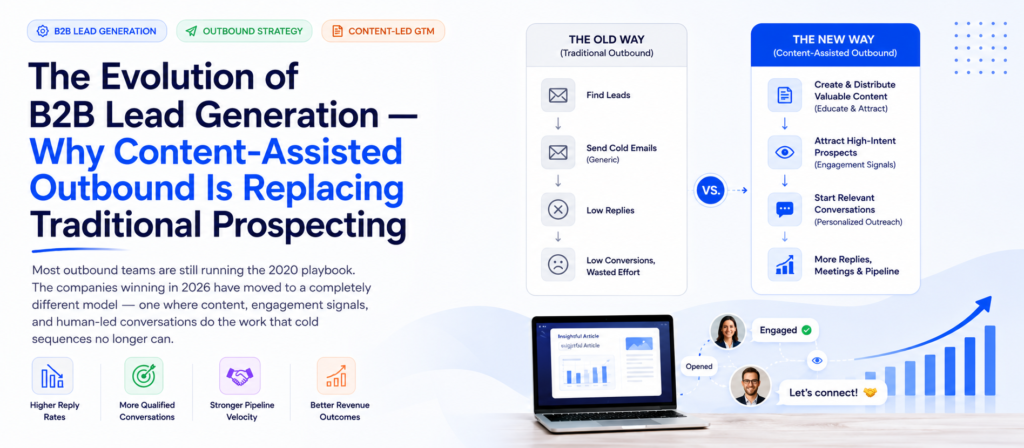
Lead generation has changed more in the last five years than it did in the previous fifteen. But most outbound teams are still running the 2020 playbook: buy a list, send cold emails, add AI personalization, launch sequences, and hope for replies. The problem is not that outbound stopped working — the problem is that buyers changed.
Today’s prospects are overloaded with outreach, immune to generic personalization, and far more likely to trust familiarity over interruption. The companies winning in 2026 are not abandoning outbound. They are combining outbound with content, engagement signals, and human-led conversations.
That shift has created a completely new model: Content-Assisted Outbound. This post traces how B2B lead generation evolved through three distinct eras — and what the best GTM teams are doing differently right now.
Era 1: The List-Based Playbook (2017–2020)
The classic outbound motion ran on a simple process: buy or scrape lead lists, send mass cold emails, run follow-up sequences, and optimise for volume. At the time, it worked extremely well. Open rates were high, inbox competition was lower, and personalization standards were minimal.
A basic email like “Hi {{FirstName}}, saw you work at {{Company}}…” could generate meetings consistently. Lead generation was primarily a numbers game, and the numbers were still forgiving enough to make the game worth playing.
“Relying purely on list-scraping and automated volume leads to burned domains and lower reply rates.” As more tools entered the market, every company started doing the same thing — same data, same templates, same automation. Prospects became desensitized, reply rates dropped, and trust disappeared.
Everyone had the same databases. Everyone used the same templates. Everyone automated outreach and scaled volume. That uniformity collapsed the model. The list-based era ended not because outbound was broken — but because the competitive moat it relied on evaporated overnight.
Era 2: The Automation-Led Stack (2020–2025)
The second wave improved operational efficiency dramatically. LinkedIn scraping, data enrichment, AI-generated personalization, automated workflows, sequencing platforms, and intent signals transformed what outbound teams could do at scale. Instead of blasting random contacts, teams could target specific personas, filter by buying signals, personalize messaging at scale, and trigger outreach automatically.
Companies adopted modern outbound stacks combining LinkedIn Sales Navigator, Clay, Apollo, Instantly, Lemlist, Trigify, and AI enrichment workflows. The result was higher efficiency and better targeting. But there was still one major problem: most outreach was still fundamentally cold. Even if AI referenced a LinkedIn post or a funding announcement, the prospect still knew it was outreach. Operational efficiency improved — but not trust. And trust is now the bottleneck.
Why AI Personalization Alone Is No Longer Enough
The dangerous assumption isn’t that personalization is bad — it’s that better personalization is the solution. Many outbound teams believe adding AI personalization solves declining reply rates. It does not. Prospects can now instantly recognize AI-written compliments, fake personalization, templated relevance, and forced familiarity.
The market adapted faster than most sales teams expected. That is why the next evolution is not “better personalization” — it is “warmer context before outreach.” The distinction is critical: personalization improves a cold message; context makes the outreach not cold in the first place. One is a copy tactic. The other is a structural shift in how pipeline is built.
The Four Pillars of Content-Assisted Outbound
The new GTM motion doesn’t start with a sequence — it starts with visibility. Content-Assisted Outbound means using content as trust infrastructure, intent filtering, and conversation warm-up. Outbound still exists, but content improves response rates, credibility, conversion quality, and sales velocity at every stage of the funnel.
This is not “post on LinkedIn and wait.” It is not “become an influencer.” It is a systematic process: publish insights and frameworks, monitor who engages, identify which engagers match ICP criteria, then initiate outreach with context the prospect already recognizes. The conversation is no longer fully cold — and that changes everything.
Publish insights, frameworks, case studies, and operational breakdowns on the channels your buyers use. The goal is not virality — it is recognizability. When your outreach arrives, it should feel like a continuation of a conversation the prospect has already started, not an interruption from a stranger.
Track post engagement, profile visits, repeat interactions, webinar attendance, newsletter opens, and content consumption patterns. Modern GTM teams monitor these signals the same way SDRs once monitored email open rates — they tell you who is paying attention before you say a word.
Instead of “send 500 emails Monday morning,” the workflow becomes: “these 12 people engaged with content, match ICP criteria, and showed buying intent this week.” That shifts outbound from interruption into contextual timing — and contextual timing is the single biggest lever on reply rate.
Anyone can scrape leads, enrich data, generate sequences, and automate follow-ups. Very few companies can build trust, create authority, and hold meaningful conversations at the right moment. “Automation-led lead gen with a human in the loop is the way” — AI for scale, automation for systems, humans for trust. That is the real competitive moat in 2026.
What the Best GTM Teams Are Building Now
Outbound is not dead. Cold email is not dead. Automation is not dead. But standalone outbound is becoming weaker every year. The companies that adapt early will dominate pipeline generation over the next decade. The ones still relying only on mass sequences and AI personalization will continue fighting declining reply rates and rising acquisition costs.
One important caveat: content alone does not replace process. Warm leads still require ownership, follow-up systems, CRM visibility, timing, qualification, and next-step management. A warm prospect can still disappear if nobody follows up or engagement signals are ignored. The future is not “content instead of outbound” — it is content-enhanced outbound with operational discipline.
Konnektys builds and operates outbound revenue engines for B2B companies — from ICP definition and signal-based account discovery to content infrastructure, CRM cleaning, and fully managed campaigns. We should talk.

Konnektys Team
B2B Growth & Outbound Specialists
Konnektys builds and operates outbound revenue engines for B2B companies — from ICP definition and AI-powered account discovery to CRM cleaning, email infrastructure, and fully managed outbound campaigns.
Still running the 2020 outbound playbook? We build content-assisted outbound systems that combine AI, signals, and human-led conversations.
Talk to Konnektys →