
Why Most B2B Companies Miss 60% of Their Market — And How to Fix It
Traditional ICP filters leave the majority of qualified buyers invisible to your sales team. Here's what high-performing outbound teams look for instead.
 Konnektys TeamMay 19, 2026 · 8 min read
Why Traditional ICP Targeting Is Failing
Modern B2B sales teams are generating more data than ever — yet pipeline is getting harder. Reply rates drop. Customer acquisition costs rise. SDRs spend more time prospecting while generating fewer qualified opportunities.
The reason isn’t messaging. It isn’t sequencing cadence. It’s account selection. When we audit outbound systems, a significant share of CRM records don’t match the company’s real Ideal Customer Profile — meaning every email, call, and dollar spent on those records is waste.
The old GTM model filters by industry, headcount, geography, then exports and repeats. The signal-based model layers behavioral and operational signals on top of firmographic fit — identifying accounts that are actively changing and therefore more likely to buy.
The uncomfortable reality: Every SDR team uses the same databases, targets the same company profiles, and sends the same volume of cold emails. Generic targeting produces generic results — and buyers have learned to ignore it.
The Invisible Market Problem
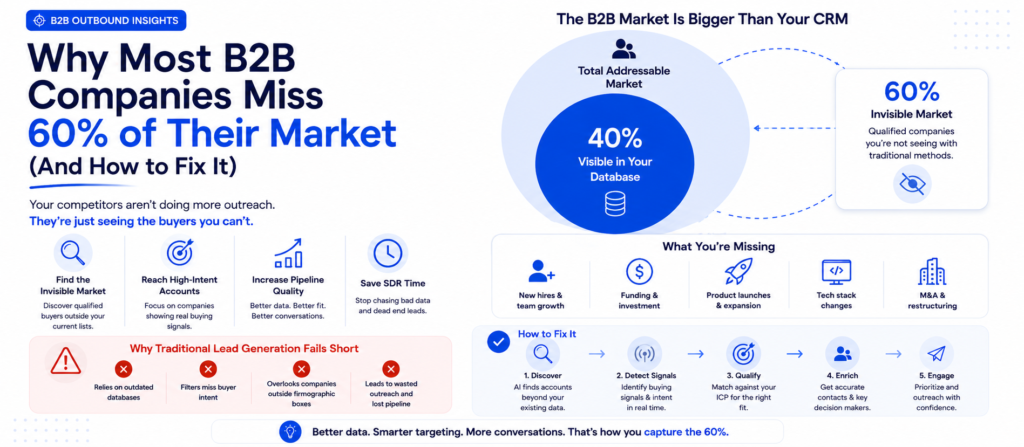
An invisible market is made up of qualified buyers your sales team cannot currently identify using traditional prospecting methods. They exist, match your ICP, and have budget — they just don’t appear in a standard database query filtered by company size and industry.
A 200-person SaaS company with a 3-person sales team is structurally different from one with a 40-person sales organisation — but most lead databases treat them identically. One has outbound infrastructure; one doesn’t. Firmographic filters don’t capture that distinction.
The core insight: firmographic filters tell you what a company looks like on paper. They don’t tell you what’s happening inside it right now — which is what actually determines whether they’ll buy.
How to Know Your ICP Has Drifted
ICP drift is common and rarely catches anyone’s attention until pipeline quality has already suffered. Open by naming the thing everyone already watches for — then pivot to the thing nobody is measuring.
The warning signs are consistent: reply rates that stay flat no matter how much you optimise copy; sales reps who manually filter prospect lists before touching them; best customers who don’t match the profile you originally built. These are diagnostic signals that your ICP no longer reflects reality.
What High-Performing Teams Look for Instead
The shift from firmographic filters to behavioral signals separates outbound teams generating consistent pipeline from those running volume operations that burn lists without results. Modern buying signals indicate that a company is actively changing — and change creates buying opportunity.
A company hiring multiple SDRs or a VP of Sales is actively building outbound capacity. This is the most reliable single signal of a company that needs your outreach infrastructure — and it’s available publicly on job boards and LinkedIn, updated in near-real time.
A company adopting Salesforce for the first time signals a shift to structured sales operations. One implementing AI tooling is investing in process — and likely evaluating adjacent vendors. Tech stack changes create buying windows that close fast.
Website structure reveals go-to-market motion. A company adding a demo CTA and pricing page is transitioning from founder-led to sales-led growth. That transition creates a specific, time-sensitive buying opportunity.
Operational complexity at scale indicates a company that has resources and a mandate to invest in revenue infrastructure. Multi-country structure with no centralised outbound tooling is a gap your solution can fill — and it’s identifiable without a single cold call.
Why Static Lists Fail — and What to Do Instead
The most common and costly outbound mistake is treating lead generation as a one-time project. A prospect that was irrelevant six months ago may be highly qualified today because they hired a new VP of Sales, raised a funding round, or shifted product focus. Static lists can’t capture that movement.
Most sales intelligence platforms focus on enrichment — improving data quality of records you already have. That’s useful, but it doesn’t solve the harder problem: finding companies outside your current CRM that match your ICP and are showing buying intent right now. Account discovery requires analysing websites, hiring pages, product messaging, and public signals — not pulling a CSV from a database.
Teams still running broad firmographic filters aren’t failing because they’re unsophisticated. They’re failing because the model was always a blunt instrument. Better targeting — built on ICP fit and behavioral signals — is the infrastructure that makes the rest of your outbound system work.
Konnektys builds and operates outbound revenue engines for B2B companies. We handle ICP definition, signal-based account discovery, CRM cleaning, email infrastructure, and fully managed campaigns. We should talk.
Konnektys Team
B2B Growth & Outbound Specialists
Konnektys builds and operates outbound revenue engines for B2B companies — from ICP definition and AI-powered account discovery to CRM cleaning, email infrastructure, and fully managed outbound campaigns.
Frequently Asked Questions
What is an ICP in B2B sales?
An ICP (Ideal Customer Profile) defines the type of company most likely to buy your product or service. A well-built ICP goes beyond firmographics like industry and headcount — it includes behavioral signals, tech stack usage, growth stage, and operational patterns that indicate genuine buying readiness.
Why is CRM cleaning important for outbound sales?
CRM cleaning removes outdated contacts, duplicate records, and unqualified accounts that accumulate over time. A polluted CRM creates misdirected outreach, poor email deliverability, and wasted SDR time. Regular cleaning improves pipeline quality, reporting accuracy, and the efficiency of every downstream function.
What is AI-powered lead generation?
AI-powered lead generation uses automation, buying signal detection, and intelligent account classification to identify high-intent prospects beyond what traditional database filters can surface. It analyses websites, hiring pages, tech ecosystems, and public signals to find accounts matching your ICP with evidence of active buying intent.
How often should B2B lead databases be updated?
B2B data should be refreshed continuously. Companies change tools, hire new teams, raise funding, and pivot strategy on a rolling basis. A prospect unqualified six months ago may now be a high-intent buyer. Static lead lists degrade quickly — dynamic sourcing is the only sustainable approach.
Why are traditional lead databases missing qualified buyers?
Most sales intelligence platforms focus on enriching records you already have — they don’t solve account discovery. The real challenge is identifying companies outside your CRM that match your ICP and are showing buying signals right now. That requires analysing behavioral and operational data that standard firmographic filters simply cannot detect.
Missing 60% of your market? We’ll find the qualified buyers your current filters can’t see.
Talk to Konnektys →Share this article:
Related articles
Your Cold Email Domain Has a 90-Day Shelf Life — Here’s What That Means for Your Pipeline
Konnektys Team · 23 May, 2026
Related article title goes here — keep it punchy
Rashid Khan · Month DD, YYYY
Related article title goes here — keep it punchy
Rashid Khan · Month DD, YYYY