
Why Fit + Timing Beats Static Lead Lists
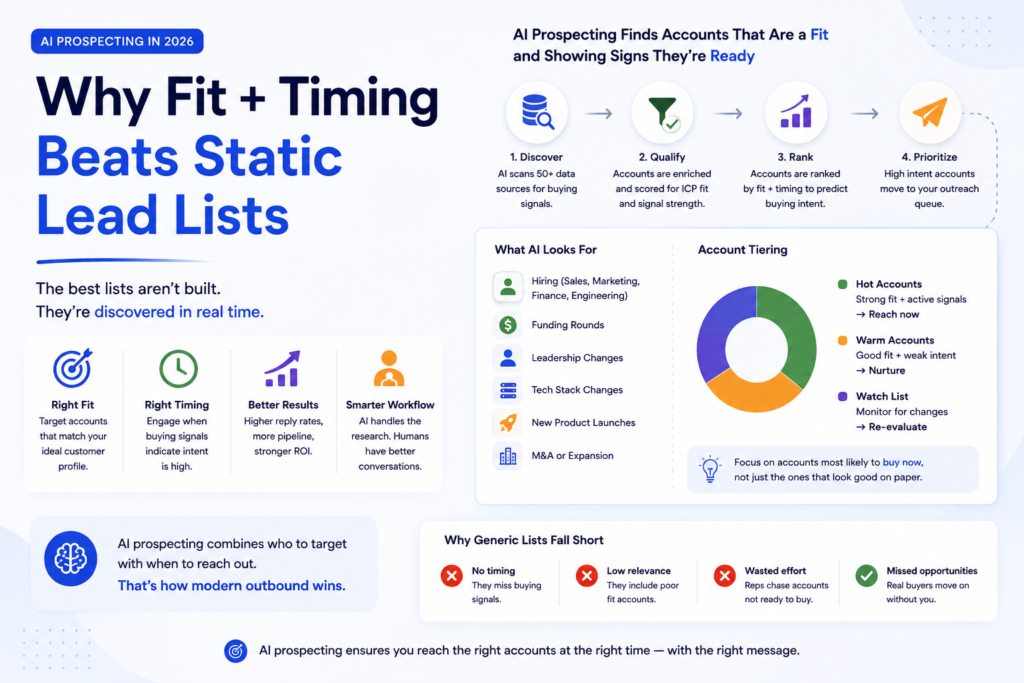
The old outbound playbook isn't broken because of bad execution. It's broken because the logic was always flawed. Build a list. Filter by company size and title. Export. Upload. Hope. The problem was never list size — it was that most companies matching your ICP aren't ready to buy when you reach them. AI prospecting is starting to fix that.
The Real Problem With Traditional Prospecting
Most outbound teams optimised for coverage. Bigger lists, more contacts, more automation. Deliverability improvements and sequencing tools made it easy to send at scale. But volume without timing is just noise at scale.
Build a list. Filter by company size, industry, title, revenue. Export CSV. Upload to sequencer. Hope. The problem was never list size — it was timing.
Layer buying signals on top of ICP fit. Surface accounts that are actively changing. Reach the right company at the moment something has moved for them.
The underlying truth: A perfect-fit account with zero urgency is just a distraction. Most traditional prospecting has no way to tell the difference between an account that's ready and one that isn't.
What AI Prospecting Actually Looks Like Now
Modern AI prospecting workflows don't replace the human — they remove the operational friction that slows the human down. Instead of manually digging through LinkedIn, Crunchbase, and job boards for every account, AI-assisted systems enrich accounts automatically, surface buying signals, rank lead quality, and return a prioritised queue already sorted by who's most likely to be in-market right now.
The input is still your ICP. The difference is what happens after.
Target job titles, industries, headcount, region, tech stack requirements, deal-breakers. The quality of your ICP definition directly determines the quality of the output. Garbage in, garbage out — AI just makes it faster.
AI systems analyse intent and timing: recent funding rounds, aggressive hiring in specific roles, leadership changes, product launches, M&A activity, tech stack shifts. These signals point to accounts that are actively changing — and change creates buying opportunity. A company that just raised a Series B and is hiring 15 SDRs is in a completely different situation than one in maintenance mode, even if they share the same ICP profile.
Why Fit + Timing Outperforms Static Lists
Here's what most people get wrong about outbound: a perfect-fit account with no urgency often converts worse than a decent-fit account under pressure. A company with strong ICP match but no active growth, no new leadership, and no obvious pain point has no reason to move. They might be interested eventually — but "eventually" doesn't fill pipeline.
The uncomfortable truth about ICP matching: Fit alone tells you a company could buy. Timing tells you they might buy now. You need both. Signal-based prospecting is the infrastructure that makes timing actionable.
What signal-based targeting unlocks
- Higher reply rates — outreach lands when the account has an active reason to engage
- Better meetings — conversations happen with accounts that have momentum, not just profile
- Faster pipeline conversion — urgency is already present, not manufactured
- Less wasted outreach — fewer touches on accounts that were never going to move
AI-Powered Account Tiering
One of the underrated benefits of signal-based prospecting is that it forces prioritisation. Not every account deserves the same attention — but most SDR teams treat them the same anyway, because they don't have a system for ranking. A scored queue removes that decision entirely. You work down the list.
Strong ICP fit + active buying signals. Immediate outreach. These accounts have a reason to move right now.
Good ICP fit, weak intent signals. Nurture sequence. Worth staying visible until timing shifts.
Not ready yet but worth monitoring. Re-ranked automatically when new signals emerge.
AI Isn't Replacing Research — It's Structuring It
The misconception that keeps resurfacing is that AI prospecting removes research from the workflow. The opposite is true. Good AI prospecting systems actually demand better-defined research inputs.
The difference is that instead of one person manually crawling five different sources per account, the AI is gathering and organising across all of them simultaneously. The intelligence is the same. The time cost is different.
What stays human: Strategy, outreach angle, the actual conversation, the close. The AI handles enrichment, signal detection, qualification, and ranking — the operational layer that was eating rep time without producing revenue.
From Static Databases to Dynamic Intelligence
Prospecting is moving away from static lead databases — where you pull a list, work it, and pull another — toward continuously scored account intelligence. Accounts get re-ranked as new signals emerge. A company you passed on three months ago might surface at the top of your queue today because they just announced a funding round.
Instead of asking "who matches our filters," the question becomes "who matches our ICP and is most likely to buy right now." The filters are still there. They're just not the whole picture anymore.
What this means operationally for SDR teams
- Less time on admin — enrichment, qualification, and ranking happen automatically
- More time on conversations — reps spend effort on work that actually requires judgment
- No more guessing where to start — a ranked queue removes the daily prioritisation decision
- Confidence that accounts have a reason to move — not just that they match a filter
The bottom line: Teams still running traditional list-building workflows aren't failing because they're lazy or unsophisticated. They're failing because the model was always a blunt instrument. Fit + timing beats fit alone — and signal-based prospecting is the infrastructure that makes timing actionable.
Frequently Asked Questions
AI prospecting uses automated enrichment, buying signal detection, and account scoring to surface in-market accounts in real time. Traditional list building filters by static attributes like company size and industry. AI prospecting adds timing — identifying which accounts are actively changing and therefore more likely to buy right now, not just accounts that match a profile on paper.
Common buying signals include recent funding rounds, aggressive hiring in specific roles (especially sales or ops functions), leadership changes, product launches, M&A activity, and tech stack shifts. These indicators suggest an account is actively changing — and change creates buying opportunity. A company hiring 15 SDRs after a Series B is in a fundamentally different position than one in maintenance mode, even if they share the same ICP profile.
No. AI prospecting handles the operational layer — enrichment, signal detection, qualification, and ranking — so that reps can spend their time on work that actually requires judgment: strategy, outreach angles, and conversations. The intelligence is the same; the time cost is different. Good AI prospecting systems actually demand better-defined inputs, not fewer humans.
AI systems segment accounts into tiers based on ICP fit and signal strength. Hot accounts have strong fit and active signals — they warrant immediate outreach. Warm accounts have good fit but weak intent and belong in a nurture sequence. Watch-list accounts aren't ready yet but are monitored continuously and re-ranked automatically when new signals emerge. The SDR works down a prioritised queue rather than deciding where to start each day.
We build signal-based prospecting infrastructure into every outbound programme we operate — from ICP definition and signal sourcing to account ranking and prioritised outreach queues. The goal is to ensure that every contact we reach has both the right profile and an active reason to move. That's what makes the difference between outreach that fills pipeline and outreach that just generates sends.
Outbound built on fit and timing — not hope.
We build and operate signal-based outbound systems — from ICP definition and buying signal sourcing to account ranking, email infrastructure, and fully managed campaigns. If you're still running static lists, let's change that.